Department of Chemistry/Bio-MAX Institute, Seoul National University, Seoul 151-747 (Korea).
Angew Chem Int Ed Engl. 2014 Jan 27;53(5):1346-50. doi: 10.1002/anie.201308826. Epub 2014 Jan 20.
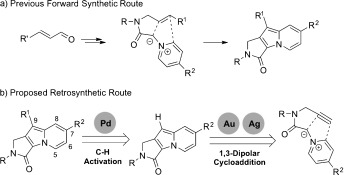
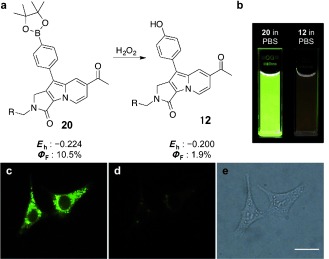
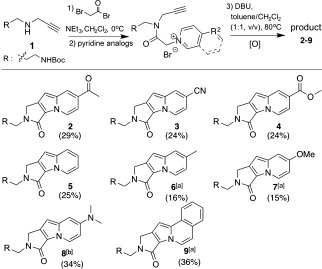
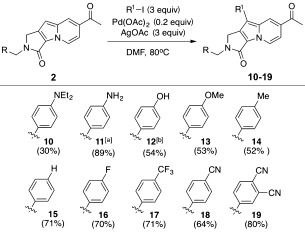
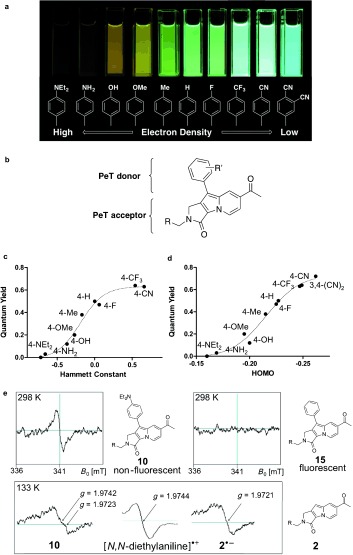
Fluorescence imaging enables the uniquely sensitive observation of functional- and molecular-recognition events in living cells. However, only a limited range of biological processes have been subjected to imaging because of the lack of a design strategy and difficulties in the synthesis of biosensors. Herein, we report a facile synthesis of emission-tunable and predictable Seoul-Fluors, 9-aryl-1,2-dihydrolopyrrolo[3,4-b]indolizin-3-ones, with various R(1) and R(2) substituents by coinage-metal-catalyzed intramolecular 1,3-dipolar cycloaddition and subsequent palladium-mediated CH activation. We also showed that the quantum yields of Seoul-Fluors are controlled by the electronic nature of the substituents, which influences the extent of photoinduced electron transfer. On the basis of this understanding, we demonstrated our design strategy by the development of a Seoul-Fluor-based chemosensor 20 for reactive oxygen species that was not accessible by a previous synthetic route.
荧光成像是在活细胞中对功能和分子识别事件进行独特灵敏观察的一种方法。然而,由于缺乏设计策略和生物传感器合成的困难,只有有限的一系列生物过程被应用于成像。在此,我们通过金属催化的分子内 1,3-偶极环加成和随后的钯介导的 CH 活化反应,报告了发射可调谐且可预测的 Seoul-Fluors(9-芳基-1,2-二氢吡咯并[3,4-b]吲哚啉-3-酮)的简便合成方法,该方法具有各种 R(1)和 R(2)取代基。我们还表明,Seoul-Fluors 的量子产率受取代基的电子性质控制,这影响了光诱导电子转移的程度。基于这种理解,我们通过开发基于 Seoul-Fluor 的化学传感器 20 来证明我们的设计策略,该传感器用于活性氧,而这是以前的合成途径无法实现的。