Department of Pathology, Carver College of Medicine, University of Iowa, Iowa City, IA, 52242, USA.
Protein Cell. 2014 Jan;5(1):12-20. doi: 10.1007/s13238-013-0001-4. Epub 2014 Jan 29.
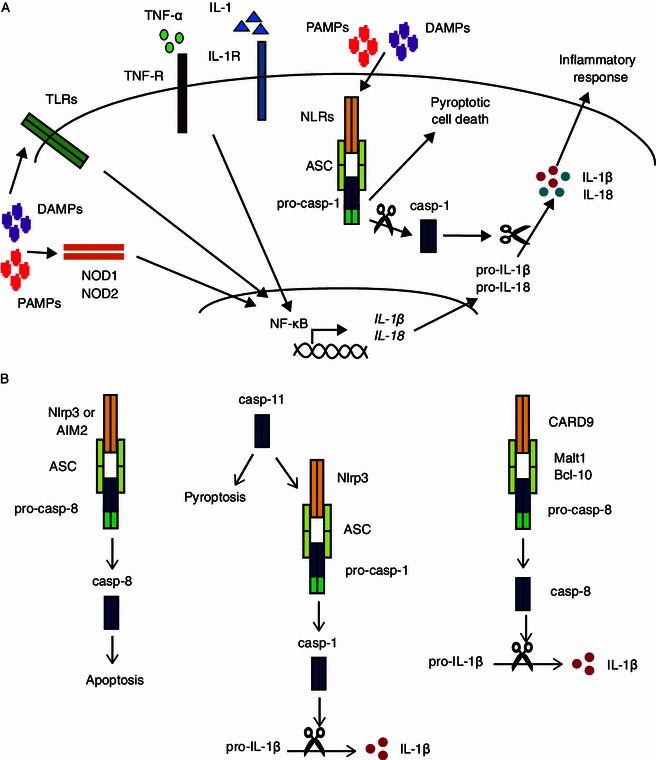
Chronic inflammatory responses have long been observed to be associated with various types of cancer and play decisive roles at different stages of cancer development. Inflammasomes, which are potent inducers of interleukin (IL)-1β and IL-18 during inflammation, are large protein complexes typically consisting of a Nod-like receptor (NLR), the adapter protein ASC, and Caspase-1. During malignant transformation or cancer therapy, the inflammasomes are postulated to become activated in response to danger signals arising from the tumors or from therapy-induced damage to the tumor or healthy tissue. The activation of inflammasomes plays diverse and sometimes contrasting roles in cancer promotion and therapy depending on the specific context. Here we summarize the role of different inflammasome complexes in cancer progression and therapy. Inflammasome components and pathways may provide novel targets to treat certain types of cancer; however, using such agents should be cautiously evaluated due to the complex roles that inflammasomes and pro-inflammatory cytokines play in immunity.
慢性炎症反应长期以来一直被认为与各种类型的癌症有关,并在癌症发展的不同阶段发挥决定性作用。炎症小体在炎症过程中是强有力的白细胞介素 (IL)-1β 和 IL-18 的诱导物,是由 Nod 样受体 (NLR)、衔接蛋白 ASC 和 Caspase-1 组成的大型蛋白复合物。在恶性转化或癌症治疗过程中,炎症小体被假设会对来自肿瘤的危险信号或肿瘤或健康组织的治疗引起的损伤作出反应而被激活。炎症小体的激活在癌症的促进和治疗中根据具体情况发挥着多样化且有时相互矛盾的作用。在这里,我们总结了不同炎症小体复合物在癌症进展和治疗中的作用。炎症小体成分和途径可能为治疗某些类型的癌症提供新的靶点;然而,由于炎症小体和促炎细胞因子在免疫中发挥的复杂作用,使用这些药物应该谨慎评估。