Jimenez Joaquin J, Wikramanayake Tongyu C, Bergfeld Wilma, Hordinsky Maria, Hickman Janet G, Hamblin Michael R, Schachner Lawrence A
Department of Dermatology and Cutaneous Surgery, University of Miami Miller School of Medicine, Miami, FL, 33136, USA,
Am J Clin Dermatol. 2014 Apr;15(2):115-27. doi: 10.1007/s40257-013-0060-6.
Male and female pattern hair loss are common, chronic dermatologic disorders with limited therapeutic options. In recent years, a number of commercial devices using low-level laser therapy have been promoted, but there have been little peer-reviewed data on their efficacy.
To determine whether treatment with a low-level laser device, the US FDA-cleared HairMax Lasercomb®, increases terminal hair density in both men and women with pattern hair loss.
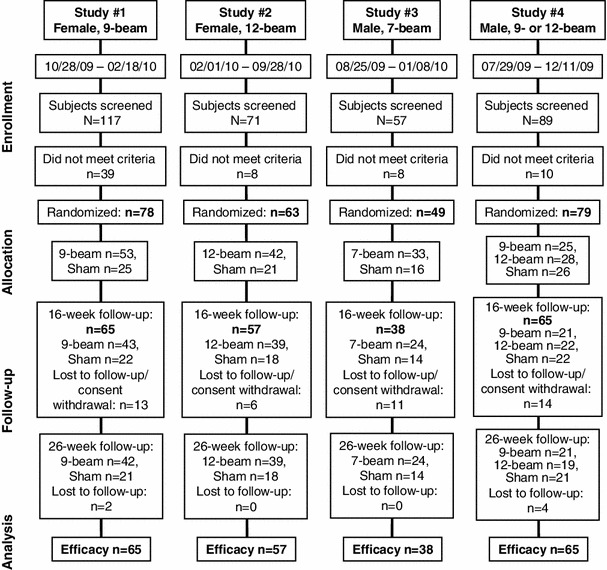
Randomized, sham device-controlled, double-blind clinical trials were conducted at multiple institutional and private practices. A total of 146 male and 188 female subjects with pattern hair loss were screened. A total of 128 male and 141 female subjects were randomized to receive either a lasercomb (one of three models) or a sham device in concealed sealed packets, and were treated on the whole scalp three times a week for 26 weeks. Terminal hair density of the target area was evaluated at baseline and at 16- and 26-week follow-ups, and analyzed to determine whether the hypothesis formulated prior to data collection, that lasercomb treatment would increase terminal hair density, was correct. The site investigators and the subjects remained blinded to the type of device they dispensed/received throughout the study. The evaluator of masked digital photographs was blinded to which trial arm the subject belonged.
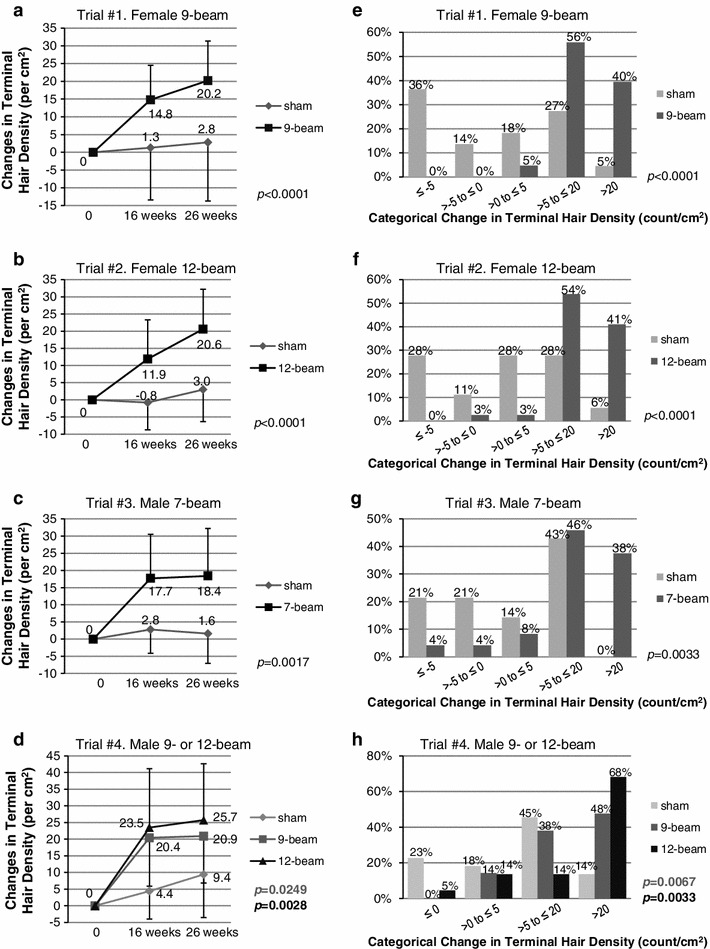
Seventy-eight, 63, 49, and 79 subjects were randomized in four trials of 9-beam lasercomb treatment in female subjects, 12-beam lasercomb treatment in female subjects, 7-beam lasercomb treatment in male subjects, and 9- and 12-beam lasercomb treatment in male subjects, compared with the sham device, respectively. Nineteen female and 25 male subjects were lost to follow-up. Among the remaining 122 female and 103 male subjects in the efficacy analysis, the mean terminal hair count at 26 weeks increased from baseline by 20.2, 20.6, 18.4, 20.9, and 25.7 per cm2 in 9-beam lasercomb-treated female subjects, 12-beam lasercomb-treated female subjects, 7-beam lasercomb-treated male subjects, and 9- and 12-beam lasercomb-treated male subjects, respectively, compared with 2.8 (p<0.0001), 3.0 (p<0.0001), 1.6 (p=0.0017), 9.4 (p=0.0249), and 9.4 (p=0.0028) in sham-treated subjects (95% confidence interval). The increase in terminal hair density was independent of the age and sex of the subject and the lasercomb model. Additionally, a higher percentage of lasercomb-treated subjects reported overall improvement of hair loss condition and thickness and fullness of hair in self-assessment, compared with sham-treated subjects. No serious adverse events were reported in any subject receiving the lasercomb in any of the four trials.
We observed a statistically significant difference in the increase in terminal hair density between lasercomb- and sham-treated subjects. No serious adverse events were reported. Our results suggest that low-level laser treatment may be an effective option to treat pattern hair loss in both men and women. Additional studies should be considered to determine the long-term effects of low-level laser treatment on hair growth and maintenance, and to optimize laser modality.
男性型和女性型脱发是常见的慢性皮肤病,治疗选择有限。近年来,一些使用低能量激光疗法的商业设备得到推广,但关于其疗效的同行评审数据很少。
确定使用美国食品药品监督管理局(FDA)批准的低能量激光设备HairMax Lasercomb® 治疗,是否能增加男性和女性型脱发患者的终毛密度。
在多个机构和私人诊所进行了随机、假设备对照、双盲临床试验。共筛选了146名男性和188名女性型脱发患者。总共128名男性和141名女性患者被随机分组,分别接受激光梳(三种型号之一)或装在隐蔽密封包装中的假设备,并每周对整个头皮进行三次治疗,持续26周。在基线以及16周和26周随访时评估目标区域的终毛密度,并进行分析,以确定数据收集前提出的激光梳治疗会增加终毛密度这一假设是否正确。在整个研究过程中,现场研究人员和受试者对他们分发/接收的设备类型保持盲态。对遮盖数码照片的评估人员不知道受试者属于哪个试验组。
在四项试验中,分别有78、63、49和79名受试者被随机分组,接受9束激光梳治疗女性受试者、12束激光梳治疗女性受试者、7束激光梳治疗男性受试者以及9束和12束激光梳治疗男性受试者,与假设备组进行比较。19名女性和25名男性受试者失访。在疗效分析中,其余122名女性和103名男性受试者中,与假治疗组相比,9束激光梳治疗女性受试者、12束激光梳治疗女性受试者、7束激光梳治疗男性受试者以及9束和12束激光梳治疗男性受试者在26周时的平均终毛计数每平方厘米分别比基线增加了20.2、20.6、18.4、20.9和25.7,而假治疗组为2.8(p<0.0001)、3.0(p<0.0001)、1.6(p = 0.0017)、9.4(p = 0.0249)和9.4(p = 0.0028)(95%置信区间)。终毛密度的增加与受试者的年龄、性别以及激光梳型号无关。此外,与假治疗组相比,接受激光梳治疗的受试者在自我评估中报告脱发状况、头发厚度和丰满度总体改善的比例更高。在四项试验中的任何一项中,接受激光梳治疗的任何受试者均未报告严重不良事件。
我们观察到激光梳治疗组和假治疗组在终毛密度增加方面存在统计学上的显著差异。未报告严重不良事件。我们的结果表明,低能量激光治疗可能是治疗男性和女性型脱发的有效选择。应考虑进一步研究以确定低能量激光治疗对毛发生长和维持的长期影响,并优化激光治疗方式。