Hatle Håvard, Støbakk Per Kristian, Mølmen Harald Edvard, Brønstad Eivind, Tjønna Arnt Erik, Steinshamn Sigurd, Skogvoll Eirik, Wisløff Ulrik, Ingul Charlotte Björk, Rognmo Øivind
K.G. Jebsen Centre of Exercise in Medicine, Norwegian University of Science and Technology (NTNU), Trondheim, Norway ; Department of Circulation and Medical Imaging, NTNU, Trondheim, Norway.
K.G. Jebsen Centre of Exercise in Medicine, Norwegian University of Science and Technology (NTNU), Trondheim, Norway ; Department of Circulation and Medical Imaging, NTNU, Trondheim, Norway ; Department of Pulmonary Medicine, St Olav University Hospital, Trondheim, Norway.
PLoS One. 2014 Feb 7;9(2):e88375. doi: 10.1371/journal.pone.0088375. eCollection 2014.
The training response of an intensified period of high-intensity exercise is not clear. Therefore, we compared the cardiovascular adaptations of completing 24 high-intensity aerobic interval training sessions carried out for either three or eight weeks, respectively.
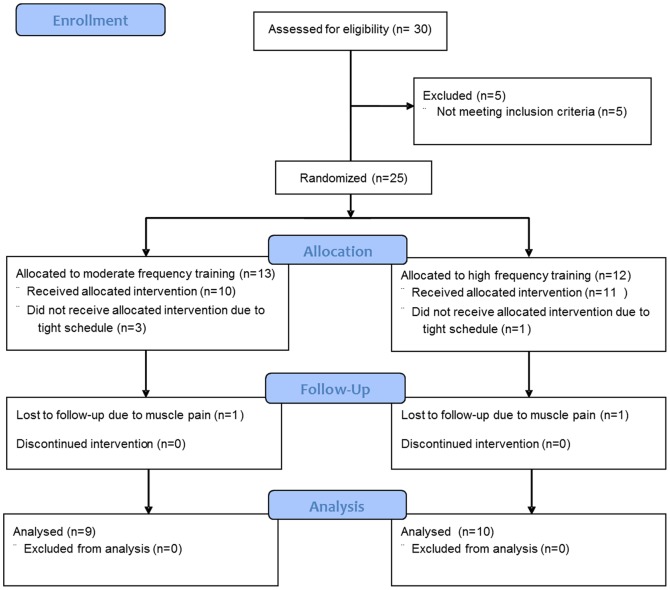
Twenty-one healthy subjects (23.0±2.1 years, 10 females) completed 24 high-intensity training sessions throughout a time-period of either eight weeks (moderate frequency, MF) or three weeks (high frequency, HF) followed by a detraining period of nine weeks without any training. In both groups, maximal oxygen uptake (VO2max) was evaluated before training, at the 9(th) and 17(th) session and four days after the final 24(th) training session. In the detraining phase VO2max was evaluated after 12 days and thereafter every second week for eight weeks. Left ventricular echocardiography, carbon monoxide lung diffusion transfer factor, brachial artery flow mediated dilatation and vastus lateralis citrate maximal synthase activity was tested before and after training.
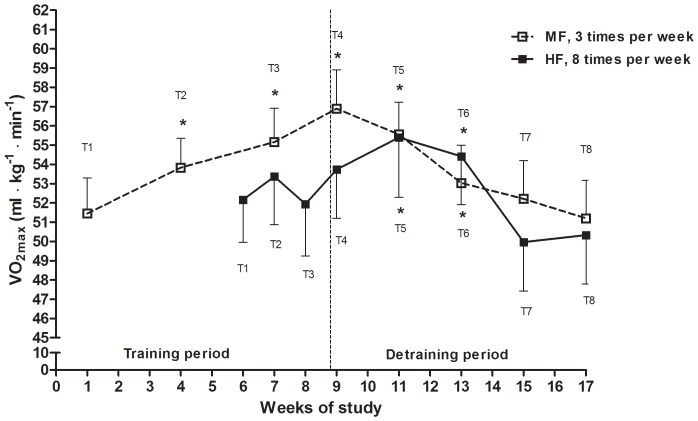
The cardiovascular adaptation after HF training was delayed compared to training with MF. Four days after ending training the HF group showed no improvement (+3.0%, p = 0.126), whereas the MF group reached their highest VO2max with a 10.7% improvement (p<0.001: group difference p = 0.035). The HF group reached their highest VO2max (6.1% increase, p = 0.026) twelve days into the detraining period, compared to a concomitant reduction to 7.9% of VO2max (p<0.001) above baseline in the MF group (group difference p = 0.609).
Both HF and MF training of high-intensity aerobic exercise improves VO2max. The cardiovascular adaptation following a HF programme of high-intensity exercise is however delayed compared to MF training.
ClinicalTrials.gov NCT00733941.
高强度运动强化期的训练反应尚不清楚。因此,我们比较了分别进行为期三周或八周的24次高强度有氧间歇训练后的心血管适应性。
21名健康受试者(23.0±2.1岁,10名女性)在为期八周(中等频率,MF)或三周(高频率,HF)的时间段内完成24次高强度训练,随后是为期九周的停训期,期间不进行任何训练。两组均在训练前、第9次和第17次训练时以及最后第24次训练后四天评估最大摄氧量(VO2max)。在停训阶段,在12天后评估VO2max,此后每两周评估一次,共八周。在训练前后测试左心室超声心动图、一氧化碳肺扩散转移因子、肱动脉血流介导的扩张和股外侧肌柠檬酸最大合酶活性。
与MF训练相比,HF训练后的心血管适应性延迟。训练结束四天后,HF组没有改善(+3.0%,p = 0.126),而MF组达到了最高VO2max,提高了10.7%(p<0.001:组间差异p = 0.035)。HF组在停训期第12天达到最高VO2max(增加6.1%,p = 0.026),而MF组在此期间VO2max降至基线以上的7.9%(p<0.001)(组间差异p = 0.609)。
高强度有氧运动的HF和MF训练均能提高VO2max。然而,与MF训练相比,高强度运动HF方案后的心血管适应性延迟。
ClinicalTrials.gov NCT00733941。