Oldmeadow Julian A, Fiske Susan T
University of York.
Princeton University.
Anal Soc Issues Public Policy. 2012 Dec 1;12(1):324-329. doi: 10.1111/j.1530-2415.2011.01277.x.
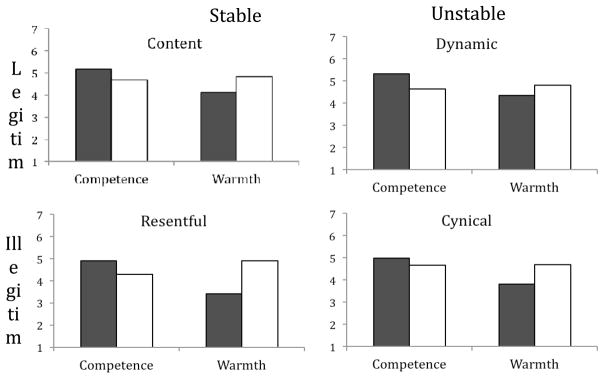
This paper describes an integration of the stereotype content model with social identity theory in which we theorise links between the legitimacy and stability of status relations between groups on the one hand, and stereotypes of warmth and competence on the other. Warmth stereotypes associate with the perceived morality of inequalities, so we reason that high and low status groups are more differentiated in warmth in illegitimate status systems. Also, stereotypes of competence explain status differences, so differences in stereotypical competence may be more pronounced when status is stable rather than unstable. Across two experiments high and low status groups were more sharply differentiated in warmth in illegitimate than legitimate status systems, as predicted. The effect of stability on competence was less clear, as groups were clearly differentiated in competence in all status systems. Implications for the roles of warmth and competence stereotypes in social change are discussed.
本文描述了刻板印象内容模型与社会认同理论的整合,在这种整合中,我们从理论上阐述了一方面群体间地位关系的合法性与稳定性,另一方面温暖与能力刻板印象之间的联系。温暖刻板印象与不平等的感知道德相关联,因此我们推断,在非法地位体系中,高地位和低地位群体在温暖方面的差异更大。此外,能力刻板印象解释了地位差异,所以当地位稳定而非不稳定时,刻板印象能力的差异可能会更加明显。正如预测的那样,在两项实验中,与合法地位体系相比,非法地位体系中的高地位和低地位群体在温暖方面的差异更为显著。稳定性对能力的影响不太明确,因为在所有地位体系中,群体在能力方面都有明显差异。本文还讨论了温暖和能力刻板印象在社会变革中的作用。