Grigoryev Dmitry, Fiske Susan T, Batkhina Anastasia
National Research University Higher School of Economics, Moscow, Russia.
Princeton University, Princeton, NJ, United States.
Front Psychol. 2019 Jul 16;10:1643. doi: 10.3389/fpsyg.2019.01643. eCollection 2019.
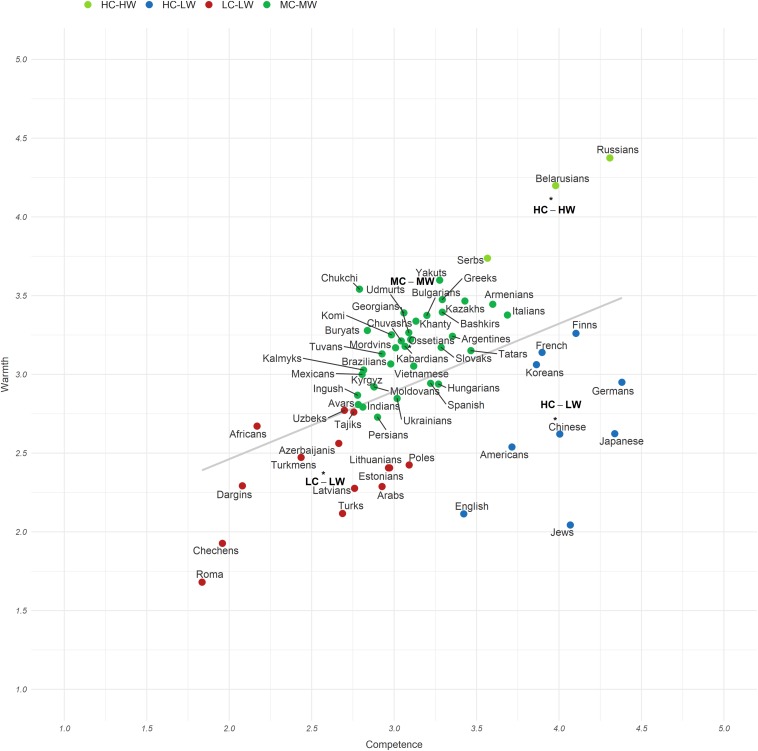
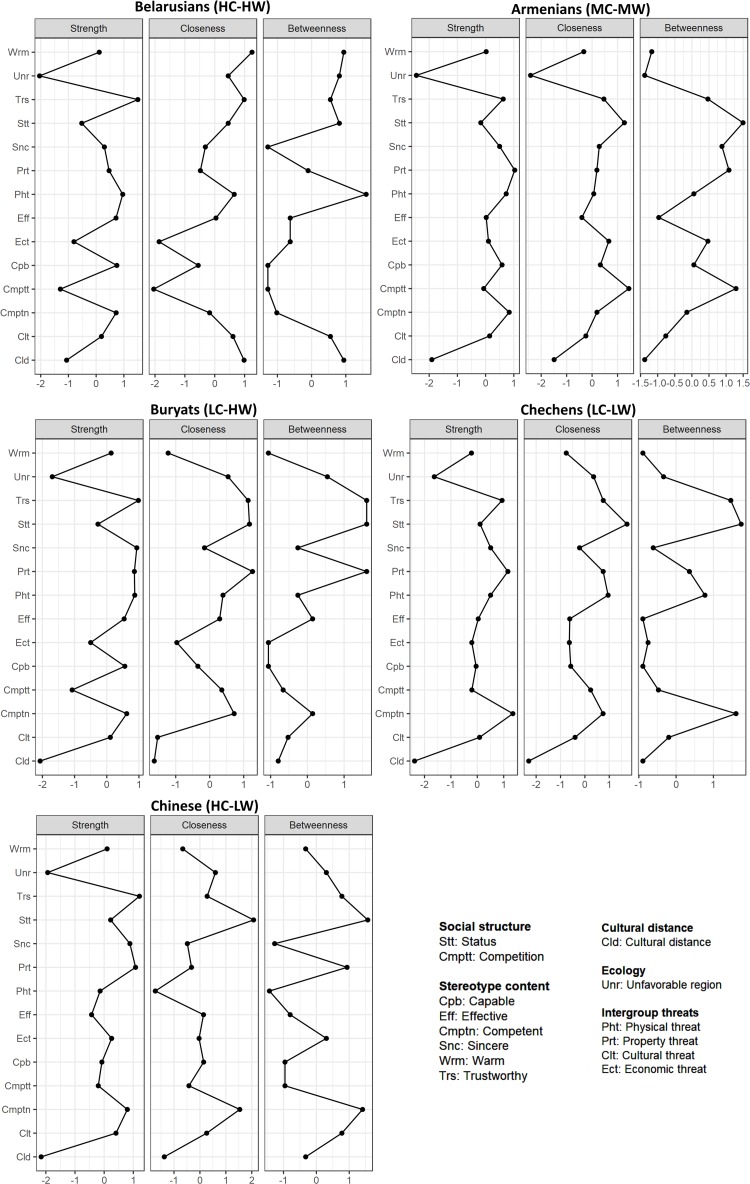
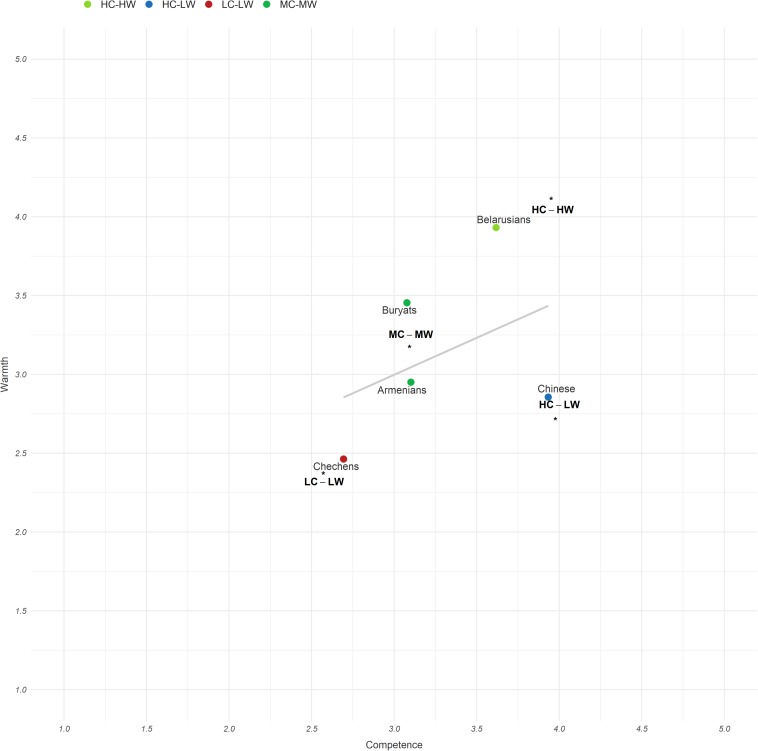
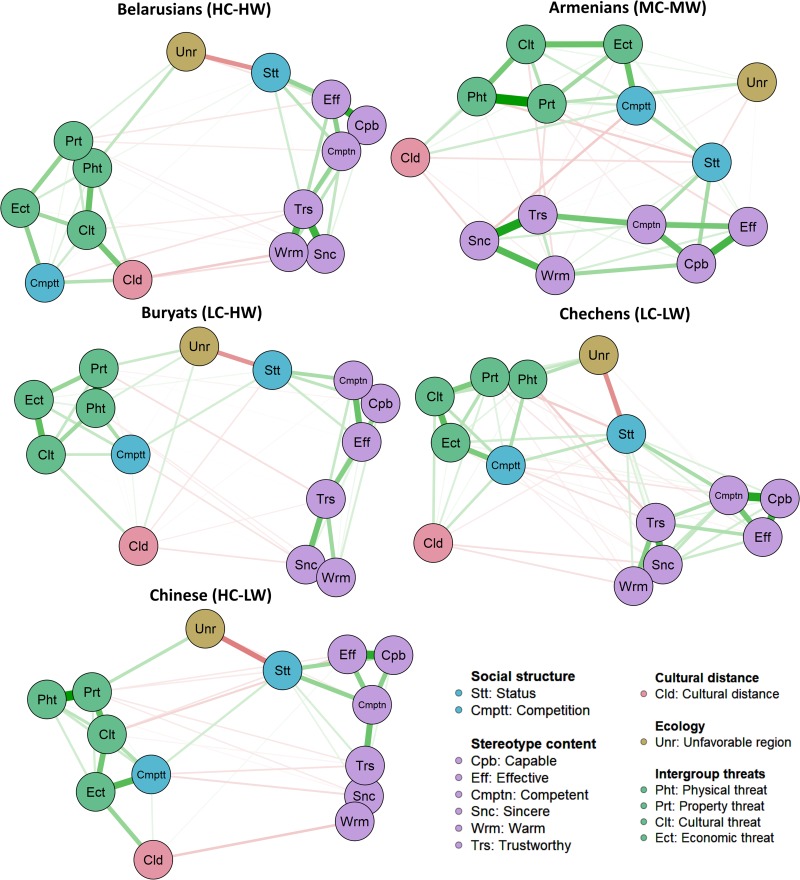
The stereotype content model (SCM), originating in the United States and generalized across nearly 50 countries, has yet to address ethnic relations in one of the world's most influential nations. Russia and the United States are somewhat alike (large, powerful, immigrant-receiving), but differ in other ways relevant to intergroup images (culture, religions, ideology, and history). Russian ethnic stereotypes are understudied, but significant for theoretical breadth and practical politics. This research tested the SCM on ethnic stereotypes in a Russian sample ( = 1115). Study 1 ( = 438) produced an SCM map of the sixty most numerous domestic ethnic groups (both ethnic minorities and immigrants). Four clusters occupied the SCM warmth-by-competence space. Study 2 ( = 677) compared approaches to ethnic stereotypes in terms of status and competition, cultural distance, perceived region, and four intergroup threats. Using the same Study 1 groups, the Russian SCM map showed correlated warmth and competence, with few ambivalent stereotypes. As the SCM predicts, status predicted competence, and competition negatively predicted warmth. Beyond the SCM, status and property threat both were robust antecedents for both competence and warmth for all groups. Besides competition, cultural distance also negatively predicted warmth for all groups. The role of the other antecedents, as expected, varied from group to group. To examine relative impact, a network analysis demonstrated that status, competition, and property threat centrally influence many other variables in the networks. The SCM, along with antecedents from other models, describes Russian ethnic-group images. This research contributes: (1) a comparison of established approaches to ethnic stereotypes (from acculturation and intergroup relations) showing the stability of the main SCM predictions; (2) network structures of the multivariate dependencies of the considered variables; (3) systematically cataloged images of ethnic groups in Russia for further comparisons, illuminating the Russian historical, societal, and interethnic context.
刻板印象内容模型(SCM)起源于美国,并在近50个国家得到推广,但尚未涉及世界上最具影响力的国家之一的种族关系。俄罗斯和美国在某些方面有相似之处(地域广阔、实力强大、接纳移民),但在与群体间形象相关的其他方面存在差异(文化、宗教、意识形态和历史)。俄罗斯的种族刻板印象研究不足,但在理论广度和实际政治方面具有重要意义。本研究在一个俄罗斯样本(n = 1115)中对种族刻板印象进行了SCM测试。研究1(n = 438)绘制了国内人数最多的60个种族群体(包括少数民族和移民)的SCM地图。四个集群占据了SCM中温暖与能力的空间。研究2(n = 677)从地位和竞争、文化距离、感知区域以及四种群体间威胁等方面比较了种族刻板印象的研究方法。使用与研究1相同的群体,俄罗斯的SCM地图显示温暖与能力呈正相关,矛盾的刻板印象较少。正如SCM所预测的,地位预示着能力,竞争与温暖呈负相关。除了SCM,地位和财产威胁对所有群体的能力和温暖都是强有力的先行因素。除了竞争,文化距离对所有群体的温暖也呈负相关。正如预期的那样,其他先行因素的作用因群体而异。为了检验相对影响,一项网络分析表明,地位、竞争和财产威胁在网络中对许多其他变量具有核心影响。SCM以及其他模型的先行因素描述了俄罗斯种族群体的形象。本研究的贡献在于:(1)对既定的种族刻板印象研究方法(来自文化适应和群体间关系)进行比较,显示了SCM主要预测的稳定性;(2)所考虑变量的多变量依赖性的网络结构;(3)对俄罗斯种族群体形象进行系统分类以便进一步比较,阐明俄罗斯的历史、社会和种族间背景。