NIHR CLAHRC Wessex, Faculty of Health Sciences, University of Southampton Building 67, Highfield Campus, University Road, S017 1BJ Hampshire, UK.
Implement Sci. 2014 Feb 13;9:19. doi: 10.1186/1748-5908-9-19.
The distribution of the roles and responsibilities of long-term condition management (LTCM) outside of formal health services implicates a wide set of relationships and activities of involvement. Yet, compared to studies of professional implementation, patient systems of implementation remain under-investigated. The aim of this paper is to explore the work, meaning and function attributed to 'weaker' ties relative to other more bonding relationships in order to identify the place of these within a context of systems of support for long-term conditions.
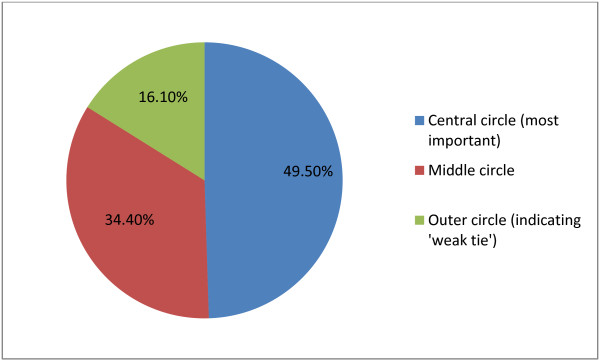
This is a mixed methods survey with nested qualitative study. A total of 300 people from deprived areas in the North West of England with chronic illnesses took part in a survey conducted in 2010 to 2011. A concentric circles diagram was used as a research tool with which participants identified 2,544 network members who contributed to illness management. Notions of 'work' were used to describe activities associated with chronic illness and to identify how weaker ties are included and perceived to be involved through social network members (SNM) contributions.
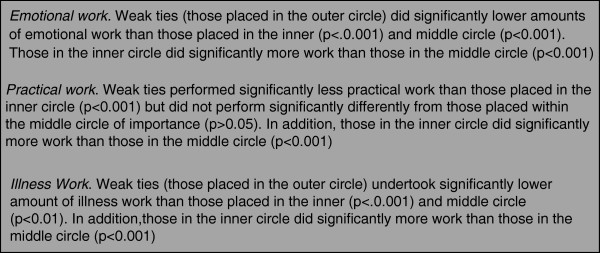
The results provide an articulation of how SNMs are substantially involved in weak tie illness management. Weaker ties constituted 16.1% of network membership involved in illness work. The amount of work undertaken was similar but less than that of stronger ties. Weaker ties appeared more durable and less liable to loss over time than stronger ties. The qualitative accounts suggested that weak ties enabled the moral positioning of the self-managing 'self' and acted on the basis of a strong sense of reciprocity.
Weak ties act as an acceptable bridge between a sense of personal agency and control and the need for external support because it is possible to construct a sense of moral acceptability through reciprocal exchange. Access to weak tie resources needs to be taken into account when considering the ways in which systems of health implementation for chronic illness are designed and delivered.
长期病管理(LTCM)的角色和职责的分布超出了正规卫生服务的范围,这涉及到广泛的关系和参与活动。然而,与专业实施的研究相比,患者实施系统仍未得到充分研究。本文的目的是探讨相对于其他更具结合力的关系,“较弱”关系所赋予的工作、意义和功能,以确定这些关系在长期病支持系统中的地位。
这是一项混合方法调查,其中嵌套了一项定性研究。2010 年至 2011 年,来自英格兰西北部贫困地区的 300 名慢性病患者参加了一项调查。使用同心圆圈图作为研究工具,参与者确定了 2544 名对疾病管理有贡献的网络成员。“工作”的概念被用来描述与慢性疾病相关的活动,并确定如何通过社会网络成员(SNM)的贡献来包括和感知较弱的联系。
研究结果提供了对 SNM 如何实质性地参与弱联系疾病管理的阐述。较弱的联系构成了参与疾病工作的网络成员的 16.1%。所承担的工作量相似,但比强联系少。较弱的联系似乎比强联系更持久,随着时间的推移不太容易失去。定性描述表明,弱联系使自我管理的“自我”的道德定位成为可能,并基于强烈的互惠意识行事。
弱联系充当了个人代理和控制意识与外部支持需求之间可接受的桥梁,因为通过互惠交换可以构建道德可接受性的意识。在考虑设计和提供慢性疾病健康实施系统的方式时,需要考虑获得弱联系资源的方式。