Zhong Junpei, Cangelosi Angelo, Wermter Stefan
Department of Computer Science, University of Hamburg Hamburg, Germany ; School of Computer Science, University of Hertfordshire Hatfield, UK.
School of Computing and Mathematics, University of Plymouth Plymouth, UK.
Front Behav Neurosci. 2014 Feb 4;8:22. doi: 10.3389/fnbeh.2014.00022. eCollection 2014.
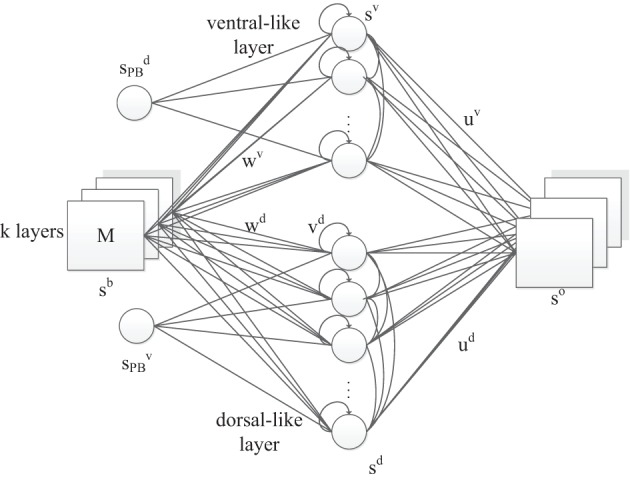
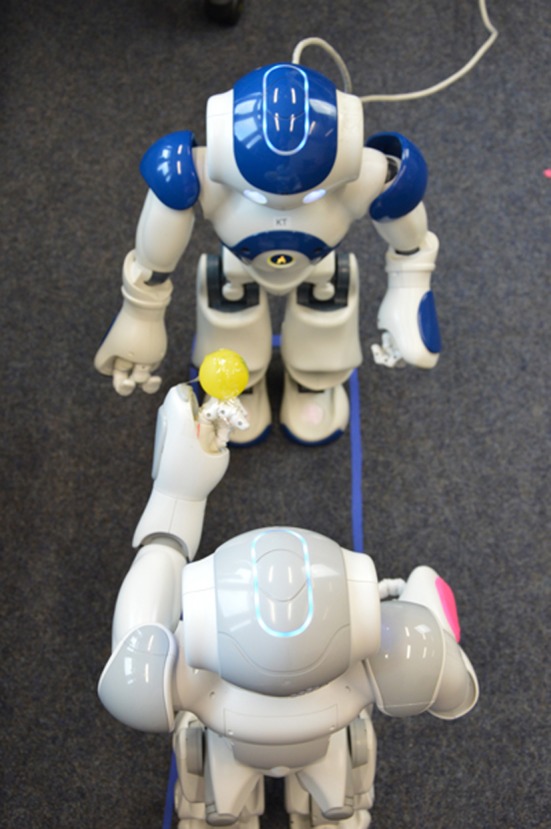
The acquisition of symbolic and linguistic representations of sensorimotor behavior is a cognitive process performed by an agent when it is executing and/or observing own and others' actions. According to Piaget's theory of cognitive development, these representations develop during the sensorimotor stage and the pre-operational stage. We propose a model that relates the conceptualization of the higher-level information from visual stimuli to the development of ventral/dorsal visual streams. This model employs neural network architecture incorporating a predictive sensory module based on an RNNPB (Recurrent Neural Network with Parametric Biases) and a horizontal product model. We exemplify this model through a robot passively observing an object to learn its features and movements. During the learning process of observing sensorimotor primitives, i.e., observing a set of trajectories of arm movements and its oriented object features, the pre-symbolic representation is self-organized in the parametric units. These representational units act as bifurcation parameters, guiding the robot to recognize and predict various learned sensorimotor primitives. The pre-symbolic representation also accounts for the learning of sensorimotor primitives in a latent learning context.
获取感觉运动行为的符号和语言表征是智能体在执行和/或观察自身及他人动作时所进行的认知过程。根据皮亚杰的认知发展理论,这些表征在感觉运动阶段和前运算阶段发展形成。我们提出了一个模型,该模型将来自视觉刺激的高级信息概念化与腹侧/背侧视觉流的发展联系起来。此模型采用了神经网络架构,其中包含基于RNNPB(带参数偏差的循环神经网络)的预测性感觉模块和水平积模型。我们通过一个被动观察物体以学习其特征和运动的机器人来举例说明这个模型。在观察感觉运动基元的学习过程中,即观察一组手臂运动轨迹及其定向物体特征时,前符号表征在参数单元中自组织形成。这些表征单元充当分岔参数,引导机器人识别和预测各种已学习的感觉运动基元。前符号表征也解释了在潜伏学习情境中感觉运动基元的学习情况。