Dereli-Korkut Zeynep, Akaydin H Dogus, Ahmed A H Rezwanuddin, Jiang Xuejun, Wang Sihong
Department of Biomedical Engineering, The City College of the City University of New York , 160 Convent Ave. Steinman Hall T-434, New York, New York 10031, United States.
Anal Chem. 2014 Mar 18;86(6):2997-3004. doi: 10.1021/ac403899j. Epub 2014 Mar 7.
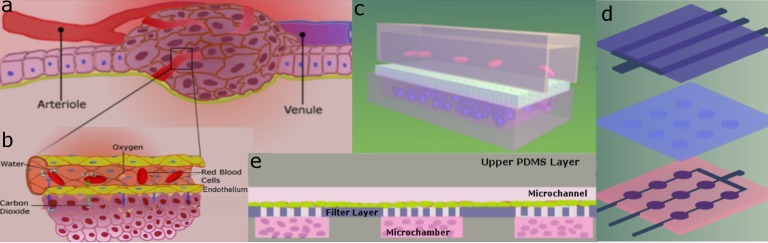
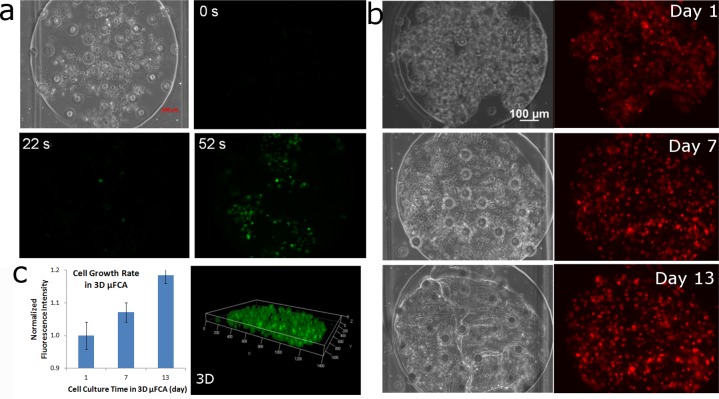
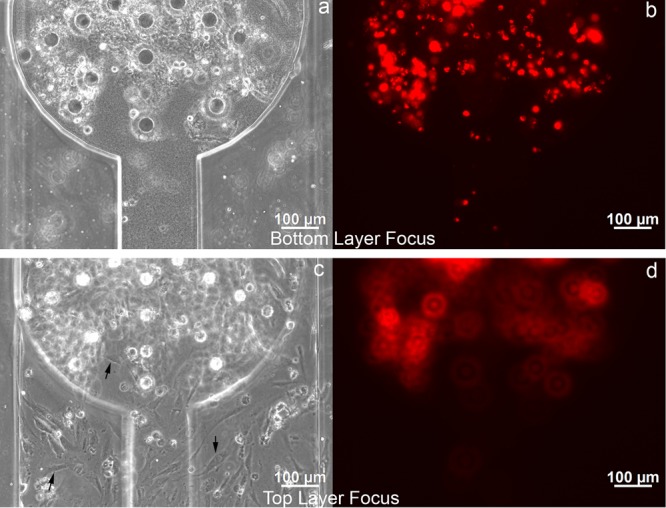
Currently, there are no reliable ex vivo models that predict anticancer drug responses in human tumors accurately. A comprehensive method of mimicking a 3D microenvironment to study effects of anticancer drugs on specific cancer types is essential. Here, we report the development of a three-dimensional microfluidic cell array (3D μFCA), which reconstructs a 3D tumor microenvironment with cancer cells and microvascular endothelial cells. To mimic the in vivo spatial relationship between microvessels and nonendothelial cells embedded in extracellular matrix, three polydimethylsiloxane (PDMS) layers were built into this array. The multilayer property of the device enabled the imitation of the drug delivery in a microtissue array with simulated blood circulation. This 3D μFCA system may provide better predictions of drug responses and identification of a suitable treatment for a specific patient if biopsy samples are used. To the pharmaceutical industry, the scaling-up of our 3D μFCA system may offer a novel high throughput screening tool.
目前,尚无能够准确预测抗癌药物对人类肿瘤反应的可靠离体模型。一种模拟三维微环境以研究抗癌药物对特定癌症类型影响的综合方法至关重要。在此,我们报告了一种三维微流控细胞阵列(3D μFCA)的开发,该阵列用癌细胞和微血管内皮细胞重建三维肿瘤微环境。为了模拟微血管与嵌入细胞外基质中的非内皮细胞之间的体内空间关系,该阵列构建了三个聚二甲基硅氧烷(PDMS)层。该装置的多层特性使得能够在具有模拟血液循环的微组织阵列中模拟药物递送。如果使用活检样本,这种3D μFCA系统可能会为药物反应提供更好的预测,并为特定患者确定合适的治疗方法。对于制药行业而言,扩大我们的3D μFCA系统规模可能会提供一种新型的高通量筛选工具。