Singh Jay P, Fazel Seena, Gueorguieva Ralitza, Buchanan Alec
Jay P. Singh, PhD, Psychiatric/Psychological Service, Department of Justice, Zürich, Switzerland; Seena Fazel, MD, Department of Psychiatry, University of Oxford, Warneford Hospital, Oxford, UK; Ralitza Gueorguieva, PhD, Department of Biostatistics, School of Public Health, Alec Buchanan, PhD, MD, Department of Psychiatry, Yale University, New Haven, Connecticut, USA.
Br J Psychiatry. 2014 Mar;204(3):180-7. doi: 10.1192/bjp.bp.113.131938.
Rates of violence in persons identified as high risk by structured risk assessment instruments (SRAIs) are uncertain and frequently unreported by validation studies.
To analyse the variation in rates of violence in individuals identified as high risk by SRAIs.
A systematic search of databases (1995-2011) was conducted for studies on nine widely used assessment tools. Where violence rates in high-risk groups were not published, these were requested from study authors. Rate information was extracted, and binomial logistic regression was used to study heterogeneity.
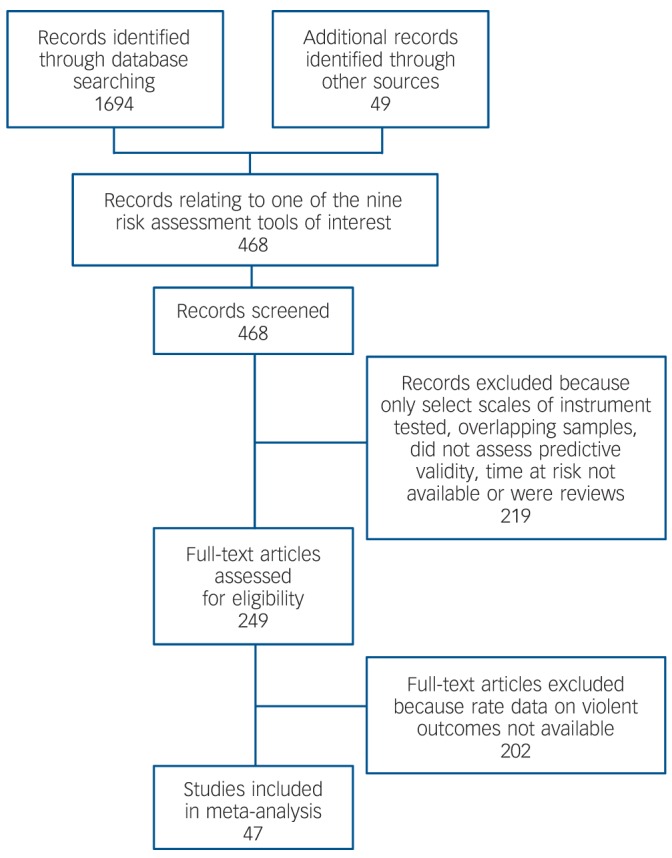
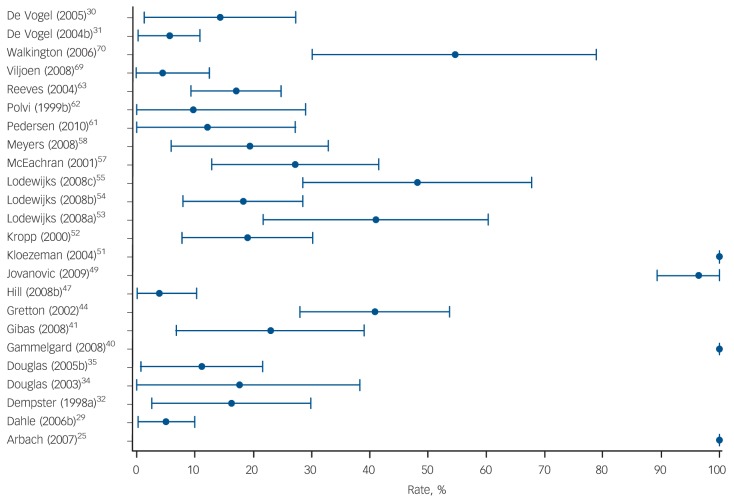
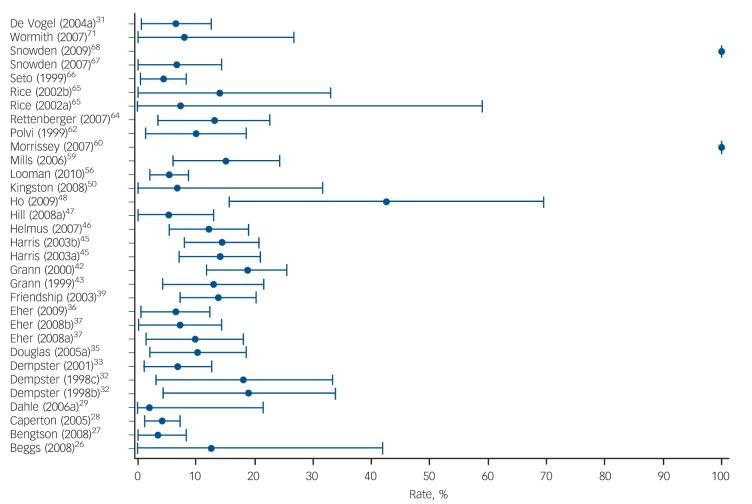
Information was collected on 13 045 participants in 57 samples from 47 independent studies. Annualised rates of violence in individuals classified as high risk varied both across and within instruments. Rates were elevated when population rates of violence were higher, when a structured professional judgement instrument was used and when there was a lower proportion of men in a study.
After controlling for time at risk, the rate of violence in individuals classified as high risk by SRAIs shows substantial variation. In the absence of information on local base rates, assigning predetermined probabilities to future violence risk on the basis of a structured risk assessment is not supported by the current evidence base. This underscores the need for caution when such risk estimates are used to influence decisions related to individual liberty and public safety.
通过结构化风险评估工具(SRAIs)确定为高风险的人群中的暴力发生率尚不确定,且验证研究中经常未报告。
分析通过SRAIs确定为高风险的个体中暴力发生率的差异。
对数据库(1995 - 2011年)进行系统检索,以查找关于九种广泛使用的评估工具的研究。若高风险组的暴力发生率未公布,则向研究作者索取。提取发生率信息,并使用二项式逻辑回归研究异质性。
从47项独立研究的57个样本中收集了13045名参与者的信息。被归类为高风险的个体的年度暴力发生率在不同工具之间以及同一工具内部均存在差异。当总体暴力发生率较高、使用结构化专业判断工具以及研究中男性比例较低时,发生率会升高。
在控制了风险时间后,通过SRAIs确定为高风险的个体的暴力发生率显示出很大差异。在缺乏当地基线发生率信息的情况下,目前的证据基础不支持基于结构化风险评估为未来暴力风险赋予预先确定的概率。这突出表明,在使用此类风险估计来影响与个人自由和公共安全相关的决策时需要谨慎。