Doom Jenalee R, Gunnar Megan R, Georgieff Michael K, Kroupina Maria G, Frenn Kristin, Fuglestad Anita J, Carlson Stephanie M
Institute of Child Development and Center for Neurobehavioral Development, University of Minnesota.
Child Dev. 2014 Sep-Oct;85(5):1805-12. doi: 10.1111/cdev.12231. Epub 2014 Mar 5.
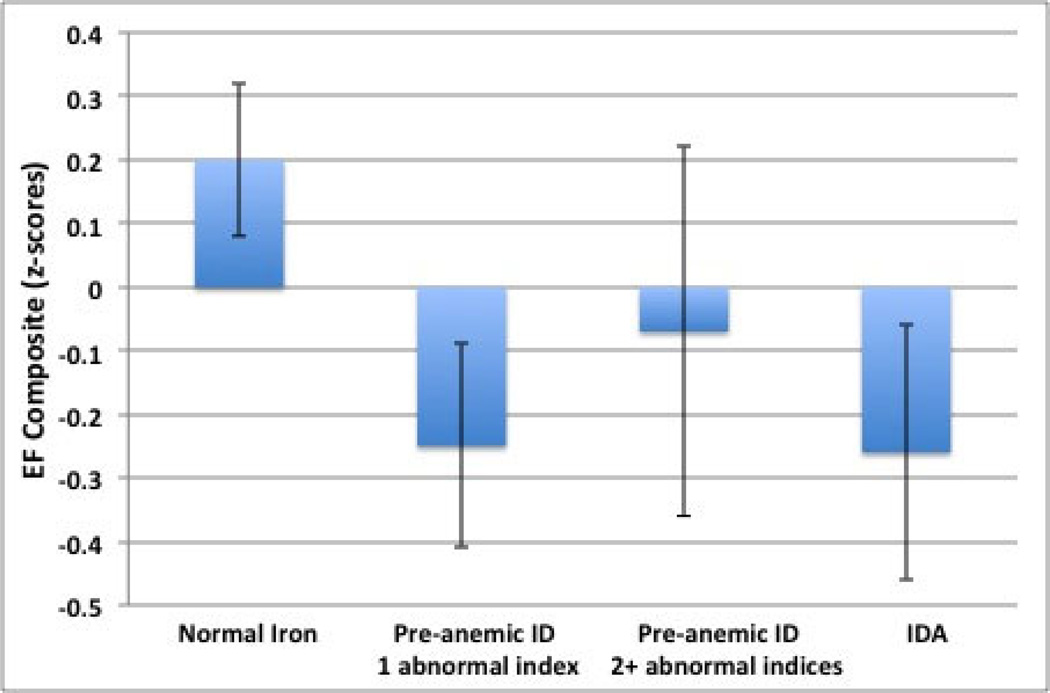
Children adopted from institutions have been studied as models of the impact of stimulus deprivation on cognitive development (Nelson, Bos, Gunnar, & Sonuga-Barke, 2011), but these children may also suffer from micronutrient deficiencies (Fuglestad et al., 2008). The contributions of iron deficiency (ID) and duration of deprivation on cognitive functioning in children adopted from institutions between 17 and 36 months of age were examined. ID was assessed in 55 children soon after adoption, and cognitive functioning was evaluated 11-14.6 months postadoption when the children averaged 37.4 months old (SD = 4.9). ID at adoption and longer duration of institutional care independently predicted lower IQ scores and executive function (EF) performance. IQ did not mediate the association between ID and EF.
从福利院收养的儿童已被作为刺激剥夺对认知发展影响的模型进行研究(尼尔森、博斯、贡纳尔和索努加-巴克,2011年),但这些儿童也可能患有微量营养素缺乏症(富格尔斯塔德等人,2008年)。研究了缺铁(ID)和剥夺持续时间对17至36个月大从福利院收养儿童认知功能的影响。在收养后不久对55名儿童进行了缺铁评估,并在收养后11 - 14.6个月对认知功能进行了评估,此时儿童平均年龄为37.4个月(标准差 = 4.9)。收养时的缺铁情况和更长时间的机构照料分别预测了较低的智商分数和执行功能(EF)表现。智商并未介导缺铁与执行功能之间的关联。