De Oliveira Thaís Cristina Galdino, Soares Fernanda Cabral, De Macedo Liliane Dias E Dias, Diniz Domingos Luiz Wanderley Picanço, Bento-Torres Natáli Valim Oliver, Picanço-Diniz Cristovam Wanderley
Laboratory of Investigations in Neurodgeneration and Infection, Biological Sciences Institute, University Hospital João de Barros Barreto, Belém, Brazil.
Laboratory of Investigations in Neurodgeneration and Infection, Biological Sciences Institute, University Hospital João de Barros Barreto, Belém, Brazil ; College of Physical Therapy and Occupational Therapy, Federal University of Pará, Belém, Brazil.
Clin Interv Aging. 2014 Feb 14;9:309-20. doi: 10.2147/CIA.S54383. eCollection 2014.
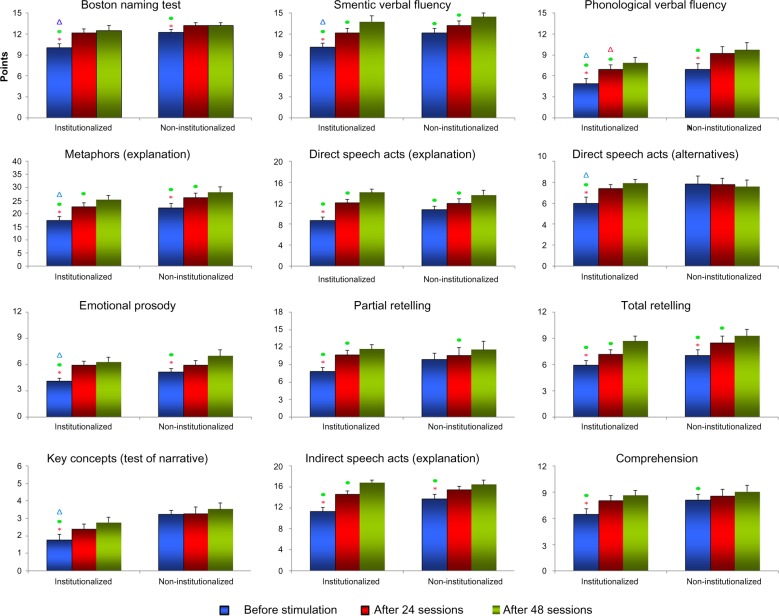
The aim of the present report was to evaluate the effectiveness and impact of multisensory and cognitive stimulation on improving cognition in elderly persons living in long-term-care institutions (institutionalized [I]) or in communities with their families (noninstitutionalized [NI]). We compared neuropsychological performance using language and Mini-Mental State Examination (MMSE) test scores before and after 24 and 48 stimulation sessions. The two groups were matched by age and years of schooling. Small groups of ten or fewer volunteers underwent the stimulation program, twice a week, over 6 months (48 sessions in total). Sessions were based on language and memory exercises, as well as visual, olfactory, auditory, and ludic stimulation, including music, singing, and dance. Both groups were assessed at the beginning (before stimulation), in the middle (after 24 sessions), and at the end (after 48 sessions) of the stimulation program. Although the NI group showed higher performance in all tasks in all time windows compared with I subjects, both groups improved their performance after stimulation. In addition, the improvement was significantly higher in the I group than the NI group. Language tests seem to be more efficient than the MMSE to detect early changes in cognitive status. The results suggest the impoverished environment of long-term-care institutions may contribute to lower cognitive scores before stimulation and the higher improvement rate of this group after stimulation. In conclusion, language tests should be routinely adopted in the neuropsychological assessment of elderly subjects, and long-term-care institutions need to include regular sensorimotor, social, and cognitive stimulation as a public health policy for elderly persons.
本报告的目的是评估多感官和认知刺激对改善居住在长期护理机构(机构化[I])或与家人一起生活在社区(非机构化[NI])的老年人认知功能的有效性和影响。我们比较了在24次和48次刺激疗程前后使用语言和简易精神状态检查表(MMSE)测试分数的神经心理学表现。两组在年龄和受教育年限方面进行了匹配。每组由十名或更少的志愿者组成,每周接受两次刺激计划,为期6个月(总共48次疗程)。疗程基于语言和记忆练习,以及视觉、嗅觉、听觉和娱乐刺激,包括音乐、唱歌和舞蹈。两组在刺激计划开始时(刺激前)、中期(24次疗程后)和结束时(48次疗程后)均接受评估。尽管与I组受试者相比,NI组在所有时间窗口的所有任务中表现更高,但两组在刺激后均提高了其表现。此外,I组的改善明显高于NI组。语言测试似乎比MMSE更有效地检测认知状态的早期变化。结果表明,长期护理机构的贫困环境可能导致刺激前认知分数较低,以及该组在刺激后的较高改善率。总之,在老年受试者的神经心理学评估中应常规采用语言测试,并且长期护理机构需要将定期的感觉运动、社交和认知刺激作为针对老年人的公共卫生政策。