Saberi Farzaneh, Sadat Zohreh, Abedzadeh-Kalahroudi Masoumeh, Taebi Mahboobeh
Department of Midwifery, Faculty of Nursing and Midwifery, Kashan University of Medical Sciences, Kashan, IR Iran.
Trauma Nursing Research Center, Kashan University of Medical Sciences, Kashan, IR Iran.
Iran Red Crescent Med J. 2013 Sep;15(9):854-61. doi: 10.5812/ircmj.12984. Epub 2013 Sep 5.
Nausea and vomiting of pregnancy (NVP) is the most common medical condition of pregnancy, affecting up to 85% of expecting mothers. NVP can have serious adverse effects on the quality of a woman's life, social, and domestic functioning, and her general well-being. Therefore, it is very important to treat this condition.
The effectiveness of ginger and acupressure in the treatment of NVP was compared in the present study.
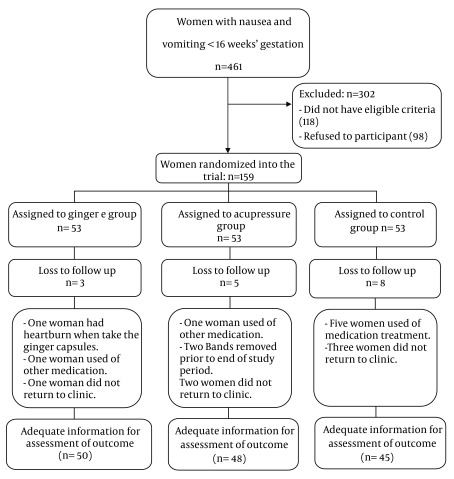
159 eligible pregnant women with symptoms of mild to moderate nausea and/or vomiting before 16 weeks gestational age participated in a 7-day clinical trial. They were divided randomly into three groups: the acupressure, ginger, and control. Participants did not receive any intervention for three days and interventions were performed for the women in acupressure and ginger groups for four days. No intervention was performed for the control group. Data was collected by self-recorded symptoms according to the Rhodes index. Data was analyzed by ANOVA, Kruskal-Wallis, Chi-square, and Fisher exact tests for quantitative and qualitative variables.
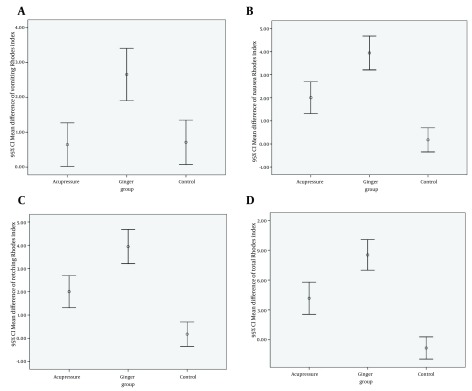
There were no statistical differences in the baseline demographics between the three groups. ANOVA test showed that there were significantly differences in mean difference Rhodes index scores (vomiting, nausea, retching and total score) in the three groups (P < 0.001).
Ginger is more effective than acupressure to relieve mild to moderate nausea and vomiting in symptomatic pregnant women in less than 16 weeks of gestational age.
妊娠恶心呕吐(NVP)是孕期最常见的病症,影响多达85%的准妈妈。NVP会对女性的生活质量、社交和家庭功能以及总体幸福感产生严重不利影响。因此,治疗这种病症非常重要。
本研究比较了生姜和指压疗法治疗NVP的效果。
159名妊娠16周前出现轻至中度恶心和/或呕吐症状的合格孕妇参与了一项为期7天的临床试验。她们被随机分为三组:指压组、生姜组和对照组。参与者三天未接受任何干预,指压组和生姜组的女性接受了四天的干预。对照组未进行干预。根据罗兹指数通过自我记录症状收集数据。对定量和定性变量的数据进行方差分析、克鲁斯卡尔-沃利斯检验、卡方检验和费舍尔精确检验。
三组之间的基线人口统计学数据无统计学差异。方差分析显示,三组的平均罗兹指数评分差异(呕吐、恶心、干呕和总分)有显著差异(P < 0.001)。
对于孕周小于16周、有症状的孕妇,生姜在缓解轻至中度恶心和呕吐方面比指压疗法更有效。