Woodhouse Cristina, Lopez Camelo Jorge, Wehby George L
College of Medicine, University of Iowa, Iowa City, Iowa, United States of America.
Centro de Educación Médica e Investigación Clínica (CEMIC); Consejo Nacional de Investigaciones, Científicas y Tecnológicas (CONICET), Buenos Aires, Argentina.
PLoS One. 2014 Mar 13;9(3):e91292. doi: 10.1371/journal.pone.0091292. eCollection 2014.
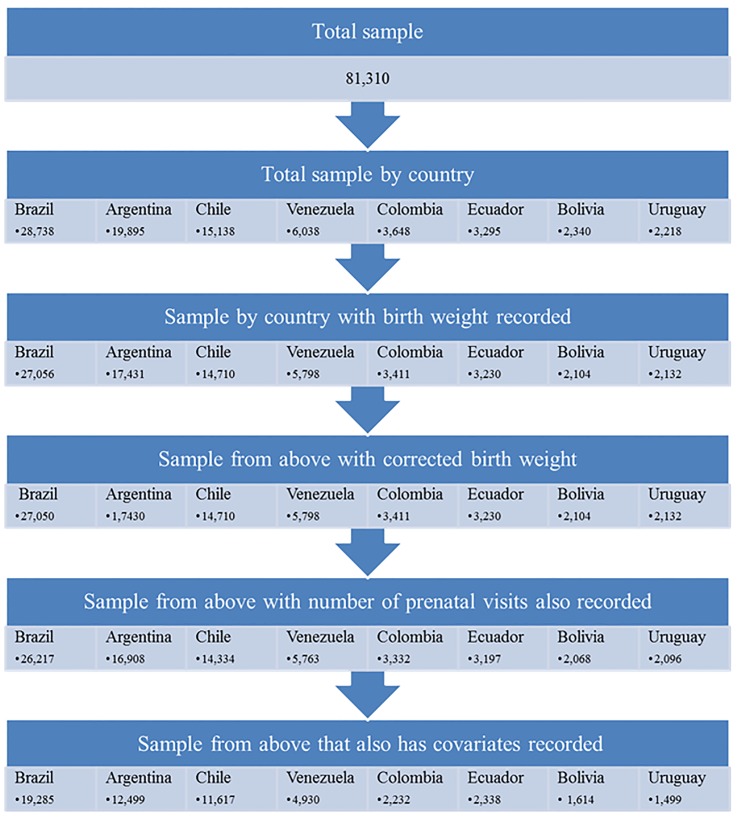
There has been little work that comprehensively compared the relationship between prenatal care and infant health across multiple countries using similar data sources and analytical models. Such comparative analyses are useful for understanding the background of differences in infant health between populations. We evaluated the association between prenatal care visits and fetal growth measured by birth weight (BW) in grams or low birth weight (<2500 grams; LBW) adjusted for gestational age in eight South American countries using similarly collected data across countries and the same analytical models. OLS and logistic regressions were estimated adjusting for a large set of relevant infant, maternal, and household characteristics and birth year and hospital fixed effects. Birth data were acquired from 140 hospitals that are part of the Latin American Collaborative Study of Congenital Malformations (ECLAMC) network. The analytical sample included 56,014 live-born infants (∼69% of total sample) with complete data born without congenital anomalies in the years 1996-2011 in Brazil, Argentina, Chile, Venezuela, Ecuador, Colombia, Bolivia, and Uruguay. Prenatal care visits were significantly (at p<.05) and positively associated with BW and negatively associated with LBW for all countries. The OLS coefficients ranged from 9 grams per visit in Bolivia to 36 grams in Uruguay. The association with LBW was strongest for Chile (OR = 0.87 per visit) and lowest for Argentina and Venezuela (OR = 0.95). The association decreased in the recent decade compared to earlier years. Our findings suggest that estimates of association between prenatal care and fetal growth are population-specific and may not be generalizable to other populations. Furthermore, as one of the indicators for a country's healthcare system for maternal and child health, prenatal care is a highly variable indicator between countries in South America.
很少有研究使用相似的数据源和分析模型,全面比较多个国家产前护理与婴儿健康之间的关系。这种比较分析有助于理解不同人群中婴儿健康差异的背景。我们使用各国类似收集的数据和相同的分析模型,评估了八个南美国家产前检查次数与以克为单位的出生体重(BW)或根据孕周调整的低出生体重(<2500克;LBW)所衡量的胎儿生长之间的关联。估计了普通最小二乘法(OLS)和逻辑回归,对大量相关的婴儿、母亲和家庭特征以及出生年份和医院固定效应进行了调整。出生数据来自拉丁美洲先天性畸形协作研究(ECLAMC)网络中的140家医院。分析样本包括1996年至2011年期间在巴西、阿根廷、智利、委内瑞拉、厄瓜多尔、哥伦比亚、玻利维亚和乌拉圭出生的56,014名无先天性异常的活产婴儿(约占总样本的69%),且数据完整。所有国家的产前检查次数与BW均呈显著正相关(p<0.05),与LBW呈负相关。OLS系数范围从玻利维亚的每次检查9克到乌拉圭的36克。智利与LBW的关联最强(每次检查的比值比[OR]=0.87),阿根廷和委内瑞拉最低(OR=0.95)。与早期相比,近十年这种关联有所下降。我们的研究结果表明,产前护理与胎儿生长之间关联的估计因人群而异,可能无法推广到其他人群。此外,作为一个国家母婴保健系统的指标之一,产前护理在南美国家之间是一个高度可变的指标。