Ishikawa Masaki, Maekawa Keiko, Saito Kosuke, Senoo Yuya, Urata Masayo, Murayama Mayumi, Tajima Yoko, Kumagai Yuji, Saito Yoshiro
Division of Medicinal Safety Science and Disease Metabolome Project, National Institute of Health Sciences, Setagaya, Tokyo, Japan.
Clinical Trial Center, Kitasato University East Hospital, Sagamihara, Kanagawa, Japan.
PLoS One. 2014 Mar 14;9(3):e91806. doi: 10.1371/journal.pone.0091806. eCollection 2014.
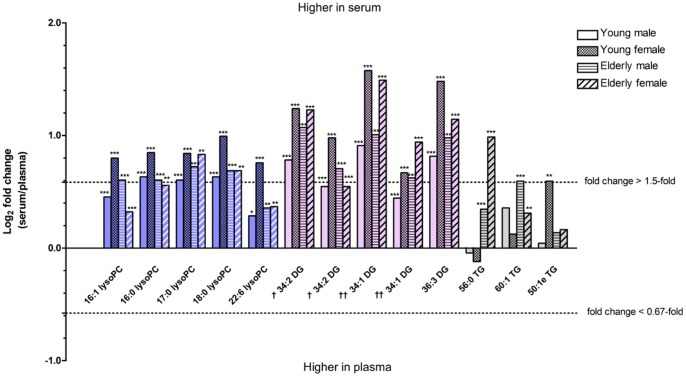
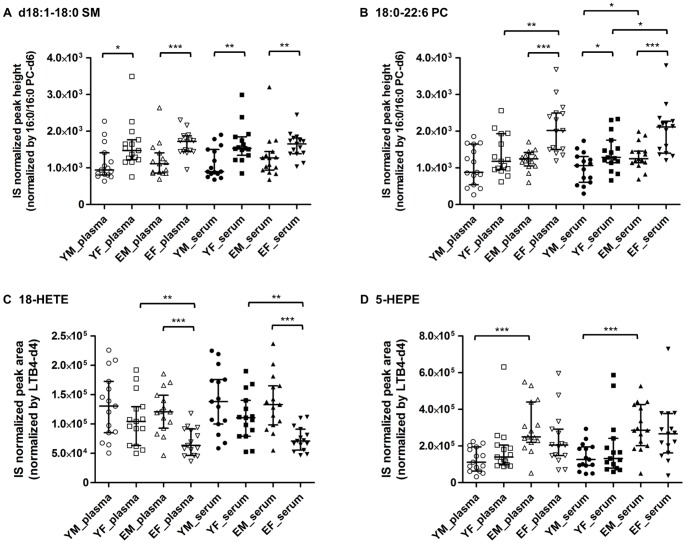
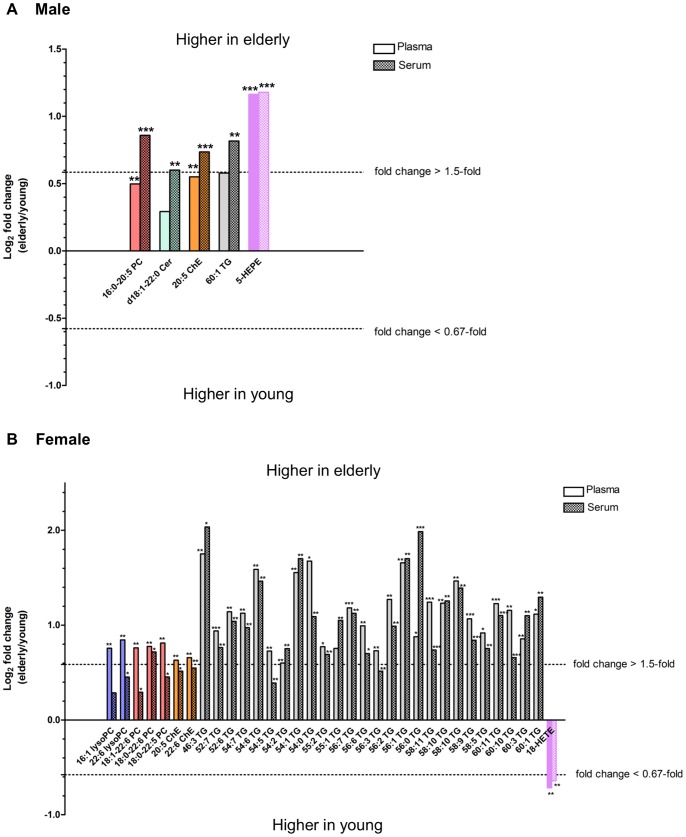
Blood is a commonly used biofluid for biomarker discovery. Although blood lipid metabolites are considered to be potential biomarker candidates, their fundamental properties are not well characterized. We aimed to (1) investigate the matrix type (serum vs. plasma) that may be preferable for lipid biomarker exploration, (2) elucidate age- and gender-associated differences in lipid metabolite levels, and (3) examine the stability of lipid metabolites in matrix samples subjected to repeated freeze-thaw cycles. Using liquid chromatography-mass spectrometry, we performed lipidomic analyses for fasting plasma and serum samples for four groups (15 subjects/group) of young and elderly (25-34 and 55-64 years old, respectively) males and females and for an additional aliquot of samples from young males, which were subjected to repeated freeze-thaw cycles. Lysophosphatidylcholine and diacylglycerol levels were higher in serum than in plasma samples, suggesting that the clotting process influences serum lipid metabolite levels. Gender-associated differences highlighted that the levels of many sphingomyelin species were significantly higher in females than in males, irrespective of age and matrix (plasma and serum). Age-associated differences were more prominent in females than in males, and in both matrices, levels of many triacylglycerols were significantly higher in elderly females than in young females. Plasma and serum levels of most lipid metabolites were reduced by freeze-thawing. Our results indicate that plasma is an optimal matrix for exploring lipid biomarkers because it represents the original properties of an individual's blood sample. In addition, the levels of some blood lipid species of healthy adults showed gender- and age-associated differences; thus, this should be considered during biomarker exploration and its application in diagnostics. Our fundamental findings on sample selection and handling procedures for measuring blood lipid metabolites is important for ensuring the quality of biomarkers identified and its qualification process.
血液是用于生物标志物发现的常用生物流体。尽管血脂代谢物被认为是潜在的生物标志物候选物,但其基本特性尚未得到充分表征。我们旨在:(1)研究哪种基质类型(血清与血浆)可能更适合脂质生物标志物的探索;(2)阐明脂质代谢物水平与年龄和性别的相关差异;(3)检查经过反复冻融循环的基质样品中脂质代谢物的稳定性。我们使用液相色谱 - 质谱法,对四组(每组15名受试者)年轻和老年(分别为25 - 34岁和55 - 64岁)男性和女性的空腹血浆和血清样品,以及来自年轻男性的另一部分经过反复冻融循环的样品进行了脂质组学分析。溶血磷脂酰胆碱和二酰基甘油水平在血清中高于血浆样品,这表明凝血过程会影响血清脂质代谢物水平。与性别相关的差异突出显示,无论年龄和基质(血浆和血清)如何,许多鞘磷脂种类的水平在女性中均显著高于男性。与年龄相关的差异在女性中比在男性中更明显,并且在两种基质中,许多三酰甘油的水平在老年女性中显著高于年轻女性。大多数脂质代谢物的血浆和血清水平因冻融而降低。我们的结果表明,血浆是探索脂质生物标志物的最佳基质,因为它代表了个体血样的原始特性。此外,健康成年人的一些血脂种类水平存在与性别和年龄相关的差异;因此,在生物标志物探索及其诊断应用过程中应考虑这一点。我们关于测量血脂代谢物的样品选择和处理程序的基本发现对于确保所鉴定生物标志物的质量及其鉴定过程非常重要。