Jiang Quanbao, Feldman Marcus W, Li Shuzhuo
Institute for Population and Development Studies, School of Public Policy and Administration, Xi'an Jiaotong University, Xi'an, 710049 Shaanxi China.
Morrison Institute for Population and Resource Studies, Stanford University, Stanford, CA 94305 USA.
Popul Res Policy Rev. 2014;33(2):189-204. doi: 10.1007/s11113-013-9283-8. Epub 2013 Apr 30.
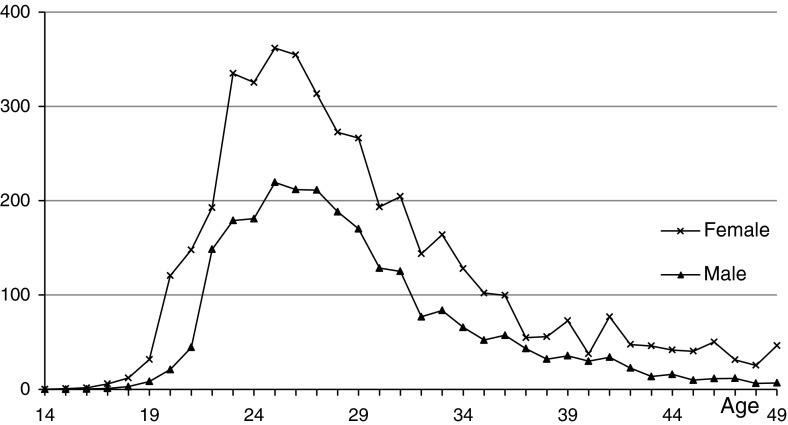
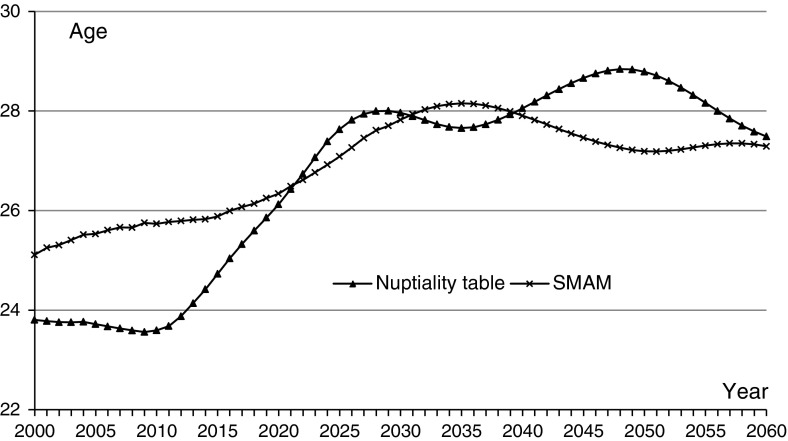
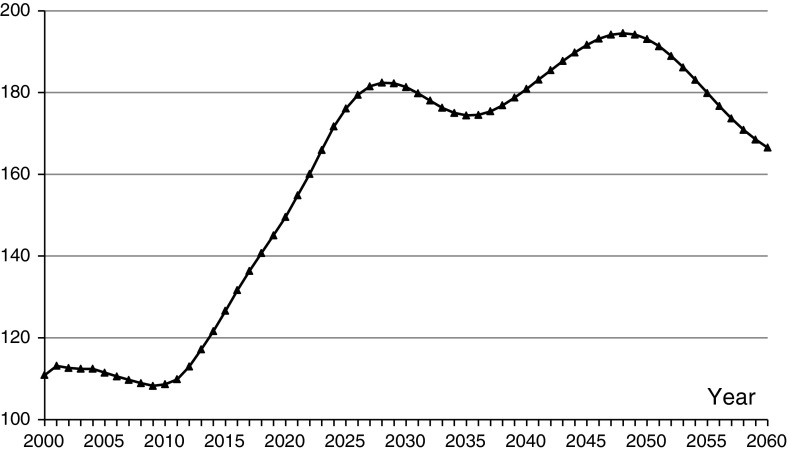
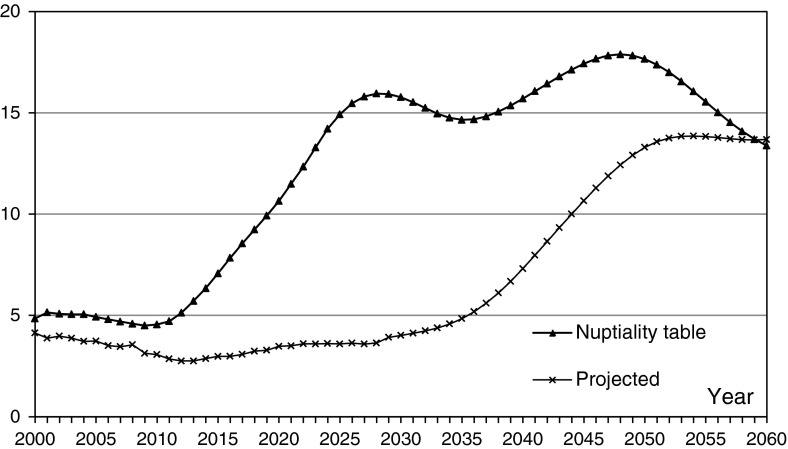
China's sex ratio imbalance and the surplus of males have received a great deal of attention, but measures of the extent of the marriage squeeze do not take into account the marital status of population. In this paper, we devise an index of the marriage squeeze for the never-married population and use it to project the male marriage squeeze from 2000 to 2060. From the predicted population and nuptiality tables, we estimate trends in the proportion of men that never marry by age 50 and the mean age at first marriage. We find that the marriage squeeze is much more intense if only the never-married population is considered, rather than including all people without distinguishing their marital status. As the lifelong never-married proportion increases, mean age at first marriage rises first and then declines.
中国的性别比例失衡以及男性过剩问题受到了广泛关注,但衡量婚姻挤压程度的指标并未考虑人口的婚姻状况。在本文中,我们设计了一个针对未婚人口的婚姻挤压指数,并使用该指数预测了2000年至2060年的男性婚姻挤压情况。根据预测的人口和婚姻状况表,我们估计了到50岁仍未婚男性的比例趋势以及初婚平均年龄。我们发现,如果仅考虑未婚人口,而非不区分婚姻状况地纳入所有人,婚姻挤压会更加严重。随着终身未婚比例的增加,初婚平均年龄先上升后下降。