Vayssier-Taussat Muriel, Albina Emmanuel, Citti Christine, Cosson Jean-Franҫois, Jacques Marie-Agnès, Lebrun Marc-Henri, Le Loir Yves, Ogliastro Mylène, Petit Marie-Agnès, Roumagnac Philippe, Candresse Thierry
INRA, UMR BIPAR (Enva/Anses) USC INRA Maisons-Alfort, France.
CIRAD, UMR CMAEE Petit-Bourg, Guadeloupe, France ; INRA, UMR 1309 CMAEE Montpellier, France ; INRA, Université de Toulouse, INP, ENVT, UMR 1225, IHAP Toulouse, France.
Front Cell Infect Microbiol. 2014 Mar 5;4:29. doi: 10.3389/fcimb.2014.00029. eCollection 2014.
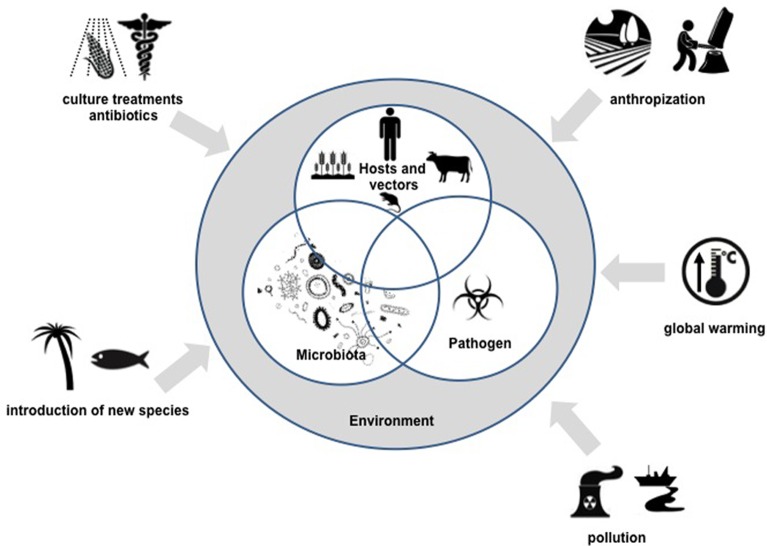
The concept of pathogenesis has evolved considerably over recent years, and the scenario "a microbe + virulence factors = disease" is probably far from reality in a number of cases. Actual pathogens have extremely broad biological diversity and are found in all major groups of microorganisms (viruses, bacteria, fungi, protozoa…). Their pathogenicity results from strong and often highly specific interactions they have with either their microbial environment, hosts and/or arthropod vectors. In this review, we explore the contribution of metagenomic approaches toward understanding pathogens within the context of microbial communities. With this broader view, we discussed the concept of "pathobiome" and the research questions that this raises.
近年来,发病机制的概念有了很大的发展,“一种微生物+毒力因子=疾病”的情况在许多案例中可能与现实相差甚远。实际的病原体具有极其广泛的生物多样性,存在于所有主要的微生物类群(病毒、细菌、真菌、原生动物……)中。它们的致病性源于它们与微生物环境、宿主和/或节肢动物载体之间强烈且通常高度特异的相互作用。在本综述中,我们探讨了宏基因组学方法在微生物群落背景下对理解病原体的贡献。从这个更广阔的视角出发,我们讨论了“病理生物群落”的概念以及由此引发的研究问题。