Chen Tao, Wang Yanhui, Bu Lingxue, Li Ningyi
Department of Oral and Maxillofacial Surgery, Affiliated Hospital of Qingdao University Medical College, Qingdao, Shandong 266003, P.R. China.
Exp Ther Med. 2014 Apr;7(4):958-962. doi: 10.3892/etm.2014.1514. Epub 2014 Jan 29.
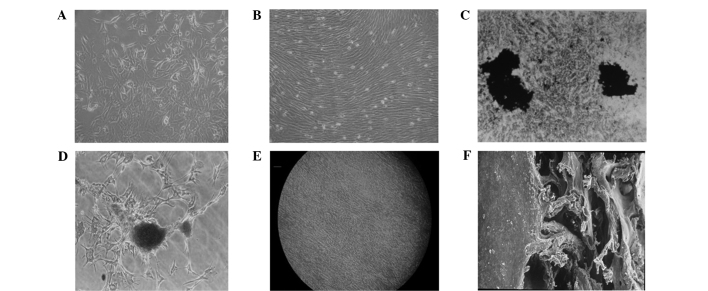
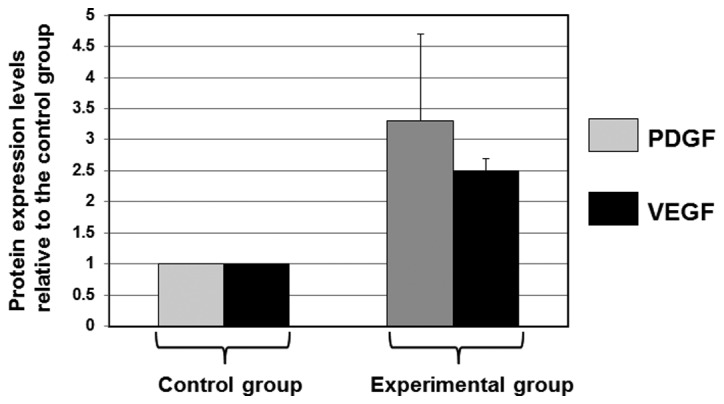
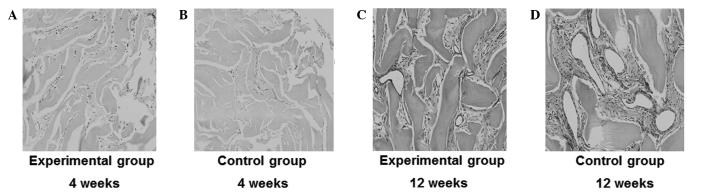
The aim of the present study was to construct functional tissue-engineered bone with cell sheet technology and compare the efficacy of this method with that of traditional bone tissue engineering techniques. Canine bone mesenchymal stem cells (BMSCs) were isolated using density gradient centrifugation and then cultured. The BMSCs were induced to differentiate into osteoblasts and cultured in temperature-responsive culture dishes. The BMSCs detached automatically from the temperature-responsive culture dishes when the temperature was reduced to 20°C, forming an intact cell sheet. Demineralized bone matrix (DBM) and platelet-rich plasma (PRP) were prepared and used to construct a DBM/PRP/BMSC cell sheet/BMSC complex, which was implanted under the left latissimus dorsi muscle in a dog model. A DBM/PRP/BMSC complex was used as a control and implanted under the right latissimus dorsi muscle in the dog model. Immunoblot assays were performed to detect the levels of growth factors. Osteogenesis was observed to be induced significantly more effectively in the DBM/PRP/BMSC cell sheet/BMSC implants than in the DBM/PRP/BMSC implants. Immunoblot assay results indicated that the levels of the growth factors platelet-derived growth factor (PDGF) and vascular endothelial growth factor (VEGF) in the experimental group were 3.2- and 2.5-fold higher compared with those in the control group, respectively. These results indicated that the BMSC cell sheets were functional and more effective than the control cell complex. Therefore, cell sheet technology may be used for the effective construction of functional tissue-engineered bone with ideal properties.
本研究的目的是利用细胞片技术构建功能性组织工程骨,并将该方法的效果与传统骨组织工程技术的效果进行比较。采用密度梯度离心法分离犬骨髓间充质干细胞(BMSCs),然后进行培养。将BMSCs诱导分化为成骨细胞,并在温度响应培养皿中培养。当温度降至20°C时,BMSCs自动从温度响应培养皿中脱离,形成完整的细胞片。制备脱矿骨基质(DBM)和富血小板血浆(PRP),并用于构建DBM/PRP/BMSC细胞片/BMSC复合物,将其植入犬模型的左背阔肌下。使用DBM/PRP/BMSC复合物作为对照,植入犬模型的右背阔肌下。进行免疫印迹分析以检测生长因子的水平。观察到在DBM/PRP/BMSC细胞片/BMSC植入物中诱导成骨的效果明显优于DBM/PRP/BMSC植入物。免疫印迹分析结果表明,实验组中血小板衍生生长因子(PDGF)和血管内皮生长因子(VEGF)的生长因子水平分别比对照组高3.2倍和2.5倍。这些结果表明,BMSC细胞片具有功能,且比对照细胞复合物更有效。因此,细胞片技术可用于有效构建具有理想特性的功能性组织工程骨。