Department of Psychology, Institute of Clinical Psychology and Psychotherapy, Technische Universität Dresden Dresden, Germany ; Department of Psychology, Neuroimaging Center, Technische Universität Dresden Dresden, Germany.
Department of Psychology, Neuroimaging Center, Technische Universität Dresden Dresden, Germany ; Section of Systems Neuroscience, Department of Psychiatry and Psychotherapy, Technische Universität Dresden Dresden, Germany.
Front Hum Neurosci. 2014 Mar 27;8:171. doi: 10.3389/fnhum.2014.00171. eCollection 2014.
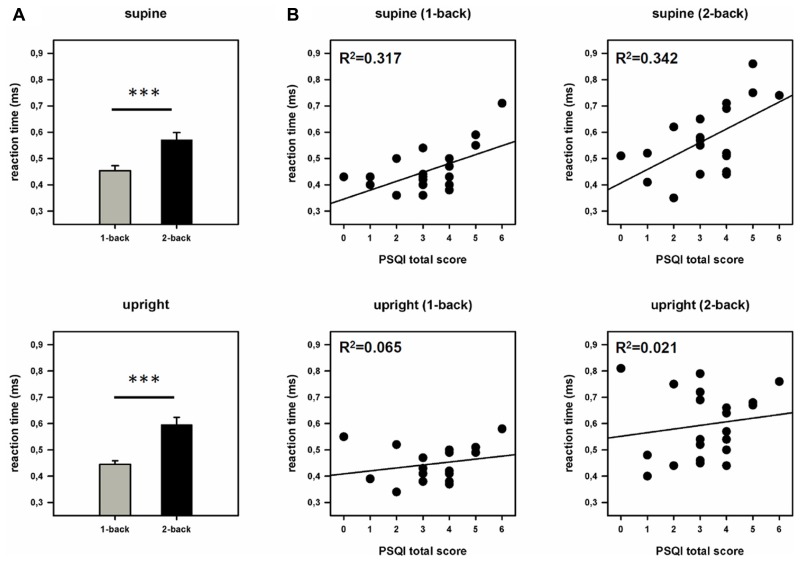
Nearly all functional magnetic resonance imaging (fMRI) studies are conducted in the supine body posture, which has been discussed as a potential confounder of such examinations. The literature suggests that cognitive functions, such as problem solving or perception, differ between supine and upright postures. However, the effect of posture on many cognitive functions is still unknown. Therefore, the aim of the present study was to investigate the effects of body posture (supine vs. sitting) on one of the most frequently used paradigms in the cognitive sciences: the N-back working memory paradigm. Twenty-two subjects were investigated in a randomized within-subject design. Subjects performed the N-back task on two consecutive days in either the supine or the upright posture. Subjective sleep quality and chronic stress were recorded as covariates. Furthermore, changes in mood dimensions and heart rate variability (HRV) were assessed during the experiment. Results indicate that the quality of sleep strongly affects reaction times when subjects performed a working memory task in a supine posture. These effects, however, could not be observed in the sitting position. The findings can be explained by HRV parameters that indicated differences in autonomic regulation in the upright vs. the supine posture. The finding is of particular relevance for fMRI group comparisons when group differences in sleep quality cannot be ruled out.
几乎所有的功能磁共振成像(fMRI)研究都是在仰卧位进行的,这一直被认为是此类检查的一个潜在混杂因素。文献表明,认知功能,如解决问题或感知,在仰卧和直立姿势之间存在差异。然而,姿势对许多认知功能的影响尚不清楚。因此,本研究的目的是调查体位(仰卧位与坐姿)对认知科学中最常用的范式之一的影响:N-back 工作记忆范式。22 名受试者在随机的自身对照设计中进行了研究。受试者在连续两天内分别以仰卧位或直立位完成 N-back 任务。记录了睡眠质量和慢性压力作为协变量。此外,在实验过程中还评估了情绪维度和心率变异性(HRV)的变化。结果表明,当受试者在仰卧位进行工作记忆任务时,睡眠质量强烈影响反应时间。然而,这些影响在坐姿时无法观察到。这些发现可以通过 HRV 参数来解释,这些参数表明在直立与仰卧姿势之间自主调节存在差异。当不能排除睡眠质量的组间差异时,这一发现对 fMRI 组间比较具有特别重要的意义。