Department of Geriatric Cardiology, Chinese PLA General Hospital, No.28, Fuxing Road, Beijing 100853, China ; School of Medicine, Nankai University, NO.94, Weijin Road, Tianjin 300071, China.
Department of Geriatric Cardiology, Chinese PLA General Hospital, No.28, Fuxing Road, Beijing 100853, China.
J Geriatr Cardiol. 2014 Mar;11(1):32-8. doi: 10.3969/j.issn.1671-5411.2014.01.007.
Arterial stiffness and homocysteine are both powerful predictors of cardiovascular disease, especially in older populations. Previous studies have investigated the association of homocysteine with arterial stiffness in human subjects, while the relationship between homocysteine and arterial stiffness in the elderly is still indefinite. The current study examined the association of homocysteine with arterial stiffness in Chinese community-based elderly persons.
We related serum levels of homocysteine to two measures of arterial stiffness (carotid-femoral pulse wave velocity (PWV) and carotid-radial PWV) in 780 participants (46.3% men, mean age 71.9 years (ranging 65-96 years old)) from two communities of Beijing, China. Arterial stiffness was measured within two days of the time of biomarker measurement.
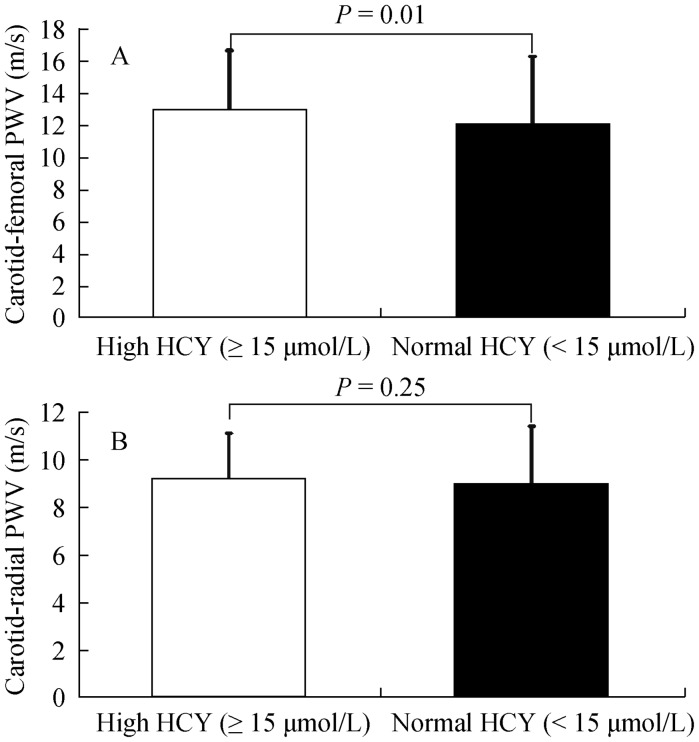
In multiple-adjusted models, homocysteine levels were strongly associated with the carotid-femoral PWV (standardized β = 0.13, P < 0.001), even after adjustment for classical risk factors of cardiovascular disease. The association is also stronger when the carotid-femoral PWV is elevated above normal, whereas no significant association with homocysteine was observed for carotid-radial PWV.
In Chinese elderly persons, serum homocysteine levels are associated with alterations of aortic stiffness.
动脉僵硬度和同型半胱氨酸都是心血管疾病的强有力预测因子,尤其是在老年人群中。先前的研究已经调查了同型半胱氨酸与人体动脉僵硬度之间的关系,而同型半胱氨酸与老年人动脉僵硬度之间的关系尚不确定。本研究旨在探讨中国社区老年人同型半胱氨酸与动脉僵硬度之间的关系。
我们将 780 名参与者(男性占 46.3%,平均年龄 71.9 岁(65-96 岁))的血清同型半胱氨酸水平与两种动脉僵硬度指标(颈股脉搏波速度(PWV)和颈桡 PWV)相关联。动脉僵硬度在生物标志物测量后的两天内进行测量。
在多因素调整模型中,同型半胱氨酸水平与颈股 PWV 呈强相关(标准化β=0.13,P<0.001),即使在调整了心血管疾病的经典危险因素后也是如此。当颈股 PWV 升高超过正常水平时,这种关联更强,而同型半胱氨酸与颈桡 PWV 之间无显著关联。
在中国老年人中,血清同型半胱氨酸水平与主动脉僵硬度的改变有关。