Kuo Hung-Chih, Lauderdale Tsai-Ling, Lo Dan-Yuan, Chen Chiou-Lin, Chen Pei-Chen, Liang Shiu-Yun, Kuo Jung-Che, Liao Ying-Shu, Liao Chun-Hsing, Tsao Chi-Sen, Chiou Chien-Shun
Department of Veterinary Medicine, National Chiayi University, Chiayi, Taiwan.
National Health Research Institutes, Miaoli, Taiwan.
PLoS One. 2014 Apr 23;9(4):e95772. doi: 10.1371/journal.pone.0095772. eCollection 2014.
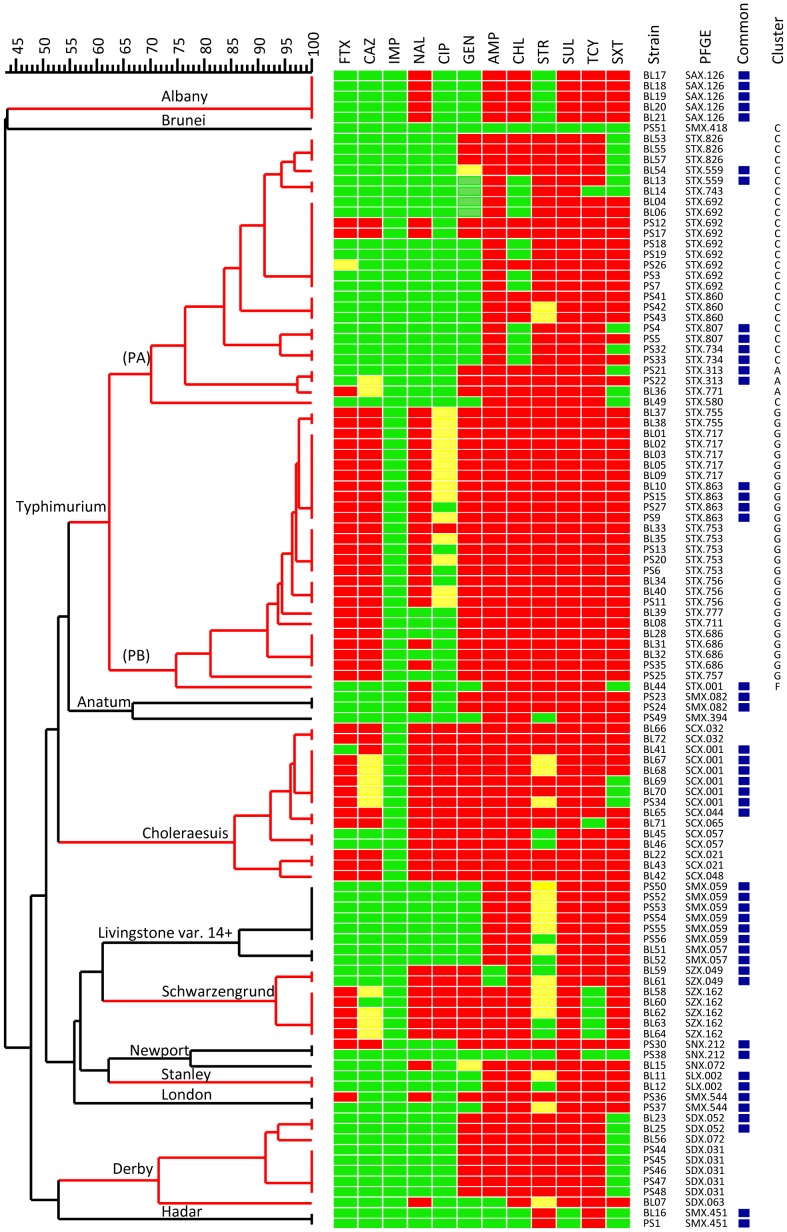
We collected 110 Salmonella enterica isolates from sick pigs and determined their serotypes, genotypes using pulsed-field gel electrophoresis (PFGE), and antimicrobial susceptibility to 12 antimicrobials and compared the data with a collection of 18,280 isolates obtained from humans. The pig isolates fell into 12 common serovars for human salmonellosis in Taiwan; S. Typhimurium, S. Choleraesuis, S. Derby, S. Livingstone, and S. Schwarzengrund were the 5 most common serovars and accounted for a total of 84% of the collection. Of the 110 isolates, 106 (96%) were multidrug resistant (MDR) and 48 (44%) had PFGE patterns found in human isolates. S. Typhimurium, S. Choleraesuis, and S. Schwarzengrund were among the most highly resistant serovars. The majority of the 3 serovars were resistant to 8-11 of the tested antimicrobials. The isolates from pigs and humans sharing a common PFGE pattern displayed identical or very similar resistance patterns and Salmonella strains that caused severe infection in pigs were also capable of causing infections in humans. The results indicate that pigs are one of the major reservoirs to human salmonellosis in Taiwan. Almost all of the pig isolates were MDR, which highlights the necessity of strictly regulating the use of antimicrobials in the agriculture sector in Taiwan.
我们从患病猪只中收集了110株肠炎沙门氏菌分离株,确定了它们的血清型、使用脉冲场凝胶电泳(PFGE)的基因型以及对12种抗菌药物的药敏情况,并将这些数据与从人类身上获得的18280株分离株的数据集进行了比较。猪源分离株属于台湾人类沙门氏菌病的12种常见血清型;鼠伤寒沙门氏菌、猪霍乱沙门氏菌、德比沙门氏菌、利文斯通沙门氏菌和施瓦岑格鲁德沙门氏菌是5种最常见的血清型,共占该收集样本的84%。在这110株分离株中,106株(96%)对多种药物耐药(MDR),48株(44%)具有在人类分离株中发现的PFGE图谱。鼠伤寒沙门氏菌、猪霍乱沙门氏菌和施瓦岑格鲁德沙门氏菌是耐药性最强的血清型之一。这3种血清型中的大多数对8 - 11种测试抗菌药物耐药。具有共同PFGE图谱的猪源和人源分离株显示出相同或非常相似的耐药模式,并且在猪身上引起严重感染的沙门氏菌菌株也能够在人类身上引起感染。结果表明,猪是台湾人类沙门氏菌病的主要宿主之一。几乎所有猪源分离株都是MDR,这凸显了在台湾农业部门严格规范抗菌药物使用的必要性。