Liabeuf Sophie, Bourron Olivier, Olivier Bourron, Vemeer Cees, Theuwissen Elke, Magdeleyns Elke, Aubert Carole Elodie, Brazier Michel, Mentaverri Romuald, Hartemann Agnes, Massy Ziad A
INSERM U1088, Jules Verne University of Picardy, F-80000 Amiens, France.
Cardiovasc Diabetol. 2014 Apr 24;13:85. doi: 10.1186/1475-2840-13-85.
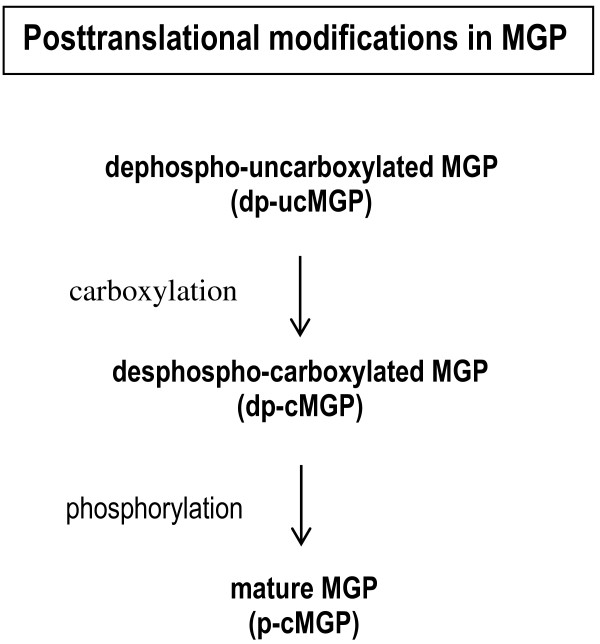
Matrix Gla protein (MGP) is an important inhibitor of calcification. The objective of the present study of patients with type 2 diabetes and normal or slightly altered kidney function was to evaluate levels of inactive, dephospho-uncarboxylated MGP(dp-ucMGP) and total uncarboxylated MGP(t-ucMGP) and assess their links with biological and clinical parameters (including peripheral vascular calcification).
The DIACART study is a cross-sectional cohort study of 198 patients with type 2 diabetes and normal or slightly altered kidney function. Matrix Gla protein levels were measured with an ELISA and all patients underwent multislice spiral computed tomography scans to score below-knee arterial calcification.
In the study population as a whole, the mean dp-ucMGP and t-ucMGP levels were 627 ± 451 pM and 4868 ± 1613 nM, respectively. Glomerular filtration rate, age and current vitamin K antagonist use were independently associated with dp-ucMGP levels. When the study population was divided according to the median peripheral arterial calcification score, patients with the higher score displayed significantly lower t-ucMGP and significantly higher dp-ucMGP levels. Furthermore, plasma dp-ucMGP was positively associated with the peripheral arterial calcification score (independently of age, gender, previous cardiovascular disease and t-ucMGP levels).
High dp-ucMGP levels were independently associated with below-knee arterial calcification score in patients with type 2 diabetes and normal or slightly altered kidney function. The reversibility of the elevation of dp-ucMGP levels and the latter's relationship with clinical events merit further investigation.
基质γ-羧基谷氨酸蛋白(MGP)是一种重要的钙化抑制剂。本研究针对肾功能正常或略有改变的2型糖尿病患者,旨在评估无活性的去磷酸化未羧化MGP(dp-ucMGP)和总未羧化MGP(t-ucMGP)的水平,并评估它们与生物学和临床参数(包括外周血管钙化)之间的联系。
DIACART研究是一项针对198例肾功能正常或略有改变的2型糖尿病患者的横断面队列研究。采用酶联免疫吸附测定法测量基质γ-羧基谷氨酸蛋白水平,所有患者均接受多层螺旋计算机断层扫描以对膝下动脉钙化进行评分。
在整个研究人群中,dp-ucMGP和t-ucMGP的平均水平分别为627±451 pM和4868±1613 nM。肾小球滤过率、年龄和当前维生素K拮抗剂的使用与dp-ucMGP水平独立相关。当根据外周动脉钙化评分中位数对研究人群进行划分时,评分较高的患者显示出明显较低的t-ucMGP水平和明显较高的dp-ucMGP水平。此外,血浆dp-ucMGP与外周动脉钙化评分呈正相关(独立于年龄、性别、既往心血管疾病和t-ucMGP水平)。
在肾功能正常或略有改变的2型糖尿病患者中,高dp-ucMGP水平与膝下动脉钙化评分独立相关。dp-ucMGP水平升高的可逆性及其与临床事件的关系值得进一步研究。