Centre for Systems Neuroscience, University of Leicester, 9 Salisbury Road, LE1 7QR, United Kingdom.
Centre for Bio-Inspired Technology, Department of Electrical and Electronic Engineering, Imperial College London, SW7 2AZ, United Kingdom.
J Neurosci Methods. 2014 Jun 15;230:51-64. doi: 10.1016/j.jneumeth.2014.04.018. Epub 2014 Apr 24.
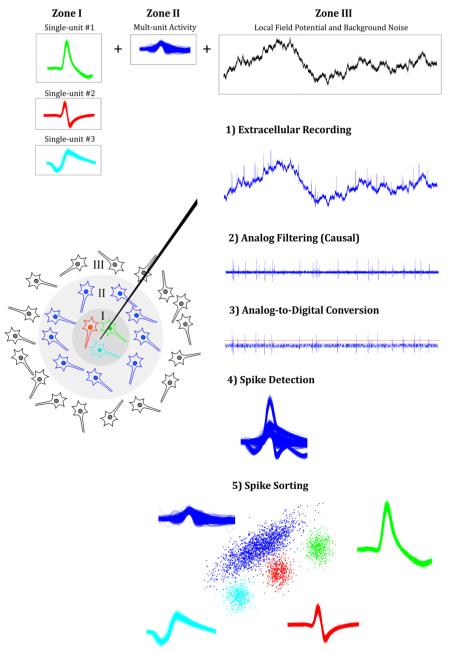
Extracellular recordings are performed by inserting electrodes in the brain, relaying the signals to external power-demanding devices, where spikes are detected and sorted in order to identify the firing activity of different putative neurons. A main caveat of these recordings is the necessity of wires passing through the scalp and skin in order to connect intracortical electrodes to external amplifiers. The aim of this paper is to evaluate the feasibility of an implantable platform (i.e., a chip) with the capability to wirelessly transmit the neural signals and perform real-time on-site spike sorting.
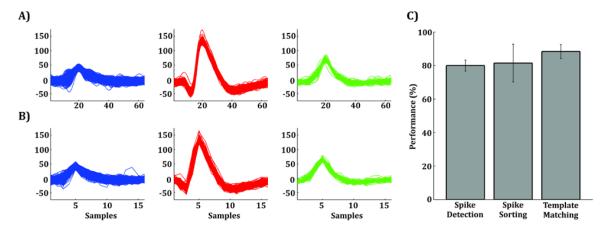
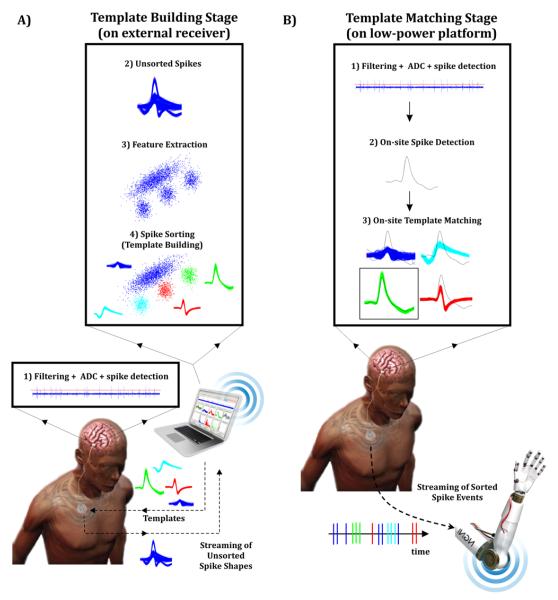
We computationally modelled a two-stage implementation for online, robust, and efficient spike sorting. In the first stage, spikes are detected on-chip and streamed to an external computer where mean templates are created and sent back to the chip. In the second stage, spikes are sorted in real-time through template matching.
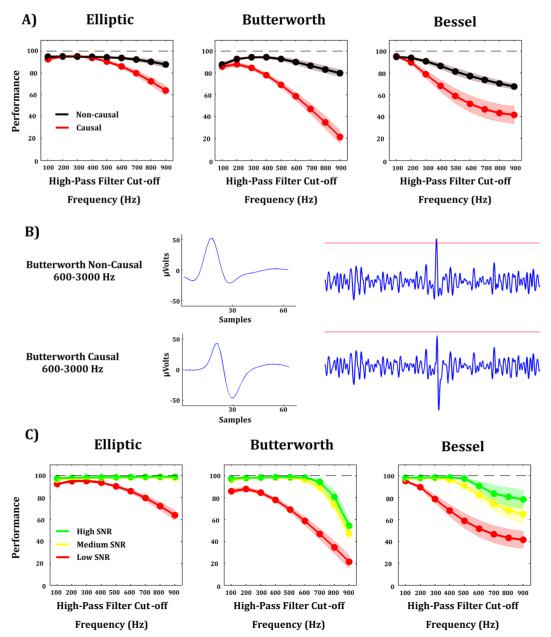
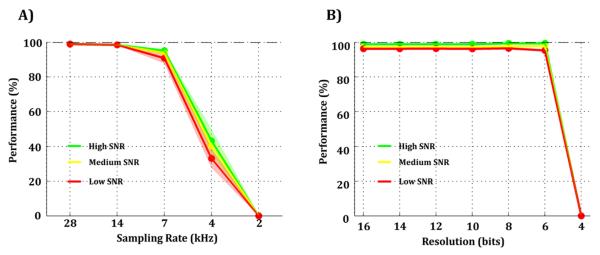
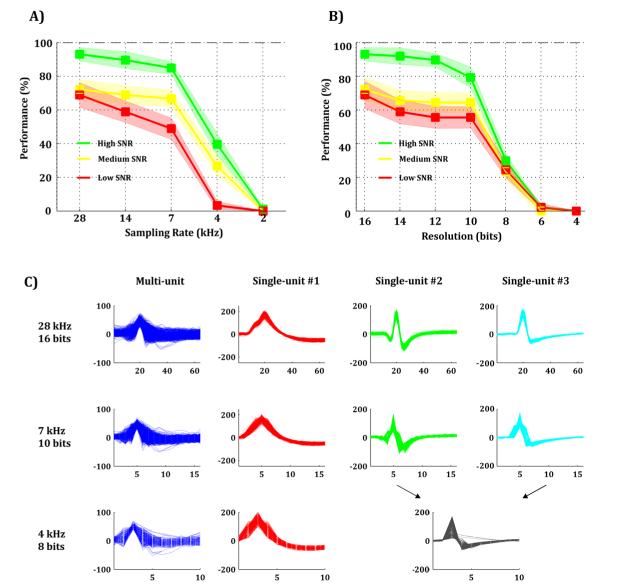
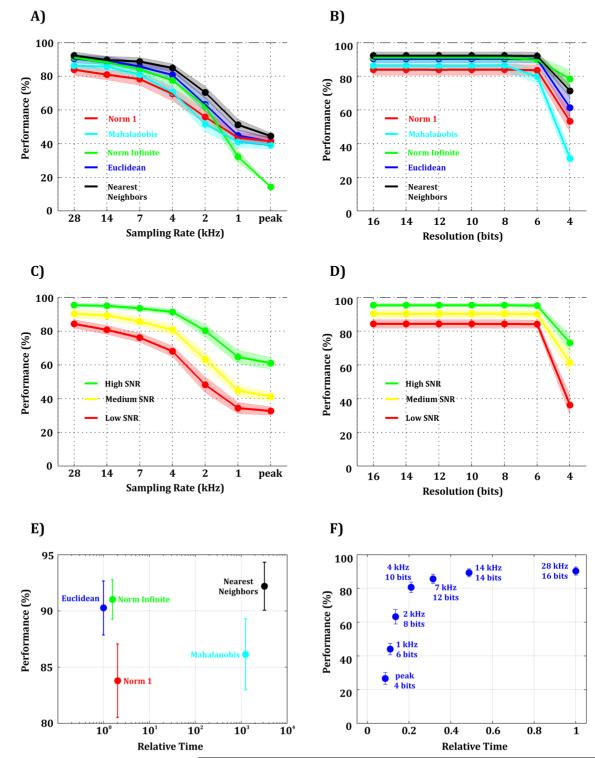
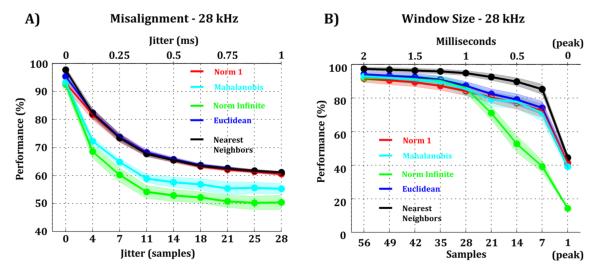
We evaluated this procedure using realistic simulations of extracellular recordings and describe a set of specifications that optimise performance while keeping to a minimum the signal requirements and the complexity of the calculations.
A key bottleneck for the development of long-term BMIs is to find an inexpensive method for real-time spike sorting. Here, we simulated a solution to this problem that uses both offline and online processing of the data.
Hardware implementations of this method therefore enable low-power long-term wireless transmission of multiple site extracellular recordings, with application to wireless BMIs or closed-loop stimulation designs.
通过将电极插入大脑来进行细胞外记录,将信号传输到外部耗电设备,在该设备中检测和分类尖峰,以识别不同假定神经元的放电活动。这些记录的一个主要问题是需要通过头皮和皮肤将内部皮质电极连接到外部放大器的电线。本文的目的是评估一种具有无线传输神经信号和实时现场尖峰分类能力的植入式平台(即芯片)的可行性。
我们对在线、稳健和高效的尖峰分类的两阶段实现进行了计算建模。在第一阶段,在芯片上检测尖峰,并将其流式传输到外部计算机,在外部计算机上创建均值模板并将其发送回芯片。在第二阶段,通过模板匹配实时对尖峰进行分类。
我们使用细胞外记录的现实模拟评估了此过程,并描述了一组规格,这些规格在最小化信号要求和计算复杂性的同时优化了性能。
长期 BMI 发展的一个关键瓶颈是找到实时尖峰分类的廉价方法。在这里,我们模拟了解决此问题的一种解决方案,该解决方案同时使用离线和在线处理数据。
该方法的硬件实现因此能够实现多个部位细胞外记录的低功耗长期无线传输,适用于无线 BMI 或闭环刺激设计。