Department of Biotechnology, Natural and Computational Sciences Faculty, University of Gondar, Gondar, Ethiopia.
Department of Parasitology, School of Biomedical and Laboratory Sciences, College of Medicine and Health Sciences, University of Gondar, P.O. Box 196, Gondar, Ethiopia.
Evid Based Complement Alternat Med. 2014;2014:562804. doi: 10.1155/2014/562804. Epub 2014 Mar 17.
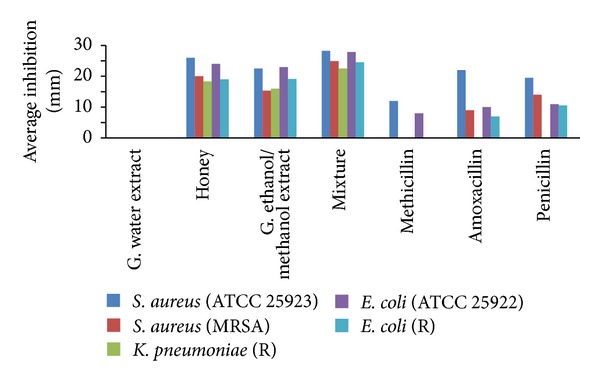
Purpose. To evaluate antimicrobial effects of mixtures of Ethiopian honeys and ginger rhizome powder extracts on Staphylococcus aureus (ATCC 25923), Escherichia coli (ATCC 25922), Staphylococcus aureus (MRSA), Escherichia coli (R), and Klebsiella pneumoniae (R). Methods. Agar diffusion and broth assays were performed to determine susceptibility of these standard and resistant clinical bacteria isolates using honey-ginger powder extract mixtures. Results. Honey-ginger powder extract mixtures produced the highest mean inhibition (25.62 mm ± 2.55) compared to the use of honeys (21.63 mm ± 3.30) or ginger extracts (19.23 mm ± 3.42) individually. The ranges of inhibitions produced by honey-ginger extract mixtures on susceptible test organisms (26-30 mm) and resistant strains (range: 19-27 mm) were higher compared to 7-22 mm and 0-14 mm by standard antibiotic discs. Minimum inhibitory concentrations (MIC) of mixture of honeys-ginger extracts were 6.25% (0.625 v/mL) on the susceptible bacteria compared to 75% for resistant clinical isolates. Minimum bactericidal concentration (MBC) of honey-ginger extracts was 12.5% (0.125 g/mL) for all the test organisms. Conclusion. The result of this study showed that honey-ginger powder extract mixtures have the potential to serve as cheap source of antibacterial agents especially for the drug resistant bacteria strains.
目的。评估埃塞俄比亚蜂蜜和姜根茎粉提取物混合物对金黄色葡萄球菌(ATCC 25923)、大肠杆菌(ATCC 25922)、耐甲氧西林金黄色葡萄球菌(MRSA)、大肠杆菌(R)和肺炎克雷伯菌(R)的抗菌效果。方法。采用琼脂扩散和肉汤法,使用蜂蜜-姜粉提取物混合物,测定这些标准和耐药临床分离菌的敏感性。结果。与单独使用蜂蜜(21.63±3.30mm)或姜提取物(19.23±3.42mm)相比,蜂蜜-姜粉提取物混合物产生的平均抑制作用最高(25.62±2.55mm)。蜂蜜-姜提取物混合物对敏感测试菌(26-30mm)和耐药株(范围:19-27mm)产生的抑制范围高于标准抗生素纸片的 7-22mm 和 0-14mm。蜂蜜-姜提取物混合物对敏感菌的最小抑菌浓度(MIC)为 6.25%(0.625v/mL),而耐药临床分离株的 MIC 为 75%。蜂蜜-姜提取物的最小杀菌浓度(MBC)对所有测试菌均为 12.5%(0.125g/mL)。结论。本研究结果表明,蜂蜜-姜粉提取物混合物具有作为廉价抗菌剂的潜力,特别是针对耐药菌株。