Zhang Zhen, Li Jing, Yang Lei, Chen Rongping, Yang Rui, Zhang Hua, Cai Dehong, Chen Hong
Department of Endocrinology, Zhujiang Hospital, Southern Medical University, Guangzhou 510282, China.
Department of Endocrinology, Nanshan Affiliated Hospital of Guangdong Medical College, Shenzhen 518052, China.
J Diabetes Res. 2014;2014:712781. doi: 10.1155/2014/712781. Epub 2014 Mar 17.
Glucose fluctuations are both strong predictor of diabetic complications and crucial factor for beta cell damages. Here we investigated the effect of intermittent high glucose (IHG) on both cell apoptosis and proliferation activity in INS-1 cells and the potential mechanisms.
Cells were treated with normal glucose (5.5 mmol/L), constant high glucose (CHG) (25 mmol/L), and IHG (rotation per 24 h in 11.1 or 25 mmol/L) for 7 days. Reactive oxygen species (ROS), xanthine oxidase (XOD) level, apoptosis, cell viability, cell cycle, and expression of cyclinD1, p21, p27, and Skp2 were determined.
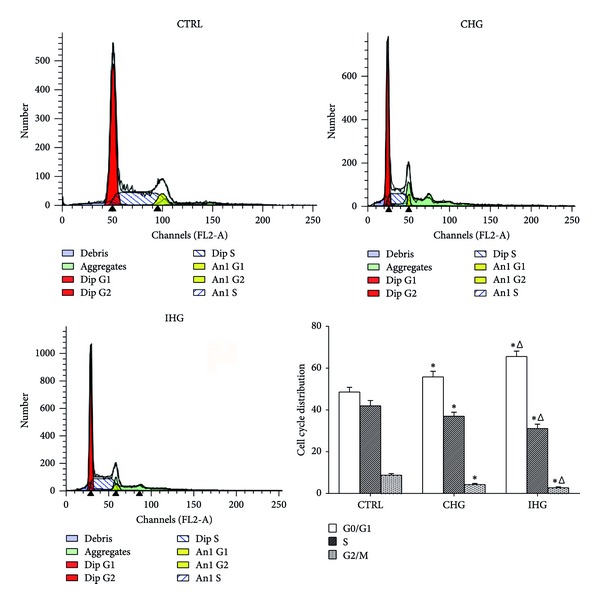
We found that IHG induced more significant apoptosis than CHG and normal glucose; intracellular ROS and XOD levels were more markedly increased in cells exposed to IHG. Cells treated with IHG showed significant decreased cell viability and increased cell proportion in G0/G1 phase. Cell cycle related proteins such as cyclinD1 and Skp2 were decreased significantly, but expressions of p27 and p21 were increased markedly.
This study suggested that IHG plays a more toxic effect including both apoptosis-inducing and antiproliferative effects on INS-1 cells. Excessive activation of cellular stress and regulation of cyclins might be potential mechanism of impairment in INS-1 cells induced by IHG.
血糖波动既是糖尿病并发症的强预测指标,也是β细胞损伤的关键因素。在此,我们研究了间歇性高糖(IHG)对INS-1细胞凋亡和增殖活性的影响及其潜在机制。
将细胞分别用正常葡萄糖(5.5 mmol/L)、持续性高糖(CHG)(25 mmol/L)和IHG(每24小时在11.1或25 mmol/L之间轮换)处理7天。检测活性氧(ROS)、黄嘌呤氧化酶(XOD)水平、细胞凋亡、细胞活力、细胞周期以及细胞周期蛋白D1、p21、p27和Skp2的表达。
我们发现,与CHG和正常葡萄糖相比,IHG诱导的细胞凋亡更为显著;暴露于IHG的细胞内ROS和XOD水平显著升高。用IHG处理的细胞显示细胞活力显著降低,G0/G1期细胞比例增加。细胞周期相关蛋白如细胞周期蛋白D1和Skp2显著降低,但p27和p21的表达显著增加。
本研究表明,IHG对INS-1细胞具有更强的毒性作用,包括诱导凋亡和抑制增殖。细胞应激的过度激活和细胞周期蛋白的调节可能是IHG诱导INS-1细胞损伤的潜在机制。