Park Jong Hwa, Lee Jae-Kwan, Um Heung-Sik, Chang Beom-Seok, Lee Si-Young
Department of Periodontology, Research Institute of Oral Sciences, Gangneung-Wonju National University College of Dentistry, Gangneung, Korea.
Department of Microbiology and Immunology, Research Institute of Oral Sciences, Gangneung-Wonju National University College of Dentistry, Gangneung, Korea.
J Periodontal Implant Sci. 2014 Apr;44(2):79-84. doi: 10.5051/jpis.2014.44.2.79. Epub 2014 Apr 24.
While single-species biofilms have been studied extensively, we know notably little regarding multispecies biofilms and their interactions. The purpose of this study was to develop and evaluate an in vitro multispecies dental biofilm model that aimed to mimic the environment of chronic periodontitis.
Streptococcus gordonii KN1, Fusobacterium nucleatum ATCC23726, Aggregatibacter actinomycetemcomitans ATCC33384, and Porphyromonas gingivalis ATCC33277 were used for this experiment. The biofilms were grown on 12-well plates with a round glass slip (12 mm in diameter) with a supply of fresh medium. Four different single-species biofilms and multispecies biofilms with the four bacterial strains listed above were prepared. The biofilms were examined with a confocal laser scanning microscope (CLSM) and scanning electron microscopy (SEM). The minimum inhibitory concentrations (MIC) for four different planktonic single-species and multispecies bacteria were determined. The MICs of doxycycline and chlorhexidine for four different single-species biofilms and a multispecies biofilm were also determined.
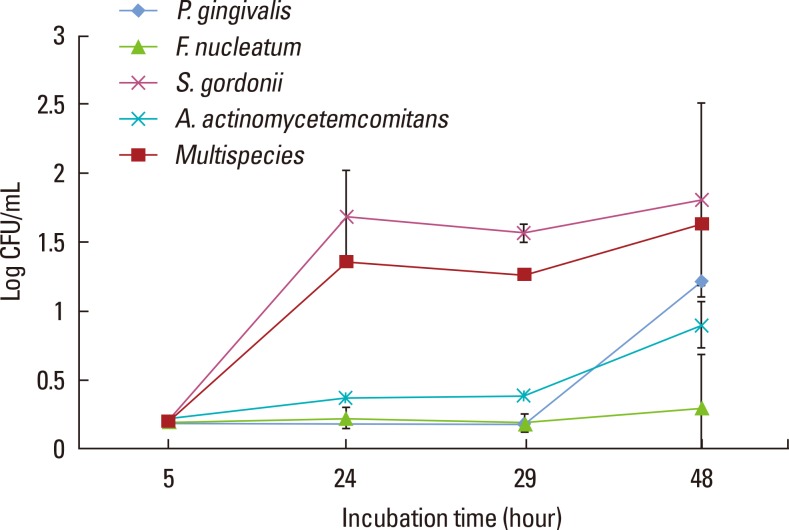
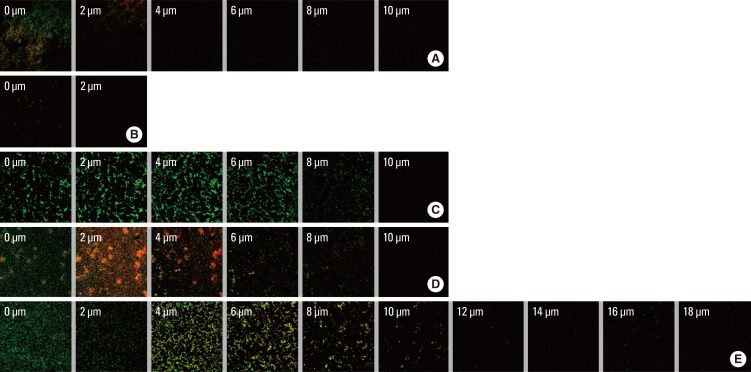
The CLSM and SEM examination revealed that the growth pattern of the multispecies biofilm was similar to those of single-species biofilms. However, the multispecies biofilm became thicker than the single-species biofilms, and networks between bacteria were formed. The MICs of doxycycline and chlorhexidine were higher in the biofilm state than in the planktonic bacteria. The MIC of doxycycline for the multispecies biofilm was higher than were those for the single-species biofilms of P. gingivalis, F. nucleatum, or A. actinomycetemcomitans. The MIC of chlorhexidine for the multispecies biofilm was higher than were those for the single-species biofilms of P. gingivalis or F. nucleatum.
To mimic the natural dental biofilm, a multispecies biofilm composed of four bacterial species was grown. The 24-hour multispecies biofilm may be useful as a laboratory dental biofilm model system.
虽然单物种生物膜已得到广泛研究,但我们对多物种生物膜及其相互作用的了解却非常有限。本研究的目的是开发和评估一种体外多物种牙齿生物膜模型,该模型旨在模拟慢性牙周炎的环境。
本实验使用了戈登链球菌KN1、具核梭杆菌ATCC23726、伴放线聚集杆菌ATCC33384和牙龈卟啉单胞菌ATCC33277。生物膜在带有圆形玻璃片(直径12毫米)的12孔板上生长,并供应新鲜培养基。制备了四种不同的单物种生物膜以及含有上述四种细菌菌株的多物种生物膜。使用共聚焦激光扫描显微镜(CLSM)和扫描电子显微镜(SEM)对生物膜进行检查。测定了四种不同浮游单物种和多物种细菌的最低抑菌浓度(MIC)。还测定了强力霉素和洗必泰对四种不同单物种生物膜和一种多物种生物膜的MIC。
CLSM和SEM检查显示,多物种生物膜的生长模式与单物种生物膜相似。然而,多物种生物膜比单物种生物膜更厚,并且细菌之间形成了网络。生物膜状态下强力霉素和洗必泰的MIC高于浮游细菌。多物种生物膜的强力霉素MIC高于牙龈卟啉单胞菌、具核梭杆菌或伴放线聚集杆菌单物种生物膜的MIC。多物种生物膜的洗必泰MIC高于牙龈卟啉单胞菌或具核梭杆菌单物种生物膜的MIC。
为了模拟天然牙齿生物膜,培养了一种由四种细菌组成的多物种生物膜。24小时的多物种生物膜可能作为一种实验室牙齿生物膜模型系统有用。