Stone Amy E L, Mitchell Angela, Brownell Jessica, Miklin Daniel J, Golden-Mason Lucy, Polyak Stephen J, Gale Michael J, Rosen Hugo R
Integrated Department in Immunology, University of Colorado Denver and National Jewish Health, Denver, Colorado, United States of America; Division of Gastroenterology & Hepatology, Hepatitis C Center, Department of Medicine, University of Colorado Denver, Aurora, Colorado, United States of America.
Department of Global Health, University of Washington, Seattle, Washington, United States of America.
PLoS One. 2014 May 1;9(5):e95627. doi: 10.1371/journal.pone.0095627. eCollection 2014.
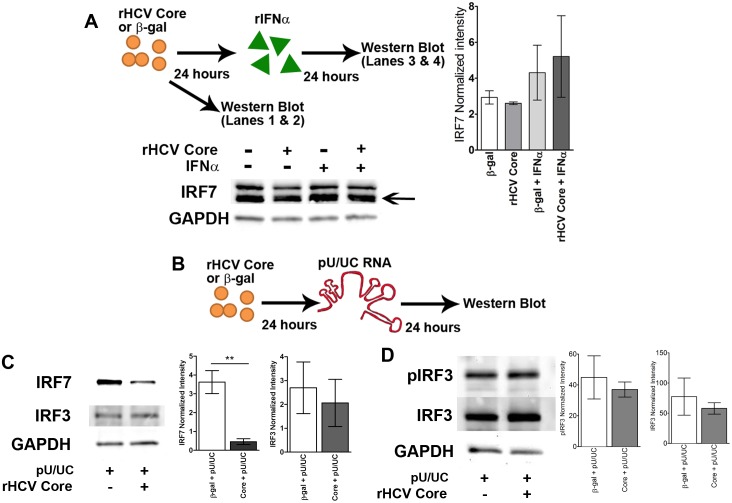
Plasmacytoid Dendritic Cells (pDCs) represent a key immune cell population in the defense against viruses. pDCs detect viral pathogen associated molecular patterns (PAMPs) through pattern recognition receptors (PRR). PRR/PAMP interactions trigger signaling events that induce interferon (IFN) production to initiate local and systemic responses. pDCs produce Type I and Type III (IFNL) IFNs in response to HCV RNA. Extracellular HCV core protein (Core) is found in the circulation in chronic infection. This study defined how Core modulates PRR signaling in pDCs. Type I and III IFN expression and production following exposure to recombinant Core or β-galactosiade was assessed in human GEN2.2 cells, a pDC cell line. Core suppressed type I and III IFN production in response to TLR agonists and the HCV PAMP agonist of RIG-I. Core suppression of IFN induction was linked with decreased IRF-7 protein levels and increased non-phosphorylated STAT1 protein. Circulating Core protein interferes with PRR signaling by pDCs to suppress IFN production. Strategies to define and target Core effects on pDCs may serve to enhance IFN production and antiviral actions against HCV.
浆细胞样树突状细胞(pDCs)是抵御病毒的关键免疫细胞群体。pDCs通过模式识别受体(PRR)检测病毒病原体相关分子模式(PAMPs)。PRR/PAMP相互作用触发信号事件,诱导干扰素(IFN)产生,从而启动局部和全身反应。pDCs在对丙型肝炎病毒(HCV)RNA作出反应时会产生I型和III型(IFNL)干扰素。在慢性感染中,细胞外HCV核心蛋白(Core)存在于循环中。本研究确定了Core如何调节pDCs中的PRR信号传导。在人pDC细胞系GEN2.2细胞中评估了暴露于重组Core或β-半乳糖苷酶后I型和III型IFN的表达和产生。Core抑制了对TLR激动剂和RIG-I的HCV PAMP激动剂作出反应时I型和III型IFN的产生。Core对IFN诱导的抑制与IRF-7蛋白水平降低和非磷酸化STAT1蛋白增加有关。循环中的Core蛋白通过pDCs干扰PRR信号传导,以抑制IFN产生。确定并靶向Core对pDCs作用的策略可能有助于增强IFN产生及针对HCV的抗病毒作用。