Straube Ronny
Analysis and Redesign of Biological Networks Group, Max Planck Institute for Dynamics of Complex Technical Systems, Magdeburg, Germany.
PLoS Comput Biol. 2014 May 8;10(5):e1003614. doi: 10.1371/journal.pcbi.1003614. eCollection 2014 May.
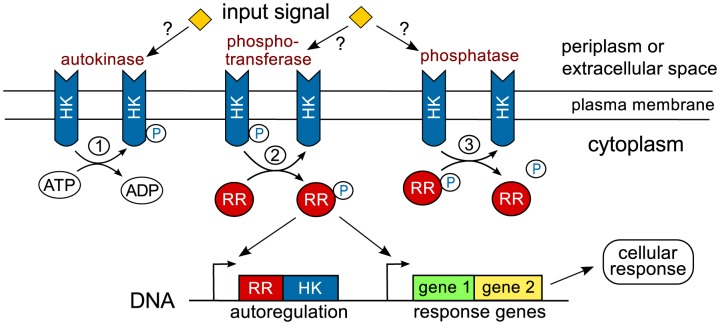
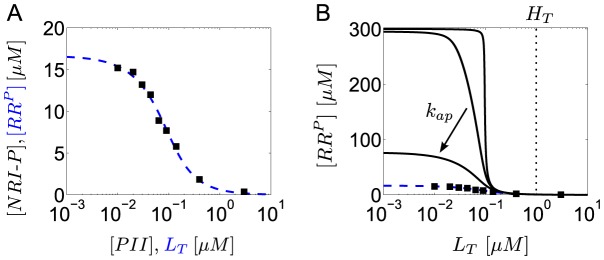
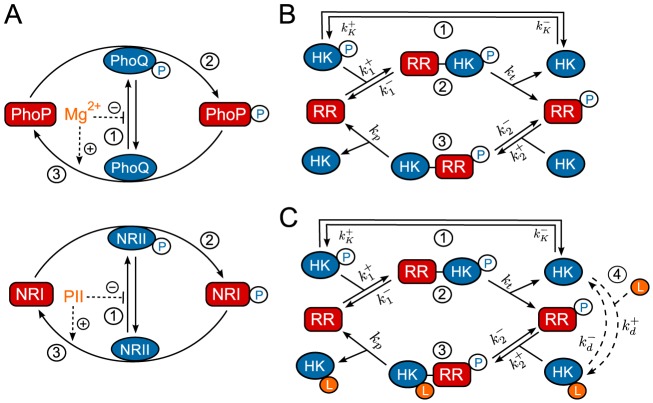
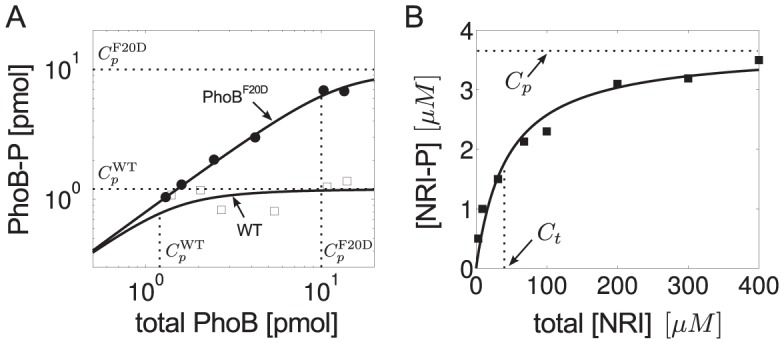
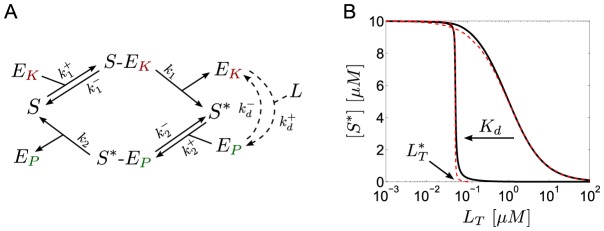
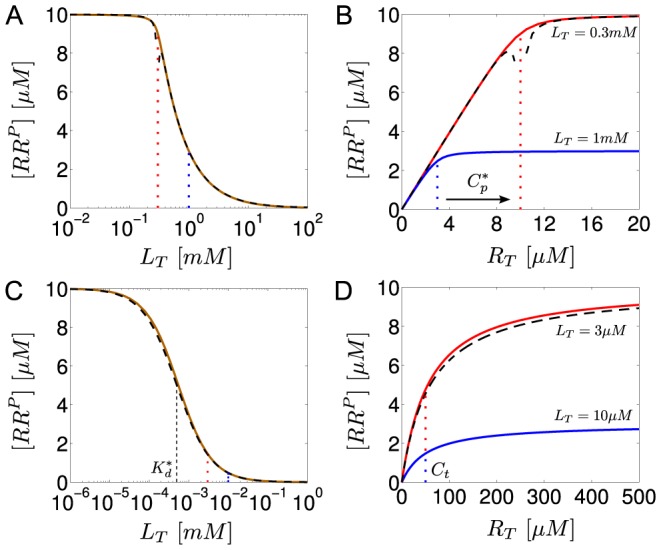
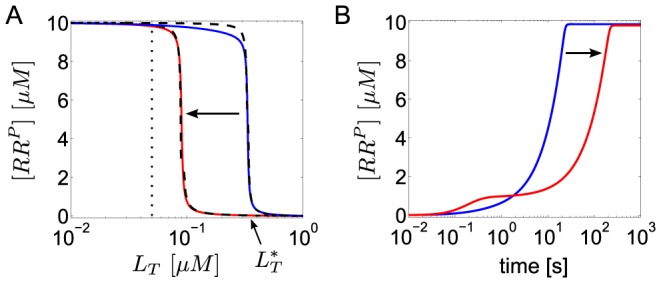
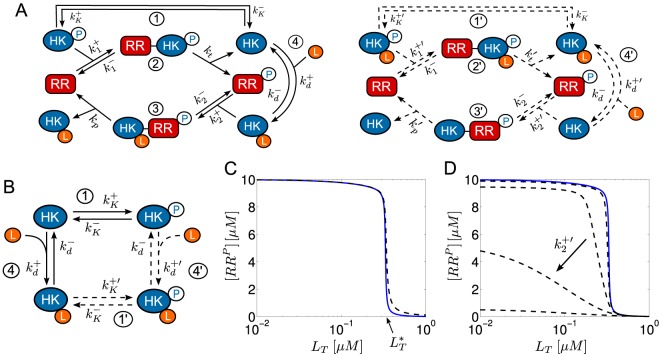
Two-component signal transduction systems, where the phosphorylation state of a regulator protein is modulated by a sensor kinase, are common in bacteria and other microbes. In many of these systems, the sensor kinase is bifunctional catalyzing both, the phosphorylation and the dephosphorylation of the regulator protein in response to input signals. Previous studies have shown that systems with a bifunctional enzyme can adjust the phosphorylation level of the regulator protein independently of the total protein concentrations--a property known as concentration robustness. Here, I argue that two-component systems with a bifunctional enzyme may also exhibit ultrasensitivity if the input signal reciprocally affects multiple activities of the sensor kinase. To this end, I consider the case where an allosteric effector inhibits autophosphorylation and, concomitantly, activates the enzyme's phosphatase activity, as observed experimentally in the PhoQ/PhoP and NRII/NRI systems. A theoretical analysis reveals two operating regimes under steady state conditions depending on the effector affinity: If the affinity is low the system produces a graded response with respect to input signals and exhibits stimulus-dependent concentration robustness--consistent with previous experiments. In contrast, a high-affinity effector may generate ultrasensitivity by a similar mechanism as phosphorylation-dephosphorylation cycles with distinct converter enzymes. The occurrence of ultrasensitivity requires saturation of the sensor kinase's phosphatase activity, but is restricted to low effector concentrations, which suggests that this mode of operation might be employed for the detection and amplification of low abundant input signals. Interestingly, the same mechanism also applies to covalent modification cycles with a bifunctional converter enzyme, which suggests that reciprocal regulation, as a mechanism to generate ultrasensitivity, is not restricted to two-component systems, but may apply more generally to bifunctional enzyme systems.
双组分信号转导系统中,调节蛋白的磷酸化状态由传感激酶调控,这在细菌和其他微生物中很常见。在许多此类系统中,传感激酶具有双功能,可响应输入信号催化调节蛋白的磷酸化和去磷酸化。先前的研究表明,具有双功能酶的系统能够独立于总蛋白浓度调节调节蛋白的磷酸化水平——这一特性被称为浓度稳健性。在此,我认为如果输入信号相互影响传感激酶的多种活性,具有双功能酶的双组分系统也可能表现出超敏感性。为此,我考虑了变构效应物抑制自身磷酸化并同时激活酶的磷酸酶活性的情况,正如在PhoQ/PhoP和NRII/NRI系统中实验观察到的那样。理论分析揭示了在稳态条件下取决于效应物亲和力的两种运行模式:如果亲和力低,系统会对输入信号产生分级响应,并表现出刺激依赖性浓度稳健性——这与先前的实验一致。相反,高亲和力效应物可能通过与具有不同转换酶的磷酸化 - 去磷酸化循环类似的机制产生超敏感性。超敏感性的出现需要传感激酶的磷酸酶活性达到饱和,但仅限于低效应物浓度,这表明这种运行模式可能用于检测和放大低丰度输入信号。有趣的是,相同的机制也适用于具有双功能转换酶的共价修饰循环,这表明作为产生超敏感性机制的相互调节并不局限于双组分系统,而是可能更广泛地适用于双功能酶系统。