Betsem Edouard, Cassar Olivier, Afonso Philippe V, Fontanet Arnaud, Froment Alain, Gessain Antoine
Institut Pasteur, Unité d'Epidémiologie et Physiopathologie des Virus Oncogènes, Département de Virologie, Paris, France; CNRS, UMR3569, Paris, France; Faculty of Medicine and Biomedical Sciences, University of Yaounde 1, Yaounde, Cameroon.
Institut Pasteur, Unité d'Epidémiologie et Physiopathologie des Virus Oncogènes, Département de Virologie, Paris, France; CNRS, UMR3569, Paris, France.
PLoS Negl Trop Dis. 2014 May 15;8(5):e2851. doi: 10.1371/journal.pntd.0002851. eCollection 2014 May.
Kaposi's sarcoma associated herpesvirus (KSHV/HHV-8) is the causal agent of all forms of Kaposi sarcoma. Molecular epidemiology of the variable K1 region identified five major subtypes exhibiting a clear geographical clustering. The present study is designed to gain new insights into the KSHV epidemiology and genetic diversity in Cameroon.
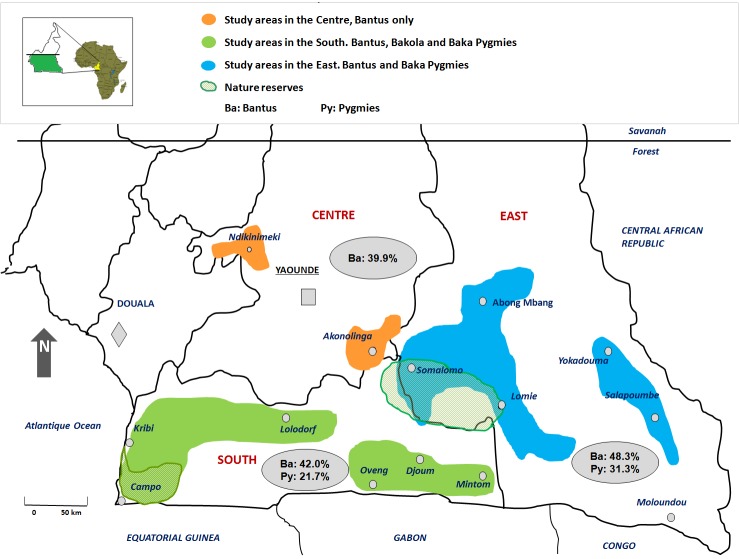
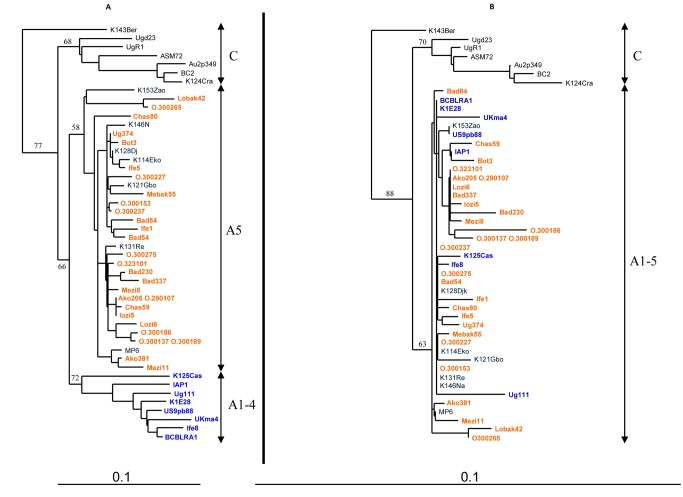
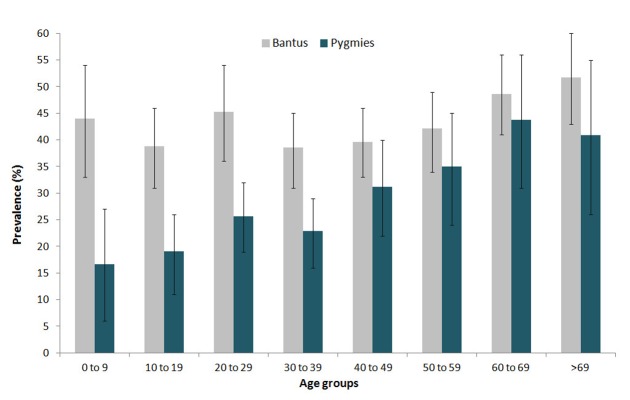
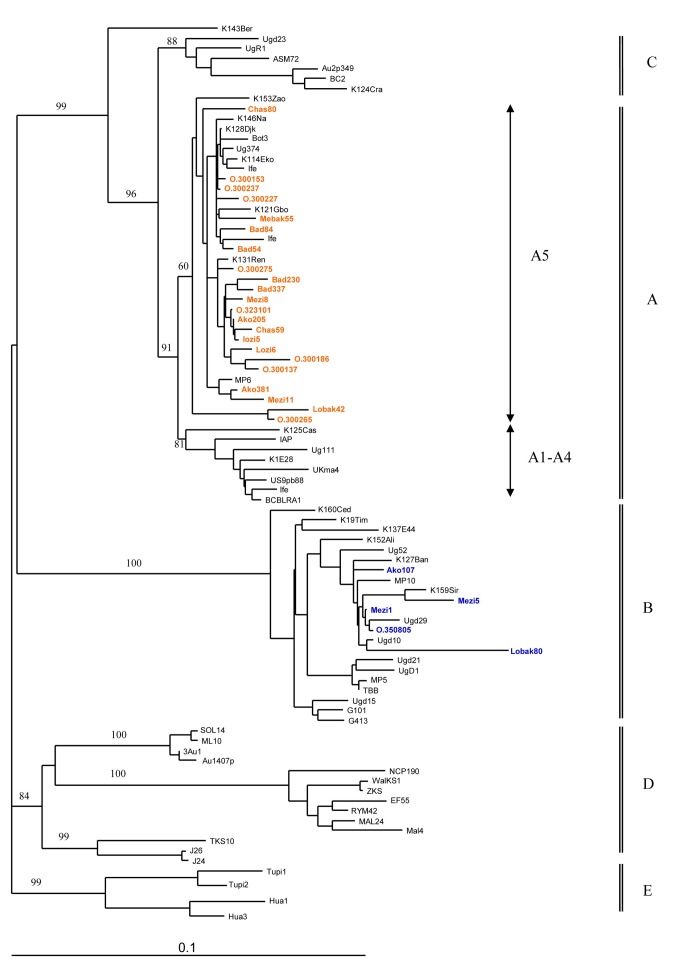
METHODOLOGY/PRINCIPAL FINDINGS: Bantu and Pygmy populations from remote rural villages were studied. Antibodies directed against latent nuclear antigens (LANA) were detected by indirect immunofluorescence using BC3 cells. Peripheral blood cell DNAs were subjected to a nested PCR amplifying a 737 bp K1 gene fragment. Consensus sequences were phylogenetically analyzed. We studied 2,063 persons (967 females, 1,096 males, mean age 39 years), either Bantus (1,276) or Pygmies (787). The Bantu group was older (42 versus 35 years: P<10(-4)). KSHV anti-LANA seroprevalence was of 37.2% (768/2063), with a significant increase with age (P<10(-4)) but no difference according to sex. Seroprevalence, as well as the anti-LANA antibodies titres, were higher in Bantus (43.2%) than in Pygmies (27.6%) (P<10(-4)), independently of age. We generated 29 K1 sequences, comprising 24 Bantus and five Pygmies. These sequences belonged to A5 (24 cases) or B (five cases) subtypes. They exhibited neither geographical nor ethnic aggregation. A5 strains showed a wide genetic diversity while the B strains were more homogenous and belonged to the B1 subgroup.
These data demonstrate high KSHV seroprevalence in the two major populations living in Southern and Eastern Cameroon with presence of mostly genetically diverse A5 but also B K1 subtypes.
卡波西肉瘤相关疱疹病毒(KSHV/HHV-8)是所有形式卡波西肉瘤的病原体。可变K1区域的分子流行病学研究确定了五个主要亚型,呈现出明显的地理聚集性。本研究旨在深入了解喀麦隆的KSHV流行病学和基因多样性。
方法/主要发现:对来自偏远乡村的班图族和俾格米族人群进行了研究。使用BC3细胞通过间接免疫荧光检测针对潜伏核抗原(LANA)的抗体。对外周血细胞DNA进行巢式PCR,扩增737 bp的K1基因片段。对一致序列进行系统发育分析。我们研究了2063人(967名女性,1096名男性,平均年龄39岁),其中班图族1276人,俾格米族787人。班图族群体年龄更大(42岁对35岁:P<10⁻⁴)。KSHV抗LANA血清阳性率为37.2%(768/2063),随年龄显著增加(P<10⁻⁴),但根据性别无差异。血清阳性率以及抗LANA抗体滴度,班图族(43.2%)高于俾格米族(27.6%)(P<10⁻⁴),与年龄无关。我们生成了29个K1序列,包括24个班图族和5个俾格米族的序列。这些序列属于A5(24例)或B(5例)亚型。它们既没有地理聚集也没有种族聚集。A5毒株表现出广泛的基因多样性,而B毒株更具同质性,属于B1亚组。
这些数据表明,喀麦隆南部和东部的两个主要人群中KSHV血清阳性率很高,存在基因多样的A5亚型以及B K1亚型。