Apaydin Dogukan Hazar, Głowacki Eric Daniel, Portenkirchner Engelbert, Sariciftci Niyazi Serdar
Linz Institute for Organic Solar Cells (LIOS), Physical Chemistry, Altenberger Strasse 69, 4040 Linz (Austria) http://www.lios.at.
Angew Chem Int Ed Engl. 2014 Jun 23;53(26):6819-22. doi: 10.1002/anie.201403618. Epub 2014 May 21.
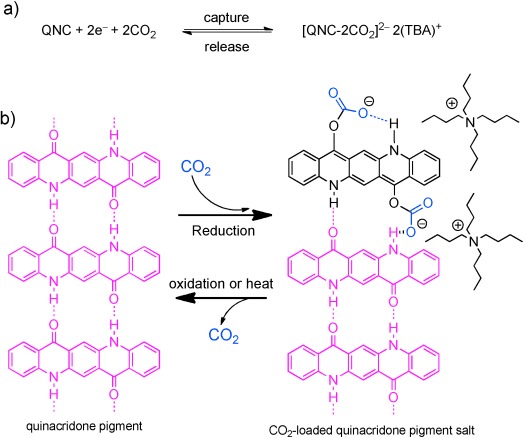
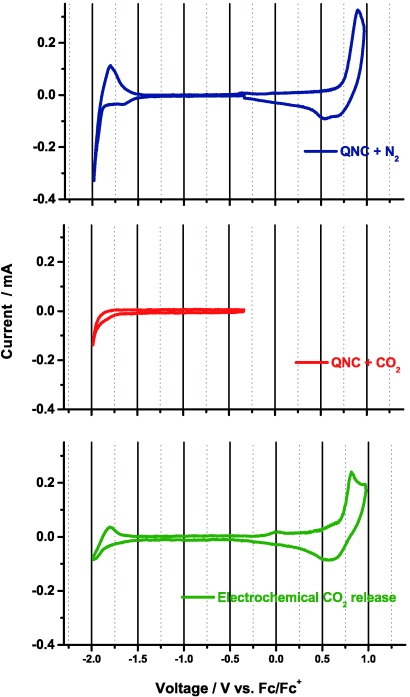
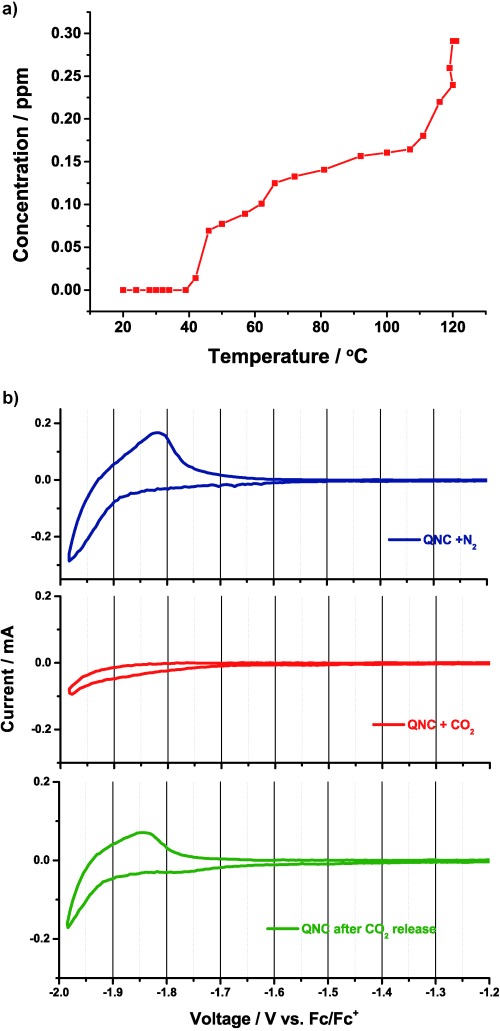
Limiting anthropogenic carbon dioxide emissions constitutes a major issue faced by scientists today. Herein we report an efficient way of controlled capture and release of carbon dioxide using nature inspired, cheap, abundant and non-toxic, industrial pigment namely, quinacridone. An electrochemically reduced electrode consisting of a quinacridone thin film (ca. 100 nm thick) on an ITO support forms a quinacridone carbonate salt. The captured CO2 can be released by electrochemical oxidation. The amount of captured CO2 was quantified by FT-IR. The uptake value for electrochemical release process was 4.61 mmol g(-1). This value is among the highest reported uptake efficiencies for electrochemical CO2 capture. For comparison, the state-of-the-art aqueous amine industrial capture process has an uptake efficiency of ca. 8 mmol g(-1).
限制人为二氧化碳排放是当今科学家面临的一个主要问题。在此,我们报告了一种利用受自然启发、廉价、丰富且无毒的工业颜料喹吖啶酮来有效控制二氧化碳捕获和释放的方法。由在ITO载体上的喹吖啶酮薄膜(约100纳米厚)组成的电化学还原电极形成喹吖啶酮碳酸盐。捕获的二氧化碳可通过电化学氧化释放。捕获的二氧化碳量通过傅里叶变换红外光谱进行定量。电化学释放过程的吸收值为4.61 mmol g⁻¹。该值是报道的电化学二氧化碳捕获吸收效率中最高的之一。作为比较,最先进的水性胺工业捕获过程的吸收效率约为8 mmol g⁻¹。