Wernike Kerstin, Holsteg Mark, Schirrmeier Horst, Hoffmann Bernd, Beer Martin
Institute of Diagnostic Virology, Friedrich-Loeffler-Institut (FLI), Greifswald - Insel Riems, Germany.
Bovine Health Service, Chamber of Agriculture for North Rhine-Westphalia, Bonn, Germany.
PLoS One. 2014 May 22;9(5):e98223. doi: 10.1371/journal.pone.0098223. eCollection 2014.
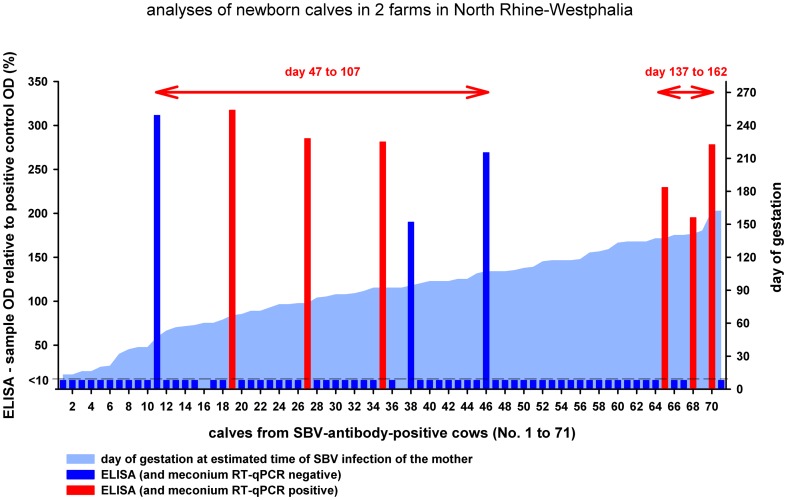
Schmallenberg virus (SBV), an orthobunyavirus discovered in European livestock in late 2011 for the first time, causes premature or stillbirth and severe fetal malformation when cows and ewes are infected during pregnancy. Therefore, cattle of two holdings in the initially most affected area in Germany were closely monitored to describe the consequence for fetuses and newborn calves. Seventy-one calves whose mothers were naturally infected during the first five months of pregnancy were clinically, virologically, and serologically examined. One calve showed typical malformation, another one, born without visible abnormalities, was dead. Two cows aborted during the studied period; spleen and brain samples or meconium swabs were tested by real-time PCR, in none of the fetuses SBV-specific RNA was detectable and the tested fetal sera were negative in a commercially available antibody ELISA. In contrast, in nine clinically healthy calves high SBV-antibody titers were measurable before colostrum intake, and in meconium swabs of six of these animals viral RNA was present as well. The mothers of all nine seropositive calves were presumably infected between days 47 and 162 of gestation, which is within the critical timeframe for fetal infection suggested for SBV and related viruses.
施马伦贝格病毒(SBV)是2011年末首次在欧洲家畜中发现的一种正布尼亚病毒,当母牛和母羊在孕期感染该病毒时,会导致早产、死产以及严重的胎儿畸形。因此,对德国最初受影响最严重地区的两个养殖场的牛群进行了密切监测,以描述对胎儿和新生小牛的影响。对71头其母亲在怀孕前五个月自然感染的小牛进行了临床、病毒学和血清学检查。一头小牛表现出典型畸形,另一头出生时无明显异常,但已死亡。在研究期间,有两头母牛流产;对脾脏和大脑样本或胎粪拭子进行了实时聚合酶链反应检测,在任何胎儿中均未检测到SBV特异性RNA,且检测的胎儿血清在市售抗体酶联免疫吸附测定中呈阴性。相比之下,在9头临床健康的小牛中,在摄入初乳前可检测到高滴度的SBV抗体,其中6头动物的胎粪拭子中也存在病毒RNA。所有9头血清阳性小牛的母亲推测在妊娠第47天至162天之间受到感染,这处于SBV及相关病毒建议的胎儿感染关键时间范围内。