• 文献检索
  • 文档翻译
  • 深度研究
  • 学术资讯
  • Suppr Zotero 插件Zotero 插件
  • 邀请有礼
  • 套餐&价格
  • 历史记录
应用&插件
Suppr Zotero 插件Zotero 插件浏览器插件Mac 客户端Windows 客户端微信小程序
定价
高级版会员购买积分包购买API积分包
服务
文献检索文档翻译深度研究API 文档MCP 服务
关于我们
关于 Suppr公司介绍联系我们用户协议隐私条款
关注我们

Suppr 超能文献

核心技术专利:CN118964589B侵权必究
粤ICP备2023148730 号-1Suppr @ 2026

文献检索

告别复杂PubMed语法,用中文像聊天一样搜索,搜遍4000万医学文献。AI智能推荐,让科研检索更轻松。

立即免费搜索

文件翻译

保留排版,准确专业,支持PDF/Word/PPT等文件格式,支持 12+语言互译。

免费翻译文档

深度研究

AI帮你快速写综述,25分钟生成高质量综述,智能提取关键信息,辅助科研写作。

立即免费体验

机器人辅助与感觉综合训练治疗多发性硬化症患者步态和平衡功能障碍的随机对照试验。

Robot-assisted vs. sensory integration training in treating gait and balance dysfunctions in patients with multiple sclerosis: a randomized controlled trial.

机构信息

Department of Neurological and Movement Sciences, Neuromotor and Cognitive Rehabilitation Research Center, University of Verona Verona, Italy.

Department of Neurological Rehabilitation, Private Hospital Villa Melitta Bolzano, Italy.

出版信息

Front Hum Neurosci. 2014 May 22;8:318. doi: 10.3389/fnhum.2014.00318. eCollection 2014.

DOI:10.3389/fnhum.2014.00318
PMID:24904361
原文链接:https://pmc.ncbi.nlm.nih.gov/articles/PMC4033226/
Abstract

BACKGROUND

Extensive research on both healthy subjects and patients with central nervous damage has elucidated a crucial role of postural adjustment reactions and central sensory integration processes in generating and "shaping" locomotor function, respectively. Whether robotic-assisted gait devices might improve these functions in Multiple sclerosis (MS) patients is not fully investigated in literature.

PURPOSE

The aim of this study was to compare the effectiveness of end-effector robot-assisted gait training (RAGT) and sensory integration balance training (SIBT) in improving walking and balance performance in patients with MS.

METHODS

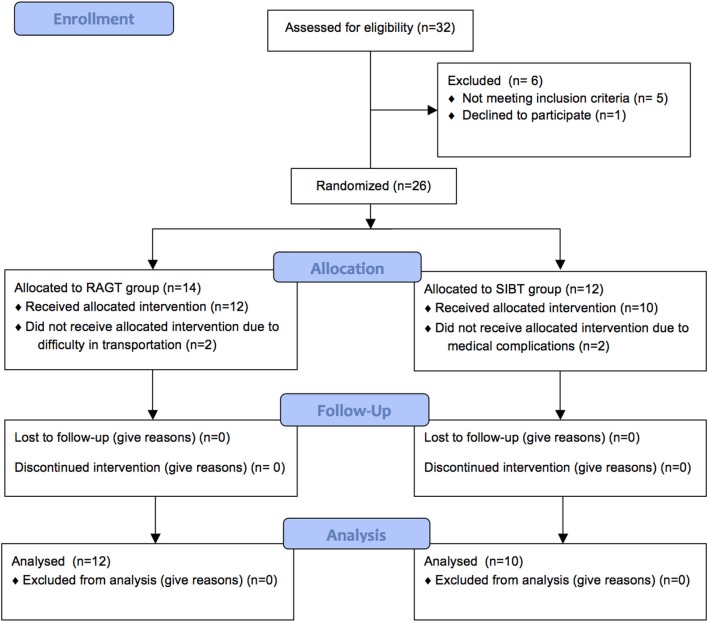
Twenty-two patients with MS (EDSS: 1.5-6.5) were randomly assigned to two groups. The RAGT group (n = 12) underwent end-effector system training. The SIBT group (n = 10) underwent specific balance exercises. Each patient received twelve 50-min treatment sessions (2 days/week). A blinded rater evaluated patients before and after treatment as well as 1 month post treatment. Primary outcomes were walking speed and Berg Balance Scale. Secondary outcomes were the Activities-specific Balance Confidence Scale, Sensory Organization Balance Test, Stabilometric Assessment, Fatigue Severity Scale, cadence, step length, single and double support time, Multiple Sclerosis Quality of Life-54.

RESULTS

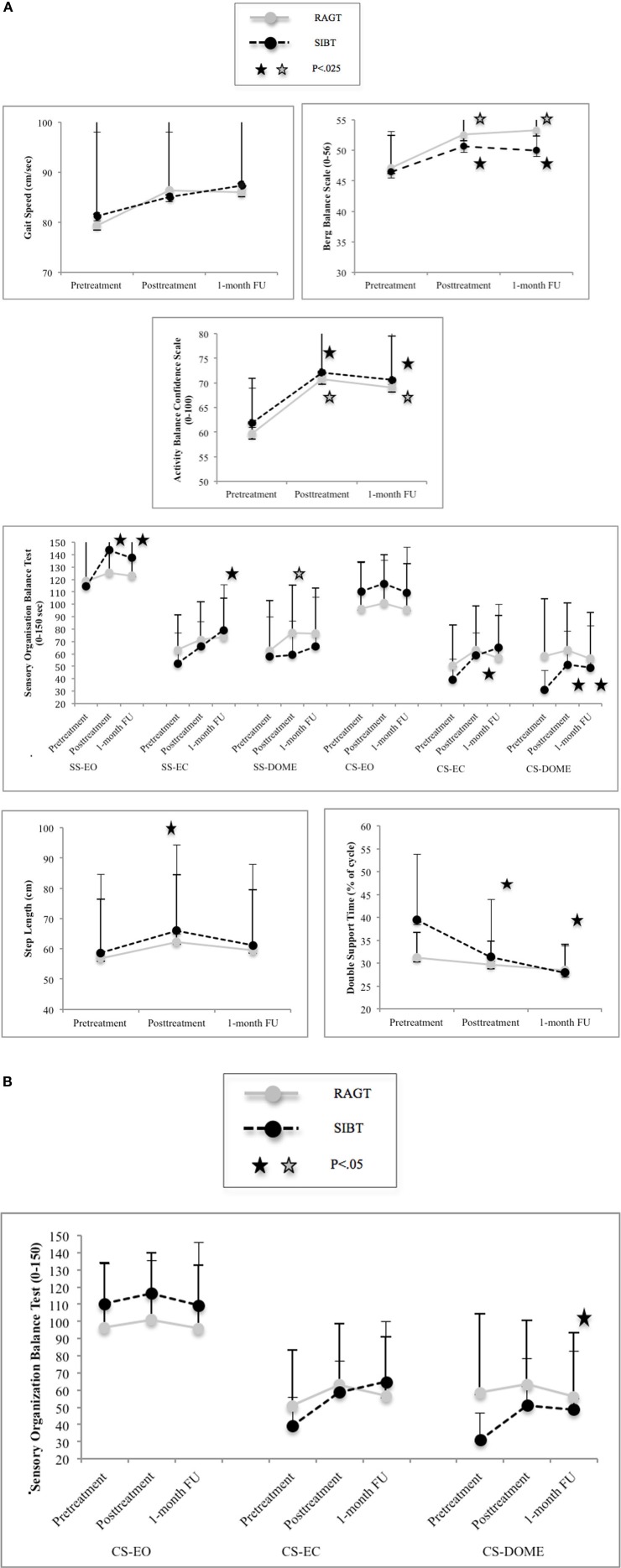
Between groups comparisons showed no significant differences on primary and secondary outcome measures over time. Within group comparisons showed significant improvements in both groups on the Berg Balance Scale (P = 0.001). Changes approaching significance were found on gait speed (P = 0.07) only in the RAGT group. Significant changes in balance task-related domains during standing and walking conditions were found in the SIBT group.

CONCLUSION

Balance disorders in patients with MS may be ameliorated by RAGT and by SIBT.

摘要

背景

广泛的研究表明,健康受试者和中枢神经系统损伤患者的姿势调整反应和中枢感觉整合过程在产生和“塑造”运动功能方面分别起着至关重要的作用。然而,机器人辅助步态训练(RAGT)是否可以改善多发性硬化症(MS)患者的这些功能,文献中尚未完全探讨。

目的

本研究旨在比较末端效应器机器人辅助步态训练(RAGT)和感觉整合平衡训练(SIBT)对改善 MS 患者步行和平衡功能的效果。

方法

22 名 MS 患者(EDSS:1.5-6.5)被随机分为两组。RAGT 组(n = 12)接受末端效应器系统训练。SIBT 组(n = 10)接受特定的平衡练习。每位患者接受 12 次 50 分钟的治疗(每周 2 天)。一位盲评者在治疗前后以及治疗后 1 个月对患者进行评估。主要结局是步行速度和 Berg 平衡量表。次要结局是活动特异性平衡信心量表、感觉组织平衡测试、稳定评估、疲劳严重程度量表、步速、步长、单支撑和双支撑时间、多发性硬化症生活质量-54。

结果

组间比较显示,在治疗期间,主要和次要结局指标均无显著差异。组内比较显示,两组 Berg 平衡量表均有显著改善(P = 0.001)。仅在 RAGT 组,步行速度有显著改善(P = 0.07)。在 SIBT 组,站立和行走条件下的平衡任务相关领域的变化接近显著。

结论

RAGT 和 SIBT 均可改善 MS 患者的平衡障碍。

https://cdn.ncbi.nlm.nih.gov/pmc/blobs/2203/4033226/fb1345eac4b6/fnhum-08-00318-g0002.jpg
https://cdn.ncbi.nlm.nih.gov/pmc/blobs/2203/4033226/460ca03cd1f6/fnhum-08-00318-g0001.jpg
https://cdn.ncbi.nlm.nih.gov/pmc/blobs/2203/4033226/fb1345eac4b6/fnhum-08-00318-g0002.jpg
https://cdn.ncbi.nlm.nih.gov/pmc/blobs/2203/4033226/460ca03cd1f6/fnhum-08-00318-g0001.jpg
https://cdn.ncbi.nlm.nih.gov/pmc/blobs/2203/4033226/fb1345eac4b6/fnhum-08-00318-g0002.jpg

相似文献

1
Robot-assisted vs. sensory integration training in treating gait and balance dysfunctions in patients with multiple sclerosis: a randomized controlled trial.机器人辅助与感觉综合训练治疗多发性硬化症患者步态和平衡功能障碍的随机对照试验。
Front Hum Neurosci. 2014 May 22;8:318. doi: 10.3389/fnhum.2014.00318. eCollection 2014.
2
Erratum.勘误
Mult Scler. 2016 Oct;22(12):NP9-NP11. doi: 10.1177/1352458515585718. Epub 2015 Jun 3.
3
Robot-Assisted Stair Climbing Training on Postural Control and Sensory Integration Processes in Chronic Post-stroke Patients: A Randomized Controlled Clinical Trial.机器人辅助的慢性中风后患者姿势控制和感觉统合过程的爬楼梯训练:一项随机对照临床试验
Front Neurosci. 2019 Oct 24;13:1143. doi: 10.3389/fnins.2019.01143. eCollection 2019.
4
The effectiveness of Robot-Assisted Gait Training versus conventional therapy on mobility in severely disabled progressIve MultiplE sclerosis patients (RAGTIME): study protocol for a randomized controlled trial.机器人辅助步态训练与传统疗法对重度残疾进展性多发性硬化症患者活动能力的疗效比较(RAGTIME):一项随机对照试验的研究方案
Trials. 2017 Feb 27;18(1):88. doi: 10.1186/s13063-017-1838-2.
5
Effects of robot-assisted gait training combined with virtual reality on motor and cognitive functions in patients with multiple sclerosis: A pilot, single-blind, randomized controlled trial.机器人辅助步态训练结合虚拟现实对多发性硬化症患者运动和认知功能的影响:一项初步的、单盲、随机对照试验。
Restor Neurol Neurosci. 2020;38(2):151-164. doi: 10.3233/RNN-190974.
6
Robot-assisted gait training in multiple sclerosis patients: a randomized trial.机器人辅助步态训练在多发性硬化症患者中的应用:一项随机试验。
Mult Scler. 2012 Jun;18(6):881-90. doi: 10.1177/1352458511431075. Epub 2011 Dec 6.
7
Sensory integration balance training in patients with multiple sclerosis: A randomized, controlled trial.多发性硬化症患者的感觉统合平衡训练:一项随机对照试验。
Mult Scler. 2015 Oct;21(11):1453-62. doi: 10.1177/1352458514562438. Epub 2015 Jan 12.
8
Effects of robot-assisted gait training on spatiotemporal gait parameters and balance in patients with chronic stroke: A randomized controlled pilot trial.机器人辅助步态训练对慢性卒中患者时空步态参数及平衡的影响:一项随机对照试验。
NeuroRehabilitation. 2016 Apr 6;38(4):343-9. doi: 10.3233/NRE-161325.
9
Effects of Robot-Assisted Gait Training in Patients With Multiple Sclerosis: A Single-Blinded Randomized Controlled Study.机器人辅助步态训练对多发性硬化症患者的影响:一项单盲随机对照研究。
Am J Phys Med Rehabil. 2022 Aug 1;101(8):768-774. doi: 10.1097/PHM.0000000000001913. Epub 2021 Oct 21.
10
Comparison of the effects on dynamic balance and aerobic capacity between objective and subjective methods of high-intensity robot-assisted gait training in chronic stroke patients: a randomized controlled trial.慢性卒中患者高强度机器人辅助步态训练的客观与主观方法对动态平衡和有氧能力影响的比较:一项随机对照试验
Top Stroke Rehabil. 2017 May;24(4):309-313. doi: 10.1080/10749357.2016.1275304. Epub 2017 Jan 19.

引用本文的文献

1
Four-Week Exoskeleton Gait Training on Balance and Mobility in Minimally Impaired Individuals with Multiple Sclerosis: A Pilot Study.四周外骨骼步态训练对轻度受损多发性硬化症患者平衡能力和活动能力的影响:一项初步研究
Bioengineering (Basel). 2025 Jul 30;12(8):826. doi: 10.3390/bioengineering12080826.
2
Multiple Sclerosis: Enhancing Botulinum Toxin Effects in Spasticity Management, a Systematic Review.多发性硬化症:增强肉毒杆菌毒素在痉挛管理中的作用,一项系统评价
J Clin Med. 2025 Jul 24;14(15):5252. doi: 10.3390/jcm14155252.
3
Comparative effects of sensory motor and virtual reality interventions to improve gait, balance and quality of life MS patients.

本文引用的文献

1
Postural response latencies are related to balance control during standing and walking in patients with multiple sclerosis.姿势反应潜伏期与多发性硬化症患者站立和行走时的平衡控制有关。
Arch Phys Med Rehabil. 2014 Jul;95(7):1390-7. doi: 10.1016/j.apmr.2014.01.004. Epub 2014 Jan 18.
2
2nd International Symposium on Gait and Balance in Multiple Sclerosis: interventions for gait and balance in MS.第二届多发性硬化症步态与平衡国际研讨会:多发性硬化症步态与平衡的干预措施
Disabil Rehabil. 2014;36(13):1128-32. doi: 10.3109/09638288.2013.833306. Epub 2013 Sep 16.
3
Does robot-assisted gait training ameliorate gait abnormalities in multiple sclerosis? A pilot randomized-control trial.
感觉运动干预和虚拟现实干预对改善多发性硬化症患者步态、平衡和生活质量的比较效果。
Sci Rep. 2025 Jun 26;15(1):20310. doi: 10.1038/s41598-025-05048-3.
4
The Role of VibraPlus on Fatigue in Multiple Sclerosis Patients: A Randomized Controlled Trial.VibraPlus对多发性硬化症患者疲劳的作用:一项随机对照试验。
J Clin Med. 2025 Jun 5;14(11):3990. doi: 10.3390/jcm14113990.
5
Effects of robotic rehabilitation on fatigue experience, disability, and quality of life in patients with multiple sclerosis (MS): A systematic review and meta-analysis.机器人康复对多发性硬化症(MS)患者疲劳体验、残疾状况和生活质量的影响:一项系统综述和荟萃分析。
Caspian J Intern Med. 2024 Aug 30;15(4):589-600. doi: 10.22088/cjim.15.4.589. eCollection 2024 Fall.
6
Interhemispheric inhibition and gait adaptation associations in people with multiple sclerosis.多发性硬化症患者的大脑两半球间抑制与步态适应的关联。
Exp Brain Res. 2024 Jul;242(7):1761-1772. doi: 10.1007/s00221-024-06860-5. Epub 2024 Jun 1.
7
Scientometric Research and Critical Analysis of Gait and Balance in Older Adults.老年人步态和平衡的科学计量研究与批判性分析。
Sensors (Basel). 2024 May 17;24(10):3199. doi: 10.3390/s24103199.
8
Traditional versus progressive robot-assisted gait training in people with multiple sclerosis and severe gait disability: study protocol for the PROGR-EX randomised controlled trial.传统与渐进式机器人辅助步态训练对多发性硬化症和严重步态障碍患者的影响:PROGR-EX随机对照试验的研究方案
BMJ Open Sport Exerc Med. 2024 May 21;10(2):e002039. doi: 10.1136/bmjsem-2024-002039. eCollection 2024.
9
Can Robotic Gait Training with End Effectors Improve Lower-Limb Functions in Patients Affected by Multiple Sclerosis? Results from a Retrospective Case-Control Study.使用末端执行器的机器人步态训练能否改善多发性硬化症患者的下肢功能?一项回顾性病例对照研究的结果。
J Clin Med. 2024 Mar 7;13(6):1545. doi: 10.3390/jcm13061545.
10
The effect of fatigue on postural control in individuals with multiple sclerosis: a systematic review.疲劳对多发性硬化症患者姿势控制的影响:系统评价。
BMC Neurol. 2023 Nov 17;23(1):409. doi: 10.1186/s12883-023-03464-4.
机器人辅助步态训练能否改善多发性硬化症的步态异常?一项初步的随机对照试验。
NeuroRehabilitation. 2013;33(4):555-63. doi: 10.3233/NRE-130990.
4
Robot-assisted gait training versus equal intensity treadmill training in patients with mild to moderate Parkinson's disease: a randomized controlled trial.机器人辅助步态训练与等强度跑步机训练对轻中度帕金森病患者的随机对照试验。
Parkinsonism Relat Disord. 2013 Jun;19(6):605-10. doi: 10.1016/j.parkreldis.2013.02.010. Epub 2013 Mar 13.
5
Balance training improves static stability and gait in chronic incomplete spinal cord injury subjects: a pilot study.平衡训练改善慢性不完全性脊髓损伤患者的静态稳定性和步态:一项初步研究。
Eur J Phys Rehabil Med. 2013 Jun;49(3):353-64. Epub 2013 Mar 13.
6
Treadmill training in multiple sclerosis: can body weight support or robot assistance provide added value? A systematic review.多发性硬化症的跑步机训练:体重支持或机器人辅助能否提供附加价值?一项系统评价。
Mult Scler Int. 2012;2012:240274. doi: 10.1155/2012/240274. Epub 2012 May 30.
7
Balance exercise for persons with multiple sclerosis using Wii games: a randomised, controlled multi-centre study.多发性硬化症患者使用 Wii 游戏进行平衡锻炼:一项随机对照多中心研究。
Mult Scler. 2013 Feb;19(2):209-16. doi: 10.1177/1352458512450088. Epub 2012 Jun 6.
8
Does robotic gait training improve balance in Parkinson's disease? A randomized controlled trial.机器人步态训练能否改善帕金森病患者的平衡?一项随机对照试验。
Parkinsonism Relat Disord. 2012 Sep;18(8):990-3. doi: 10.1016/j.parkreldis.2012.05.010. Epub 2012 Jun 4.
9
Feedforward postural control in individuals with multiple sclerosis during load release.在释放负荷期间,多发性硬化症患者的前馈姿势控制。
Gait Posture. 2012 Jun;36(2):225-30. doi: 10.1016/j.gaitpost.2012.02.022. Epub 2012 Apr 5.
10
Anticipatory postural adjustments in individuals with multiple sclerosis.多发性硬化症患者的预期姿势调整。
Neurosci Lett. 2012 Jan 11;506(2):256-60. doi: 10.1016/j.neulet.2011.11.018. Epub 2011 Nov 20.