Hernandez Adrian V, Guarnizo Mirella, Miranda Yony, Pasupuleti Vinay, Deshpande Abhishek, Paico Socorro, Lenti Hosten, Ganoza Silvia, Montalvo Laritza, Thota Priyaleela, Lazaro Herbert
Instituto Médico de la Mujer/Instituto Médico Metabólico, Lima, Peru; Postgraduate and Medical Schools, Universidad Peruana de Ciencias Aplicadas (UPC), Lima, Peru; Health Outcomes and Clinical Epidemiology Section, Department of Quantitative Health Sciences, Lerner Research Institute, Cleveland Clinic, Cleveland, Ohio, United States of America.
Instituto Médico de la Mujer/Instituto Médico Metabólico, Lima, Peru.
PLoS One. 2014 Jun 9;9(6):e99317. doi: 10.1371/journal.pone.0099317. eCollection 2014.
This study was undertaken to evaluate the association between components defining insulin resistance and breast cancer in women.
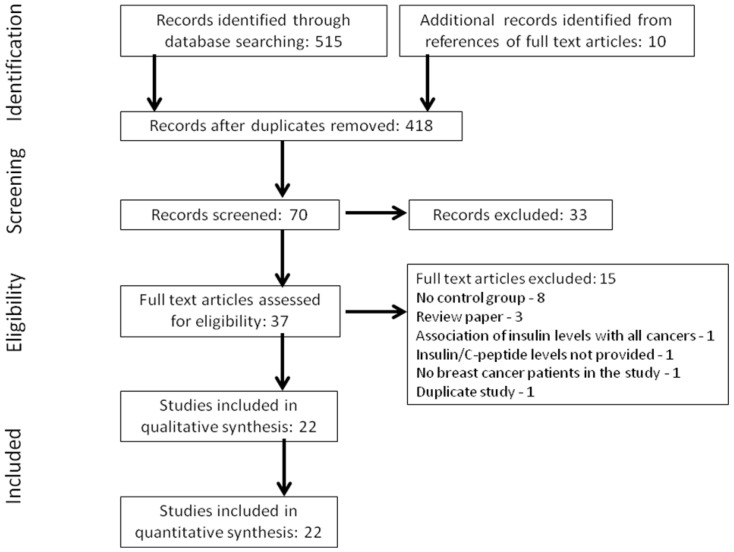
We conducted a systematic review of four databases (PubMed-Medline, EMBASE, Web of Science, and Scopus) for observational studies evaluating components defining insulin resistance in women with and without breast cancer. A meta-analysis of the association between insulin resistance components and breast cancer was performed using random effects models.
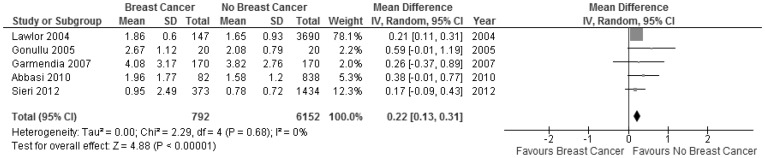
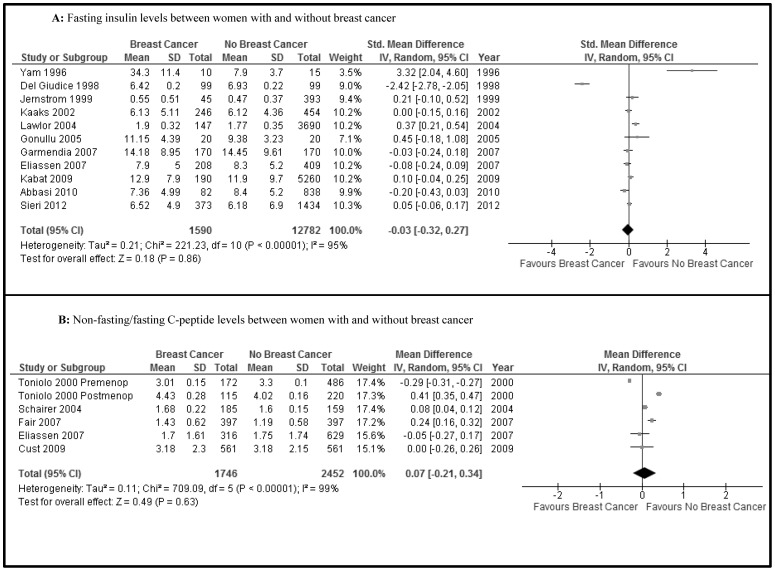
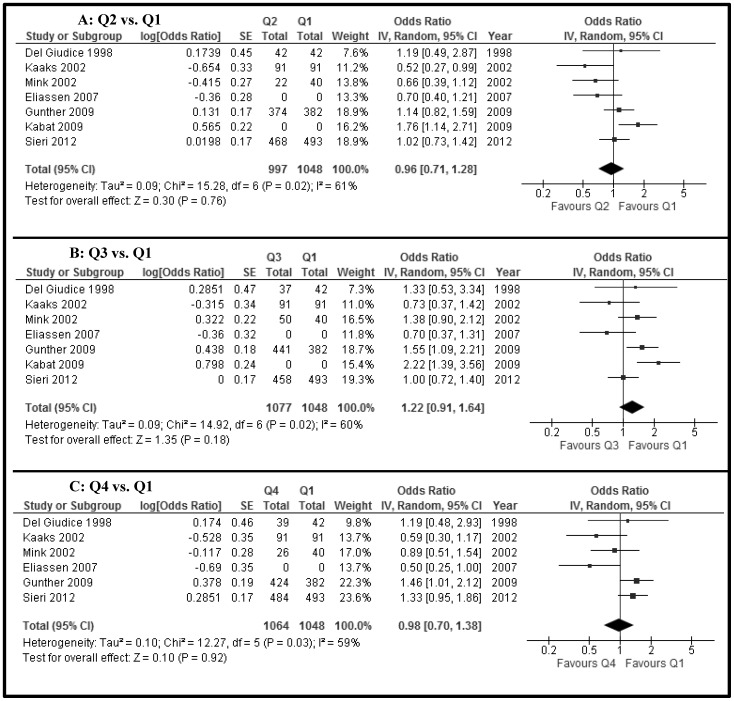
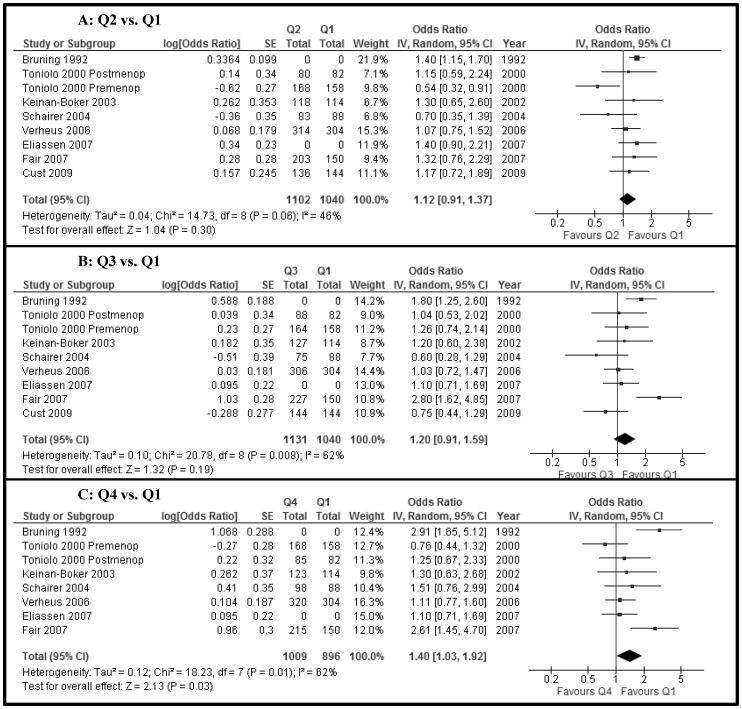
Twenty-two studies (n = 33,405) were selected. Fasting insulin levels were not different between women with and without breast cancer (standardized mean difference, SMD -0.03, 95%CI -0.32 to 0.27; p = 0.9). Similarly, non-fasting/fasting C-peptide levels were not different between the two groups (mean difference, MD 0.07, -0.21 to 0.34; p = 0.6). Using individual odds ratios (ORs) adjusted at least for age, there was no higher risk of breast cancer when upper quartiles were compared with the lowest quartile (Q1) of fasting insulin levels (OR Q2 vs. Q1 0.96, 0.71 to 1.28; OR Q3 vs. Q1 1.22, 0.91 to 1.64; OR Q4 vs. Q1 0.98, 0.70 to 1.38). Likewise, there were no differences for quartiles of non-fasting/fasting C-peptide levels (OR Q2 vs. Q1 1.12, 0.91 to 1.37; OR Q3 vs. Q1 1.20, 0.91 to 1.59; OR Q4 vs. Q1 1.40, 1.03 to 1.92). Homeostatic model assessment (HOMA-IR) levels in breast cancer patients were significantly higher than in people without breast cancer (MD 0.22, 0.13 to 0.31, p<0.00001).
Higher levels of fasting insulin or non-fasting/fasting C-peptide are not associated with breast cancer in women. HOMA-IR levels are slightly higher in women with breast cancer.
本研究旨在评估定义胰岛素抵抗的各因素与女性乳腺癌之间的关联。
我们对四个数据库(PubMed - Medline、EMBASE、Web of Science和Scopus)进行了系统评价,纳入评估有无乳腺癌女性中定义胰岛素抵抗各因素的观察性研究。使用随机效应模型对胰岛素抵抗各因素与乳腺癌之间的关联进行荟萃分析。
共纳入22项研究(n = 33405)。有乳腺癌和无乳腺癌女性的空腹胰岛素水平无差异(标准化均数差,SMD -0.03,95%CI -0.32至0.27;p = 0.9)。同样,两组间非空腹/空腹C肽水平也无差异(均数差,MD 0.07,-0.21至0.34;p = 0.6)。使用至少根据年龄调整的个体比值比(OR),将空腹胰岛素水平的上四分位数与最低四分位数(Q1)相比时,乳腺癌风险并未升高(Q2与Q1相比的OR为0.96,0.71至1.28;Q3与Q1相比的OR为1.22,0.91至1.64;Q4与Q1相比的OR为0.98,0.70至1.38)。同样,非空腹/空腹C肽水平的四分位数之间也无差异(Q2与Q1相比的OR为1.12,0.91至1.37;Q3与Q1相比的OR为1.20,0.91至1.59;Q4与Q1相比的OR为1.40,1.03至1.92)。乳腺癌患者的稳态模型评估(HOMA - IR)水平显著高于无乳腺癌者(MD 0.22,0.13至0.31,p<0.00001)。
空腹胰岛素或非空腹/空腹C肽水平升高与女性乳腺癌无关。乳腺癌女性的HOMA - IR水平略高。