Institute of Biomedical Research (IIB Sant Pau), Barcelona, Iberoamerican Cochrane Centre, Hospital de la Santa Creu i Sant Pau, Pavelló 18 C/Sant Antoni Mª Claret 167, Barcelona, Catalunya 08025, España.
Implement Sci. 2014 Jun 11;9:72. doi: 10.1186/1748-5908-9-72.
Updating is important to ensure clinical guideline (CG) recommendations remain valid. However, little research has been undertaken in this field. We assessed CGs produced by the National Institute for Health and Care Excellence (NICE) to identify and describe updated recommendations and to investigate potential factors associated with updating. Also, we evaluated the reporting and presentation of recommendation changes.
We performed a descriptive analysis of original and updated CGs and recommendations, and an assessment of presentation formats and methods for recording information. We conducted a case-control study, defining cases as original recommendations that were updated ('new-replaced' recommendations), and controls as original recommendations that were considered to remain valid ('not changed' recommendations). We performed a comparison of main characteristics between cases and controls, and we planned a multiple regression analysis to identify potential predictive factors for updating.
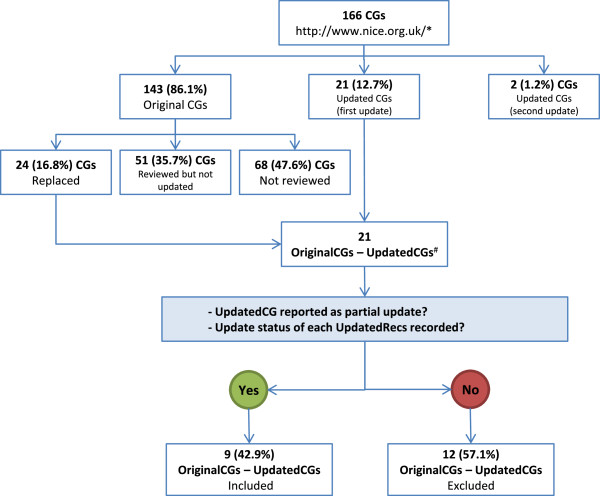
We included nine updated CGs (1,306 recommendations) and their corresponding original versions (1,106 recommendations). Updated CGs included 812 (62%) recommendations 'not reviewed', 368 (28.1%) 'new' recommendations, 104 (7.9%) 'amended' recommendations, and 25 (1.9%) recommendations reviewed but unchanged. The presentation formats used to indicate the changes in recommendations varied widely across CGs. Changes in 'amended', 'deleted', and 'new-replaced' recommendations (n = 296) were reported infrequently, mostly in appendices. These changes were recorded in 167 (56.4%) recommendations; and were explained in 81 (27.4%) recommendations. We retrieved a total of 7.1% (n = 78) case recommendations ('new-replaced') and 2.4% (n = 27) control recommendations ('not changed') in original CGs. The updates were mainly from 'Fertility CG', about 'gynaecology, pregnancy and birth' topic, and 'treatment' or 'prevention' purposes. We did not perform the multiple regression analysis as originally planned due to the small sample of recommendations retrieved.
Our study is the first to describe and assess updated CGs and recommendations from a national guideline program. Our results highlight the pressing need to standardise the reporting and presentation of updated recommendations and the research gap about the optimal way to present updates to guideline users. Furthermore, there is a need to investigate updating predictive factors.
更新对于确保临床指南(CG)建议的有效性非常重要。然而,在这一领域的研究很少。我们评估了英国国家卫生与保健优化研究所(NICE)制定的 CG,以确定和描述更新的建议,并调查与更新相关的潜在因素。此外,我们还评估了建议变更的报告和呈现方式。
我们对原始和更新的 CG 和建议进行了描述性分析,并对呈现格式和记录信息的方法进行了评估。我们进行了病例对照研究,将原始建议中更新的建议定义为“新替换”建议(“new-replaced” recommendations),而原始建议中被认为仍然有效的建议定义为“未更改”建议(“not changed” recommendations)。我们对病例和对照之间的主要特征进行了比较,并计划进行多元回归分析,以确定更新的潜在预测因素。
我们纳入了 9 项更新的 CG(1306 条建议)及其对应的原始版本(1106 条建议)。更新的 CG 中包括 812 条(62%)“未审查”建议、368 条(28.1%)“新”建议、104 条(7.9%)“修订”建议和 25 条(1.9%)经审查但未更改的建议。用于指示建议变更的呈现格式在 CG 之间差异很大。“修订”、“删除”和“新替换”建议(n=296)的变更报告频率较低,主要在附录中。这些变更记录在 167 条(56.4%)建议中,并在 81 条(27.4%)建议中进行了说明。我们共检索到 7.1%(n=78)原始 CG 中的案例建议(“new-replaced”)和 2.4%(n=27)对照建议(“not changed”)。更新主要来自“生育 CG”,涉及“妇科、妊娠和分娩”主题,以及“治疗”或“预防”目的。由于检索到的建议数量较少,我们没有按原计划进行多元回归分析。
我们的研究是首次对来自国家指南计划的更新 CG 和建议进行描述和评估。我们的结果突出表明迫切需要标准化更新建议的报告和呈现方式,以及向指南使用者呈现更新内容的最佳方式的研究差距。此外,需要调查更新的预测因素。