Park Ju Young, Lee Jeong Eun, Park Jong Bae, Yoo Heon, Lee Seung-Hoon, Kim Jong Heon
Cancer Cell and Molecular Biology Branch, Research Institute, National Cancer Center, Goyang, Korea.
Specific Organs Cancer Branch, Research Institute, National Cancer Center, Goyang, Korea. ; Department of System Cancer Science, Graduate School of Cancer Science and Policy, National Cancer Center, Goyang, Korea.
Brain Tumor Res Treat. 2014 Apr;2(1):1-6. doi: 10.14791/btrt.2014.2.1.1. Epub 2014 Apr 29.
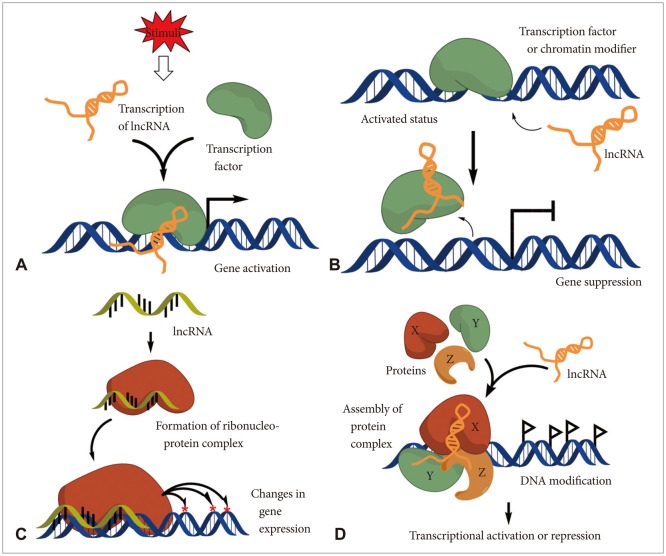
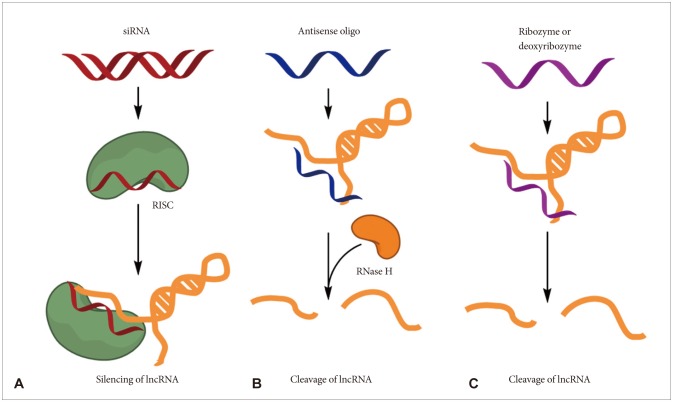
More than 98% of eukaryotic tanscriptomes are composed of non-coding RNAs with no functional protein-coding capacity. Those transcripts also include tens of thousands of long non-coding RNAs (lncRNAs) which are emerging as key elements of cellular homeostasis, essentially tumorigenesis steps. However, we are only beginning to understand the nature and extent of the involvement of lncRNAs on tumorigeneis. Here, we highlight recent progresses that have identified a myriad of molecular functions on tumorigenesis for several lncRNAs including metastasis-associated lung adenocarcinoma transcript 1 (MALAT1), prostate cancer associated non-coding RNA 1 (PRNCR1), prostate cancer gene expression marker 1 (PCGEM1), H19, and homeobox transcript antisense intergenic RNA (HOTAIR), and several new lncRNAs for glioma development. Potential therapeutic approaches for the lncRNAs in various human diseases are also discussed.
超过98%的真核转录组由没有功能性蛋白质编码能力的非编码RNA组成。这些转录本还包括数以万计的长链非编码RNA(lncRNA),它们正逐渐成为细胞稳态(本质上是肿瘤发生步骤)的关键要素。然而,我们才刚刚开始了解lncRNA在肿瘤发生中的参与性质和程度。在这里,我们重点介绍了最近的进展,这些进展已经确定了几种lncRNA在肿瘤发生中的无数分子功能,包括转移相关肺腺癌转录本1(MALAT1)、前列腺癌相关非编码RNA 1(PRNCR1)、前列腺癌基因表达标志物1(PCGEM1)、H19和同源盒转录本反义基因间RNA(HOTAIR),以及几种与胶质瘤发展相关的新lncRNA。还讨论了针对各种人类疾病中lncRNA的潜在治疗方法。