Liu Yuan, Lv Quanjun, Gao Jian, Long Lu, Duan Zhaojun, Liang Hua, Shen Tao, Lu Fengmin
Department of Microbiology & Infectious Disease Center, Peking University Health Science Center, Beijing, China; Department of Nutrition and Food Hygiene, College of Public Health, Zhengzhou University, Henan, China.
Department of Nutrition and Food Hygiene, College of Public Health, Zhengzhou University, Henan, China.
PLoS One. 2014 Jun 13;9(6):e98039. doi: 10.1371/journal.pone.0098039. eCollection 2014.
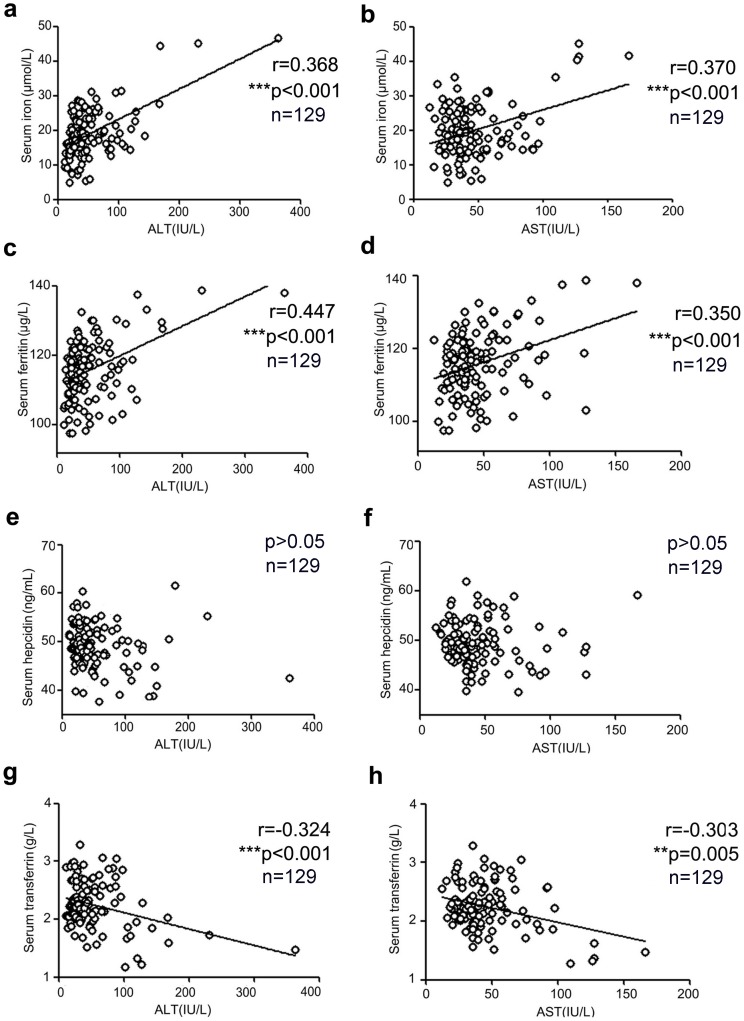
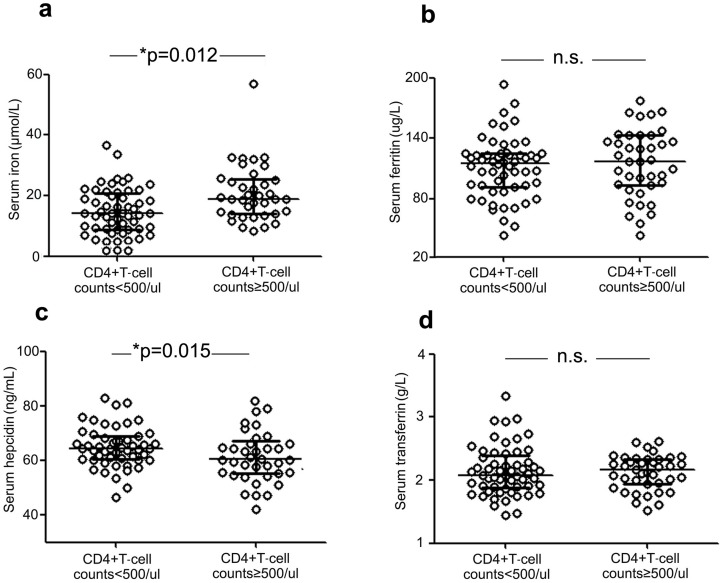
Most chronically-infected hepatitis C virus (HCV) patients have increased levels of iron in the liver. Iron overload reduces sustained responses to antiviral therapy, leading to more rapid progression to liver cirrhosis and the development of hepatocellular carcinoma. However, it is still unclear how HIV-1 infection affects iron status in patients chronically infected with HCV. The present study recruited 227 patients from a village in central China. These patients were either monoinfected with HCV (n = 129) or coinfected with HCV/HIV-1 (n = 98). Healthy controls (n = 84) were also recruited from the same village. Indicators of iron status, such as serum levels of iron, ferritin, and transferrin, total iron-binding capacity (TIBC), transferrin saturation (Tfs), and hepcidin, were analyzed and compared across the three groups. The results showed that serum levels of iron (p = 0.001) and ferritin (p = 0.009) and the Tfs (p = 0.002) were significantly higher in HCV-monoinfected patients than in the healthy controls; however, there were no differences in iron levels and Tfs between HCV/HIV-1 coinfected patients and healthy controls. Additionally, although serum hepcidin levels in HCV-monoinfected and HCV/HIV-1-coinfected patients were lower (p<0.001) than those in health controls, the levels in coinfected patients were higher (p = 0.025) than those in HCV-monoinfected patients. Serum iron and ferritin levels in HCV-monoinfected patients were positively correlated with serum ALT/AST. Serum transferrin levels were negatively correlated with ALT/AST levels. The levels of iron in the serum of coinfected patients with a CD4+T-cell count <500/µl were lower than those in patients with a CD4+T-cell count ≥500/µl, whereas serum hepcidin levels showed the opposite trend. Taken together, these results suggest that coinfection with HIV-1 alleviates iron accumulation caused by chronic HCV infection. Our study indicated that determining the status of serum iron and other iron-associated parameters will be helpful to understand the complexity of alternations in iron distribution in HCV/HIV-1-coinfected patients.
大多数慢性丙型肝炎病毒(HCV)感染者肝脏中的铁含量会升高。铁过载会降低对抗病毒治疗的持续反应,导致更快地发展为肝硬化和肝细胞癌。然而,HIV-1感染如何影响慢性HCV感染者的铁状态仍不清楚。本研究从中国中部一个村庄招募了227名患者。这些患者要么是单纯HCV感染(n = 129),要么是HCV/HIV-1合并感染(n = 98)。还从同一个村庄招募了健康对照者(n = 84)。分析并比较了三组患者的铁状态指标,如血清铁、铁蛋白、转铁蛋白水平、总铁结合力(TIBC)、转铁蛋白饱和度(Tfs)和铁调素。结果显示,单纯HCV感染患者的血清铁水平(p = 0.001)、铁蛋白水平(p = 0.009)和Tfs(p = 0.002)显著高于健康对照者;然而,HCV/HIV-1合并感染患者与健康对照者的铁水平和Tfs没有差异。此外,尽管单纯HCV感染和HCV/HIV-1合并感染患者的血清铁调素水平低于健康对照者(p<0.001),但合并感染患者的水平高于单纯HCV感染患者(p = 0.025)。单纯HCV感染患者的血清铁和铁蛋白水平与血清ALT/AST呈正相关。血清转铁蛋白水平与ALT/AST水平呈负相关。CD4+T细胞计数<500/µl的合并感染患者血清铁水平低于CD4+T细胞计数≥500/µl的患者,而血清铁调素水平则呈现相反趋势。综上所述,这些结果表明,HIV-1合并感染减轻了慢性HCV感染引起的铁蓄积。我们的研究表明,测定血清铁和其他铁相关参数的状态将有助于了解HCV/HIV-1合并感染患者铁分布变化的复杂性。