Idili Andrea, Amodio Alessia, Vidonis Marco, Feinberg-Somerson Jacob, Castronovo Matteo, Ricci Francesco
Dipartimento di Scienze e Tecnologie Chimiche, University of Rome, Tor Vergata , Via della Ricerca Scientifica 1, 00133 Rome, Italy.
Anal Chem. 2014 Sep 16;86(18):9013-9. doi: 10.1021/ac501418g. Epub 2014 Jul 3.
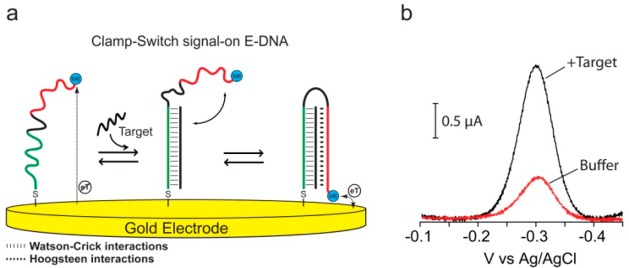
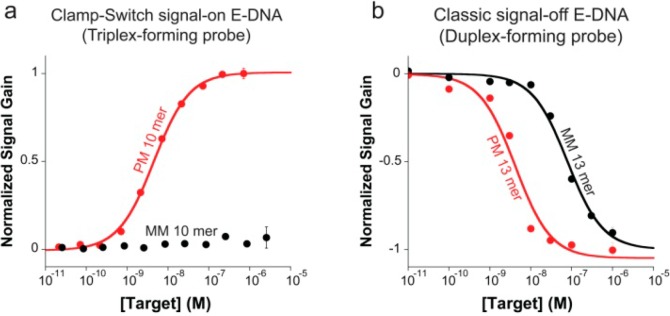
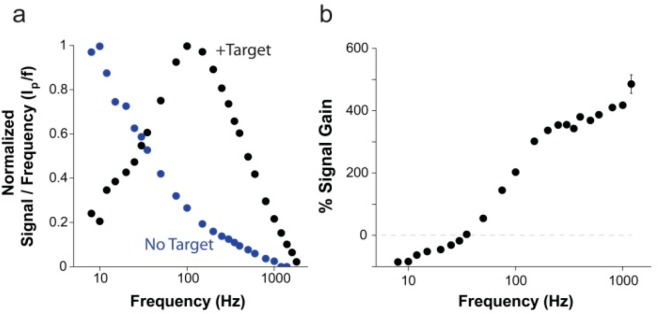
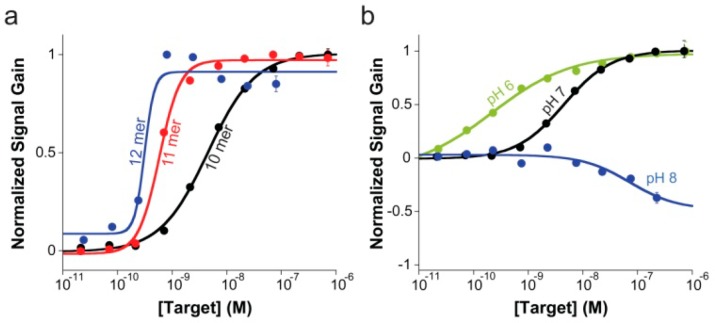
Here we investigate a novel signal-on electrochemical DNA sensor based on the use of a clamp-like DNA probe that binds a complementary target sequence through two distinct and sequential events, which lead to the formation of a triplex DNA structure. We demonstrate that this target-binding mechanism can improve both the affinity and specificity of recognition as opposed to classic probes solely based on Watson-Crick recognition. By using electrochemical signaling to report the conformational change, we demonstrate a signal-on E-DNA sensor with up to 400% signal gain upon target binding. Moreover, we were able to detect with nanomolar affinity a perfectly matched target as short as 10 bases (K(D) = 0.39 nM). Finally, thanks to the molecular "double-check" provided by the concomitant Watson-Crick and Hoogsteen base pairings involved in target recognition, our sensor provides excellent discrimination efficiency toward a single-base mismatched target.
在此,我们研究了一种基于钳状DNA探针的新型信号开启型电化学DNA传感器,该探针通过两个不同且连续的事件与互补靶序列结合,从而导致三链DNA结构的形成。我们证明,与仅基于沃森-克里克识别的经典探针相比,这种靶标结合机制可以提高识别的亲和力和特异性。通过使用电化学信号来报告构象变化,我们展示了一种信号开启型E-DNA传感器,在靶标结合时信号增益高达400%。此外,我们能够以纳摩尔亲和力检测短至10个碱基的完全匹配靶标(K(D)=0.39 nM)。最后,由于靶标识别过程中涉及的沃森-克里克和 hoogsteen碱基配对提供了分子“双重检查”,我们的传感器对单碱基错配靶标具有出色的区分效率。