Brown Daniel R, Barton Geraint, Pan Zhensheng, Buck Martin, Wigneshweraraj Sivaramesh
MRC Centre for Molecular Bacteriology and Infection, Imperial College London, London SW7 2AZ, UK.
Centre for Systems Biology and Bioinformatics, Division of Biosciences, Imperial College London, London SW7 2AZ, UK.
Nat Commun. 2014 Jun 20;5:4115. doi: 10.1038/ncomms5115.
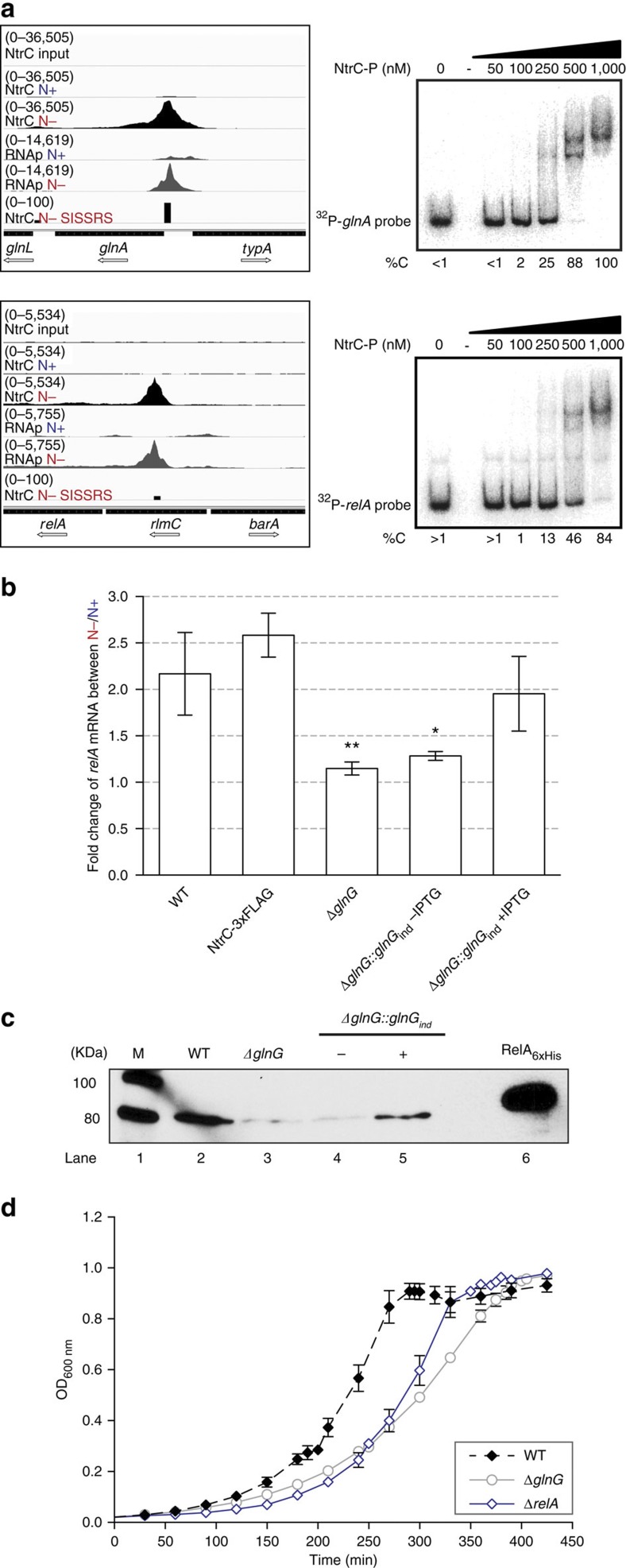
Assimilation of nitrogen is an essential process in bacteria. The nitrogen regulation stress response is an adaptive mechanism used by nitrogen-starved Escherichia coli to scavenge for alternative nitrogen sources and requires the global transcriptional regulator NtrC. In addition, nitrogen-starved E. coli cells synthesize a signal molecule, guanosine tetraphosphate (ppGpp), which serves as an effector molecule of many processes including transcription to initiate global physiological changes, collectively termed the stringent response. The regulatory mechanisms leading to elevated ppGpp levels during nutritional stresses remain elusive. Here, we show that transcription of relA, a key gene responsible for the synthesis of ppGpp, is activated by NtrC during nitrogen starvation. The results reveal that NtrC couples these two major bacterial stress responses to manage conditions of nitrogen limitation, and provide novel mechanistic insights into how a specific nutritional stress leads to elevating ppGpp levels in bacteria.
氮的同化是细菌中的一个重要过程。氮调节应激反应是氮饥饿的大肠杆菌用来寻找替代氮源的一种适应性机制,需要全局转录调节因子NtrC。此外,氮饥饿的大肠杆菌细胞会合成一种信号分子四磷酸鸟苷(ppGpp),它作为许多过程的效应分子,包括转录,以启动全局生理变化,统称为严谨反应。营养应激期间导致ppGpp水平升高的调节机制仍然不清楚。在这里,我们表明,relA(负责ppGpp合成的关键基因)的转录在氮饥饿期间被NtrC激活。结果表明,NtrC将这两种主要的细菌应激反应联系起来,以应对氮限制条件,并为特定营养应激如何导致细菌中ppGpp水平升高提供了新的机制见解。