Kwon MiYoung, Lu Zhong-Lin, Miller Alexandra, Kazlas Melanie, Hunter David G, Bex Peter J
Schepens Eye Research Institute/Massachusetts Eye and Ear Infirmary, Boston, Massachusetts, United States of America; Department of Ophthalmology, Harvard Medical School, Boston, Massachusetts, United States of America.
Department of Psychology, Ohio State University, Columbus, Ohio, United States of America.
PLoS One. 2014 Jun 24;9(6):e100156. doi: 10.1371/journal.pone.0100156. eCollection 2014.
To measure binocular interaction in amblyopes using a rapid and patient-friendly computer-based method, and to test the feasibility of the assessment in the clinic.
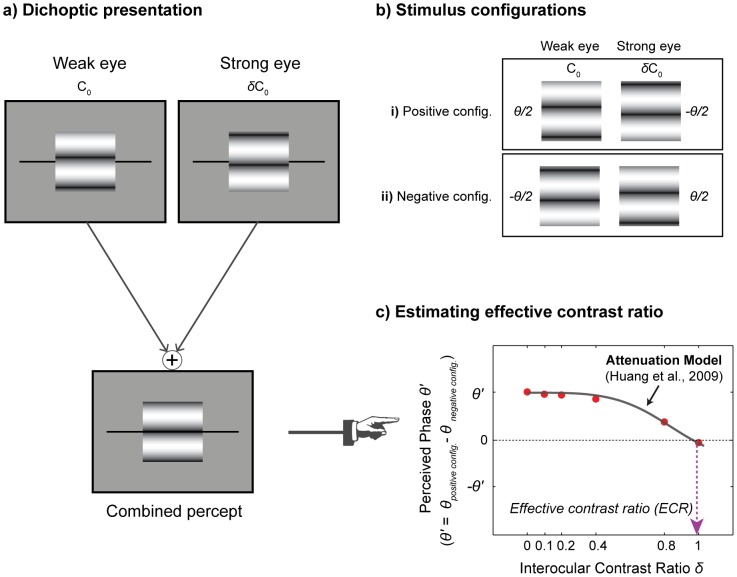
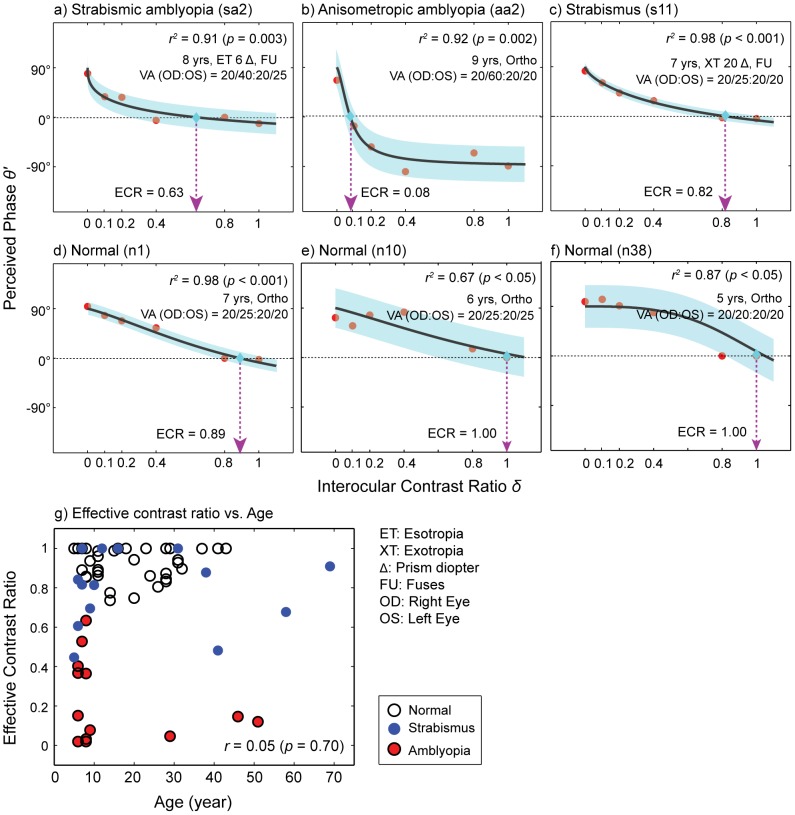
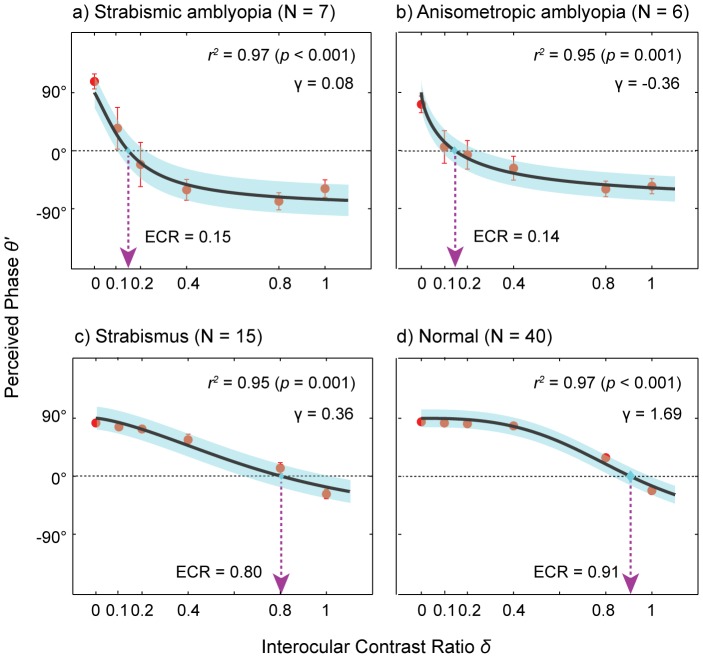
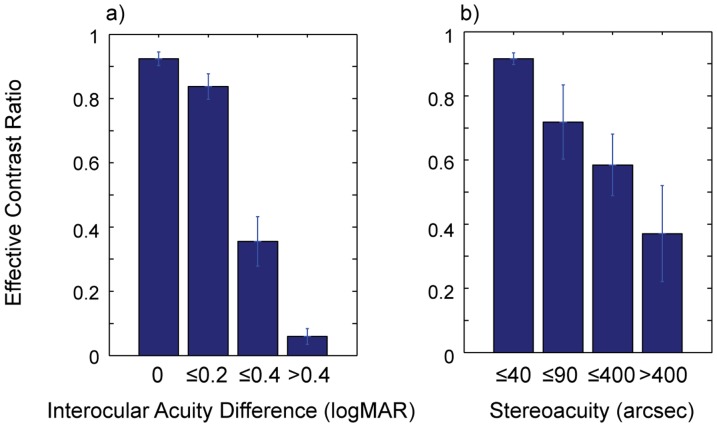
Binocular interaction was assessed in subjects with strabismic amblyopia (n = 7), anisometropic amblyopia (n = 6), strabismus without amblyopia (n = 15) and normal vision (n = 40). Binocular interaction was measured with a dichoptic phase matching task in which subjects matched the position of a binocular probe to the cyclopean perceived phase of a dichoptic pair of gratings whose contrast ratios were systematically varied. The resulting effective contrast ratio of the weak eye was taken as an indicator of interocular imbalance. Testing was performed in an ophthalmology clinic under 8 mins. We examined the relationships between our binocular interaction measure and standard clinical measures indicating abnormal binocularity such as interocular acuity difference and stereoacuity. The test-retest reliability of the testing method was also evaluated.
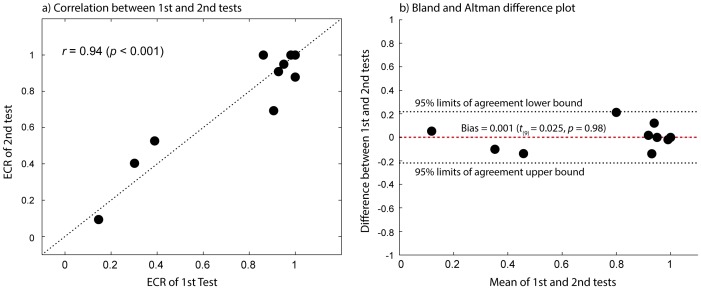
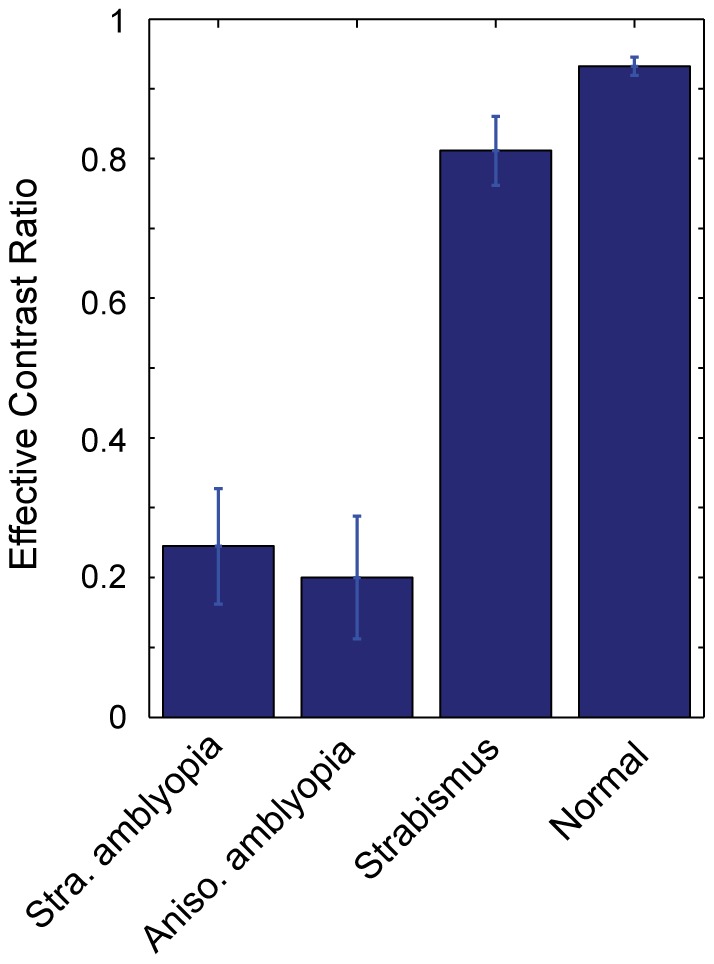
Compared to normally-sighted controls, amblyopes exhibited significantly reduced effective contrast (∼20%) of the weak eye, suggesting a higher contrast requirement for the amblyopic eye compared to the fellow eye. We found that the effective contrast ratio of the weak eye covaried with standard clincal measures of binocular vision. Our results showed that there was a high correlation between the 1st and 2nd measurements (r = 0.94, p<0.001) but without any significant bias between the two.
Our findings demonstrate that abnormal binocular interaction can be reliably captured by measuring the effective contrast ratio of the weak eye and quantitative assessment of binocular interaction is a quick and simple test that can be performed in the clinic. We believe that reliable and timely assessment of deficits in a binocular interaction may improve detection and treatment of amblyopia.
采用一种快速且对患者友好的基于计算机的方法测量弱视患者的双眼相互作用,并测试该评估方法在临床中的可行性。
对患有斜视性弱视(n = 7)、屈光参差性弱视(n = 6)、无弱视的斜视(n = 15)和视力正常(n = 40)的受试者进行双眼相互作用评估。通过双眼分视相位匹配任务测量双眼相互作用,在该任务中,受试者将双眼探测器的位置与一对双眼分视光栅的独眼感知相位相匹配,这对光栅的对比度比率会系统地变化。将弱势眼的有效对比度比率作为眼间不平衡的指标。测试在眼科诊所进行,用时8分钟以内。我们研究了双眼相互作用测量值与表明双眼异常的标准临床测量值(如眼间视力差异和立体视锐度)之间的关系。还评估了测试方法的重测信度。
与视力正常的对照组相比,弱视患者的弱势眼有效对比度显著降低(约20%),这表明弱视眼与对侧眼相比需要更高的对比度。我们发现弱势眼的有效对比度比率与双眼视觉的标准临床测量值相关。我们的结果表明,第一次和第二次测量之间存在高度相关性(r = 0.94,p<0.001),但两者之间没有任何显著偏差。
我们的研究结果表明,通过测量弱势眼的有效对比度比率可以可靠地捕捉到异常的双眼相互作用,双眼相互作用的定量评估是一种可在临床中进行的快速简单测试。我们认为,对双眼相互作用缺陷进行可靠且及时的评估可能会改善弱视的检测和治疗。