Nomata Jiro, Kondo Toru, Mizoguchi Tadashi, Tamiaki Hitoshi, Itoh Shigeru, Fujita Yuichi
1] Graduate School of Bioagricultural Sciences, Nagoya University, Furo-cho, Chikusa-ku, Nagoya 464-8601, Japan [2].
1] Graduate School of Science, Nagoya University, Furo-cho, Chikusa-ku, Nagoya 464-8602, Japan [2].
Sci Rep. 2014 Jun 26;4:5455. doi: 10.1038/srep05455.
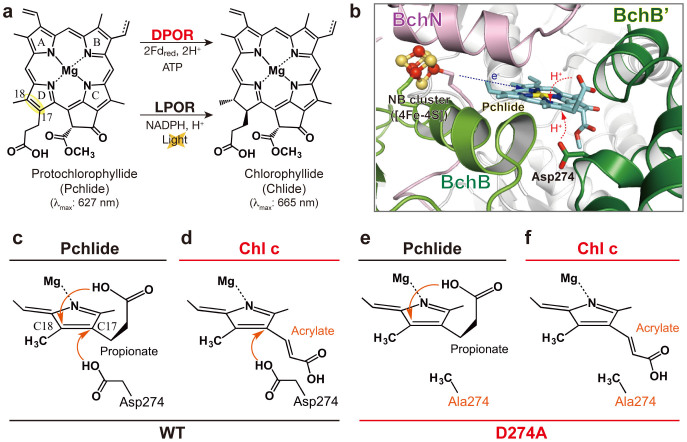
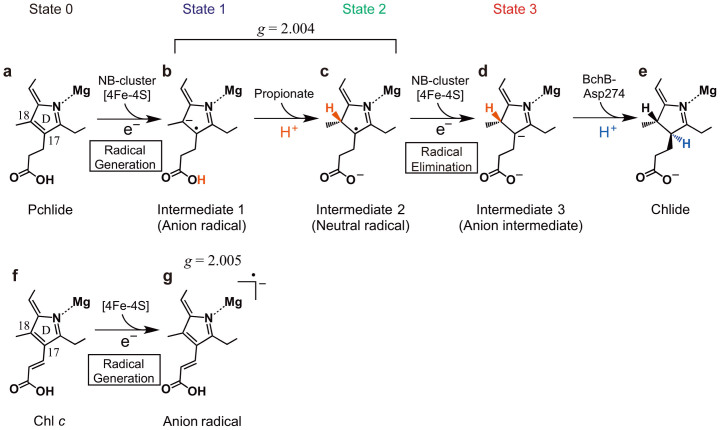
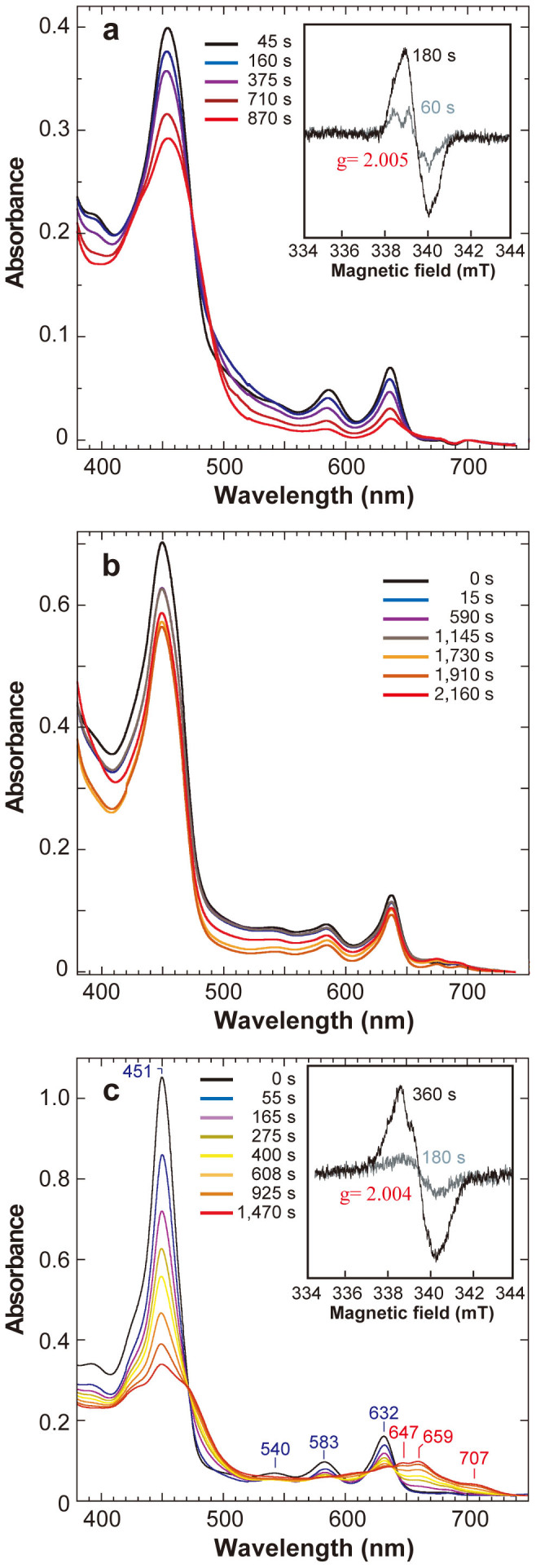
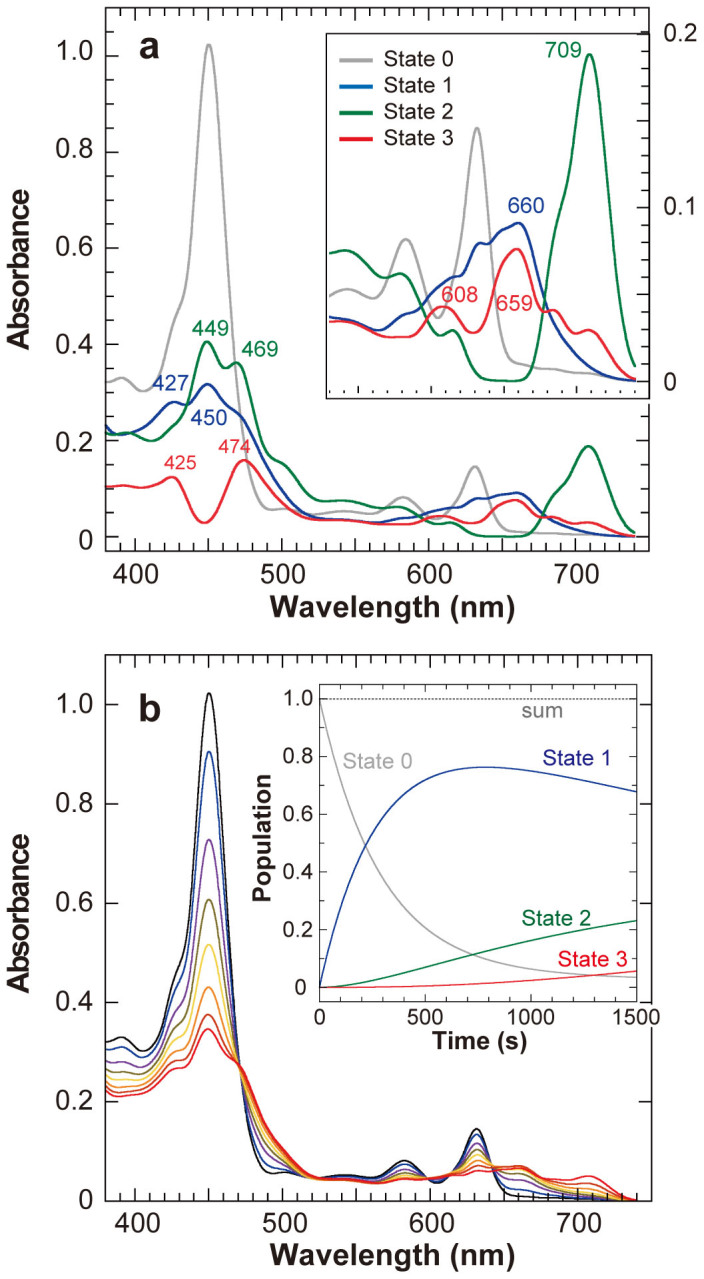
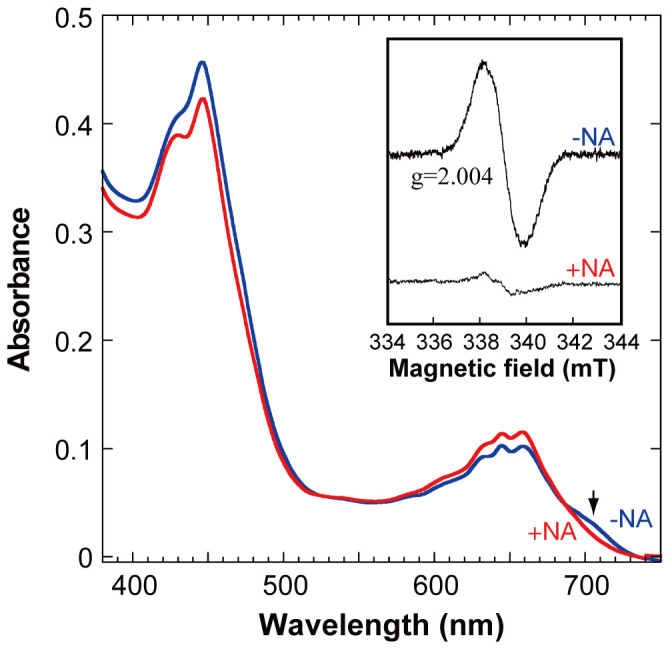
Photosynthesis converts solar energy to chemical energy using chlorophylls (Chls). In a late stage of biosynthesis of Chls, dark-operative protochlorophyllide (Pchlide) oxidoreductase (DPOR), a nitrogenase-like enzyme, reduces the C17 = C18 double bond of Pchlide and drastically changes the spectral properties suitable for photosynthesis forming the parental chlorin ring for Chl a. We previously proposed that the spatial arrangement of the proton donors determines the stereospecificity of the Pchlide reduction based on the recently resolved structure of the DPOR catalytic component, NB-protein. However, it was not clear how the two-electron and two-proton transfer events are coordinated in the reaction. In this study, we demonstrate that DPOR initiates a single electron transfer reaction from a [4Fe-4S]-cluster (NB-cluster) to Pchlide, generating Pchlide anion radicals followed by a single proton transfer, and then, further electron/proton transfer steps transform the anion radicals into chlorophyllide (Chlide). Thus, DPOR is a unique iron-sulphur enzyme to form substrate radicals followed by sequential proton- and electron-transfer steps with the protein folding very similar to that of nitrogenase. This novel radical-mediated reaction supports the biosynthesis of Chl in a wide variety of photosynthetic organisms.
光合作用利用叶绿素(Chls)将太阳能转化为化学能。在叶绿素生物合成的后期,暗反应原叶绿素酸酯(Pchlide)氧化还原酶(DPOR),一种类似于固氮酶的酶,还原Pchlide的C17 = C18双键,并极大地改变适合光合作用的光谱特性,形成叶绿素a的母体二氢卟吩环。我们之前基于最近解析的DPOR催化组分NB-蛋白的结构提出,质子供体的空间排列决定了Pchlide还原的立体特异性。然而,尚不清楚反应中双电子和双质子转移事件是如何协调的。在本研究中,我们证明DPOR启动从[4Fe-4S]簇(NB-簇)到Pchlide的单电子转移反应,生成Pchlide阴离子自由基,随后进行单质子转移,然后,进一步的电子/质子转移步骤将阴离子自由基转化为叶绿素酸酯(Chlide)。因此,DPOR是一种独特的铁硫酶,可形成底物自由基,随后进行连续的质子和电子转移步骤,其蛋白质折叠与固氮酶非常相似。这种新型的自由基介导反应支持多种光合生物中叶绿素的生物合成。