Department of Applied Chemistry, Faculty of Science and Engineering, Chuo University, 1-13-27 Kasuga, Bunkyo-ku 112-8551, Japan.
Department of Chemistry, The Hong Kong University of Science and Technology, Clear Water Bay, Kowloon, Hong Kong.
Nat Commun. 2014 Jun 26;5:4245. doi: 10.1038/ncomms5245.
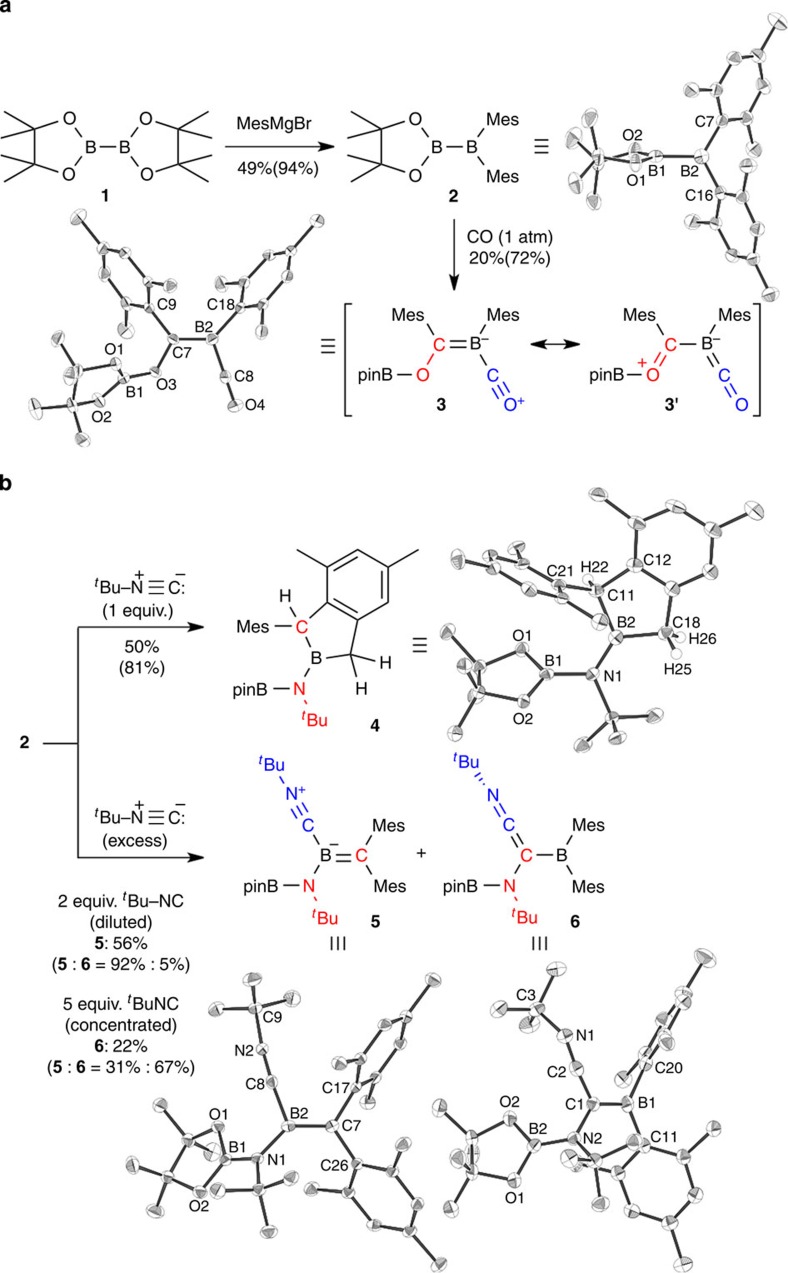
Transition metal reagents and catalysts are generally effective to cleave all three bonds (one σ and two π) in a triple bond despite its high bonding energy. Recently, chemistry of single-bond cleavage by using main-group element compounds is rapidly being developed in the absence of transition metals. However, the cleavage of a triple bond using non-transition-metal compounds is less explored. Here we report that an unsymmetrical diborane(4) compound could react with carbon monoxide and tert-butyl isonitrile at room temperature. In the latter case, the carbon-nitrogen triple bond was completely cleaved in the absence of transition metal as confirmed by X-ray crystallographic analysis, (13)C NMR spectroscopy with (13)C labelling and DFT calculations. The DFT calculations also revealed the detailed reaction mechanism and indicated that the key for the carbon-nitrogen triple-bond cleavage could be attributed to the presence of nucleophilic nitrogen atom in one of the intermediates.
过渡金属试剂和催化剂通常能够有效地切断三键中的所有三个键(一个σ键和两个π键),尽管三键具有很高的键能。最近,在没有过渡金属的情况下,利用主族元素化合物进行单键断裂的化学迅速得到发展。然而,利用非过渡金属化合物切断三键的研究较少。在这里,我们报告一种不对称二硼烷(4)化合物可以在室温下与一氧化碳和叔丁基异腈反应。在后一种情况下,通过 X 射线晶体学分析、(13)C 标记的 NMR 光谱和 DFT 计算证实,在没有过渡金属的情况下,碳-氮三键完全被切断。DFT 计算还揭示了详细的反应机制,并表明碳-氮三键断裂的关键可能归因于其中一个中间体中亲核氮原子的存在。