Hintsala Heidi, Kenttä Tuomas V, Tulppo Mikko, Kiviniemi Antti, Huikuri Heikki V, Mäntysaari Matti, Keinänen-Kiukaannemi Sirkka, Bloigu Risto, Herzig Karl-Heinz, Antikainen Riitta, Rintamäki Hannu, Jaakkola Jouni J K, Ikäheimo Tiina M
Center for Environmental and Respiratory Health Research, University of Oulu, Oulu, Finland; Medical Research Center Oulu, Oulu University Hospital and University of Oulu, Oulu, Finland.
Medical Research Center Oulu, Oulu University Hospital and University of Oulu, Oulu, Finland; Institute of Clinical Medicine, Department of Internal Medicine, University of Oulu, Oulu, Finland.
PLoS One. 2014 Jul 1;9(7):e99973. doi: 10.1371/journal.pone.0099973. eCollection 2014.
The aim of our study was to assess the effect of short-term cold exposure, typical in subarctic climate, on cardiac electrical function among untreated middle-aged hypertensive men.
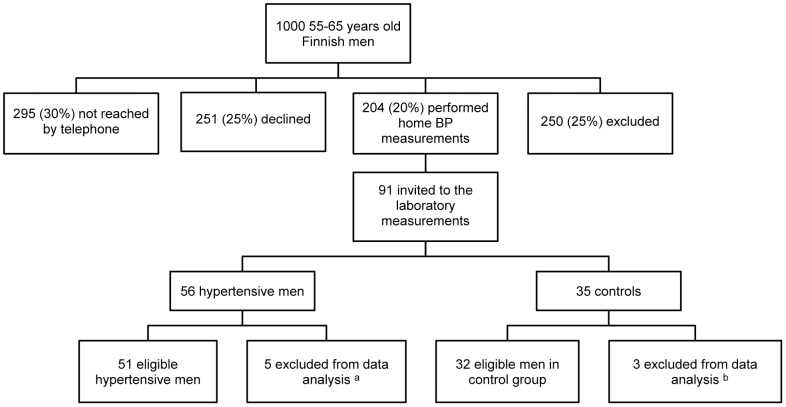
We conducted a population-based recruitment of 51 hypertensive men and a control group of 32 men without hypertension (age 55-65 years) who underwent whole-body cold exposure (15 min exposure to temperature -10°C, wind 3 m/s, winter clothes). Conduction times and amplitudes, vectorcardiography, arrhythmias, and heart rate variability (autonomic nervous function) were assessed.
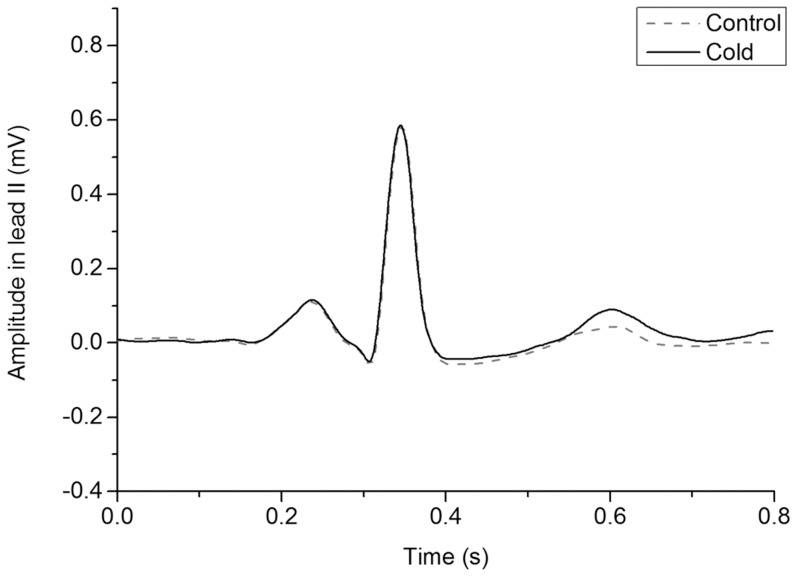
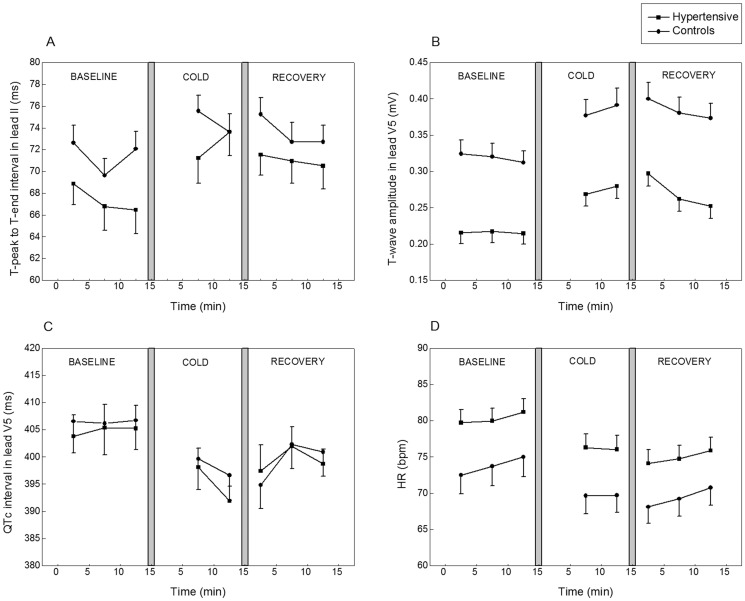
Short-term cold exposure increased T-peak to T-end interval from 67 to 72 ms (p<0.001) and 71 to 75 ms (p<0.001) and T-wave amplitude from 0.12 to 0.14 mV (p<0.001) and from 0.17 to 0.21 mV (p<0.001), while QTc interval was shortened from 408 to 398 ms (p<0.001) and from 410 to 401 ms (p<0.001) among hypertensive men and controls, respectively. Cold exposure increased both low (from 390 to 630 ms2 (p<0.001) and 380 to 700 ms2 (p<0.001), respectively) and high frequency heart rate variability (from 90 to 190 ms2 (p<0.001) and 150 to 300 ms2 (p<0.001), respectively), while low-to-high frequency-ratio was reduced. In addition, the frequency of ventricular ectopic beats increased slightly during cold exposure. The cold induced changes were similar between untreated hypertensive men and controls.
Short-term cold exposure with moderate facial and mild whole body cooling resulted in prolongation of T-peak to T-end interval and higher T-wave amplitude while QTc interval was shortened. These changes of ventricular repolarization may have resulted from altered cardiac autonomic regulation and were unaffected by untreated hypertension.
ClinicalTrials.gov NCT02007031.
我们研究的目的是评估在亚北极气候中常见的短期寒冷暴露对未经治疗的中年高血压男性心脏电功能的影响。
我们以人群为基础招募了51名高血压男性和一个由32名无高血压男性组成的对照组(年龄55 - 65岁),他们接受了全身寒冷暴露(暴露于-10°C温度、3米/秒风速、穿着冬衣15分钟)。评估了传导时间和幅度、向量心电图、心律失常以及心率变异性(自主神经功能)。
短期寒冷暴露使高血压男性和对照组的T波峰至T波末间期分别从67毫秒增加到72毫秒(p<0.001)和从71毫秒增加到75毫秒(p<0.001),T波幅度分别从0.12毫伏增加到0.14毫伏(p<0.001)和从0.17毫伏增加到0.21毫伏(p<0.001),而QTc间期分别从408毫秒缩短到398毫秒(p<0.001)和从410毫秒缩短到401毫秒(p<0.001)。寒冷暴露增加了低频(分别从390毫秒²增加到630毫秒²(p<0.001)和从380毫秒²增加到700毫秒²(p<0.001))和高频心率变异性(分别从90毫秒²增加到190毫秒²(p<0.001)和从150毫秒²增加到300毫秒²(p<0.001)),而低频与高频比值降低。此外,寒冷暴露期间室性早搏的频率略有增加。未经治疗的高血压男性和对照组中寒冷诱导的变化相似。
伴有适度面部和轻度全身降温的短期寒冷暴露导致T波峰至T波末间期延长和T波幅度升高,而QTc间期缩短。心室复极的这些变化可能是由心脏自主神经调节改变引起的,且不受未经治疗的高血压影响。
ClinicalTrials.gov NCT02007031。