Elfrink Marlies E C, Moll Henriette A, Kiefte-de Jong Jessica C, Jaddoe Vincent W V, Hofman Albert, ten Cate Jacob M, Veerkamp Jaap S J
Department of Cariology, Endodontology and Pedodontology, Academic Centre for Dentistry Amsterdam (ACTA), University of Amsterdam and VU University Amsterdam, Amsterdam, The Netherlands.
Department of Pediatrics, Erasmus Medical Centre - Sophia Children's Hospital, Rotterdam, The Netherlands.
PLoS One. 2014 Jul 2;9(7):e91057. doi: 10.1371/journal.pone.0091057. eCollection 2014.
Deciduous Molar Hypomineralisation (DMH) and Molar Incisor Hypomineralisation (MIH) are common developmental disturbances in pediatric dentistry. Their occurrence is related. The same determinants as suggested for MIH are expected for DMH, though somewhat earlier in life. Perinatal medical problems may influence the prevalence of DMH but this has not been studied sufficiently.
This study aimed to identify possible determinants of DMH in a prospective cohort study among 6-year-old children.
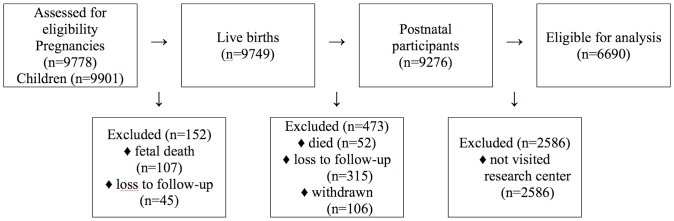
This study was embedded in the Generation R Study, a population-based prospective cohort study from fetal life until young adulthood. The the data were used to identify the determinants of DMH. Clinical photographs of clean, moist teeth were taken with an intra-oral camera in 6690 children (mean age 6.2 years; 49.9% girls). Data on possible determinants that had occurred during pregnancy and/or the child's first year of life were on the basis of manual standardized measurements (like length and weight) and questionnaires. Multivariate analyse with backward and forward selection was performed.
A number of factors in the pre-, peri- and postnatal phase were found to be associated with DMH. After multivariate logistic regression analyses, Dutch ethnic background, low birth weight, maternal alcohol consumption during pregnancy, and fever episodes in the first year of the child's life were found to play a role in the development of DMH in 6-year-old children.
This study shows that Dutch ethnicity, low birth weight, alcohol consumption by the mother during pregnancy and any fever in the first year of the child's life are associated with DMH. Not only childhood factors but also prenatal lifestyle factors need to be taken into account when studying determinants for DMH.
乳牙矿化不全(DMH)和乳磨牙及恒前磨牙矿化不全(MIH)是儿童牙科学中常见的发育障碍。它们的发生有关联。虽然DMH的发生时间比MIH稍早,但预计与MIH的决定因素相同。围产期医学问题可能影响DMH的患病率,但这方面的研究尚不充分。
本研究旨在通过对6岁儿童进行前瞻性队列研究,确定DMH可能的决定因素。
本研究纳入了Generation R研究,这是一项基于人群的前瞻性队列研究,从胎儿期直至成年早期。利用这些数据确定DMH的决定因素。用口腔内相机为6690名儿童(平均年龄6.2岁;49.9%为女孩)清洁、湿润的牙齿拍摄临床照片。关于孕期和/或儿童出生后第一年可能的决定因素的数据基于手动标准化测量(如身长和体重)和问卷调查。进行了向前和向后选择的多变量分析。
发现产前、围产期和产后阶段的一些因素与DMH有关。经过多变量逻辑回归分析,发现荷兰族裔背景、低出生体重、孕期母亲饮酒以及儿童出生后第一年的发热发作在6岁儿童DMH的发生中起作用。
本研究表明,荷兰族裔、低出生体重、孕期母亲饮酒以及儿童出生后第一年的任何发热都与DMH有关。在研究DMH的决定因素时,不仅要考虑儿童期因素,还要考虑产前生活方式因素。