Dionisio Kathie L, Baxter Lisa K, Chang Howard H
National Exposure Research Laboratory, U.S. Environmental Protection Agency, Research Triangle Park, North Carolina, USA.
Environ Health Perspect. 2014 Nov;122(11):1216-24. doi: 10.1289/ehp.1307772. Epub 2014 Jul 8.
Using multipollutant models to understand combined health effects of exposure to multiple pollutants is becoming more common. However, complex relationships between pollutants and differing degrees of exposure error across pollutants can make health effect estimates from multipollutant models difficult to interpret.
We aimed to quantify relationships between multiple pollutants and their associated exposure errors across metrics of exposure and to use empirical values to evaluate potential attenuation of coefficients in epidemiologic models.
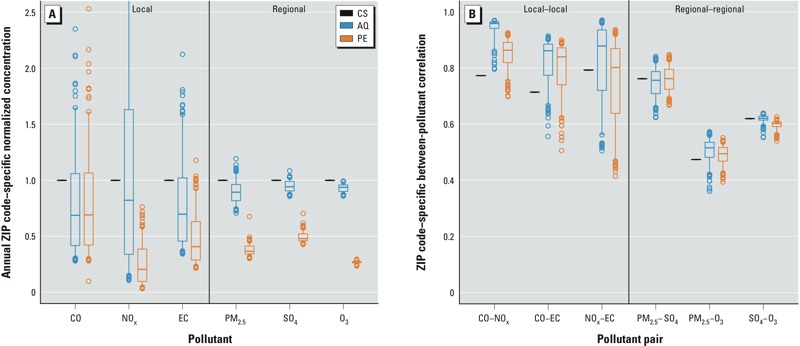
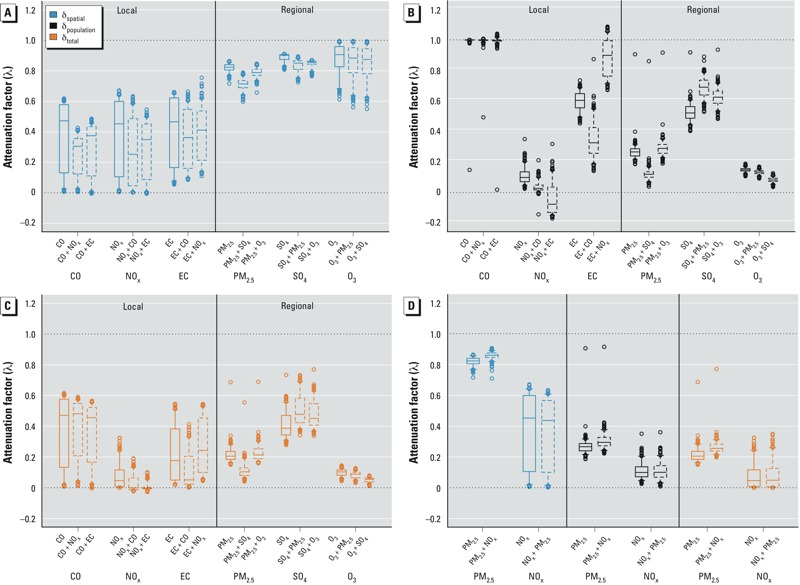
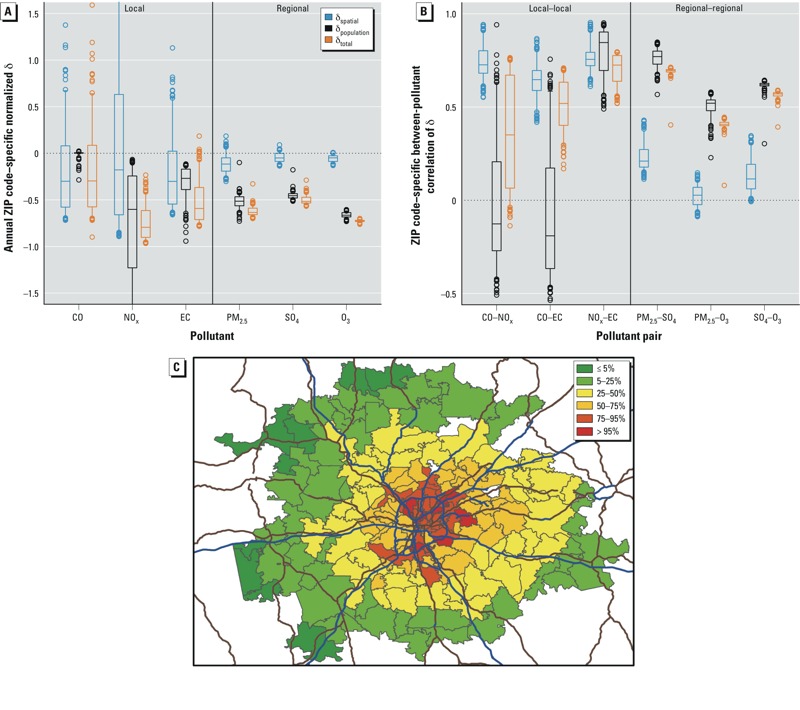
We used three daily exposure metrics (central-site measurements, air quality model estimates, and population exposure model estimates) for 193 ZIP codes in the Atlanta, Georgia, metropolitan area from 1999 through 2002 for PM2.5 and its components (EC and SO4), as well as O3, CO, and NOx, to construct three types of exposure error: δspatial (comparing air quality model estimates to central-site measurements), δpopulation (comparing population exposure model estimates to air quality model estimates), and δtotal (comparing population exposure model estimates to central-site measurements). We compared exposure metrics and exposure errors within and across pollutants and derived attenuation factors (ratio of observed to true coefficient for pollutant of interest) for single- and bipollutant model coefficients.
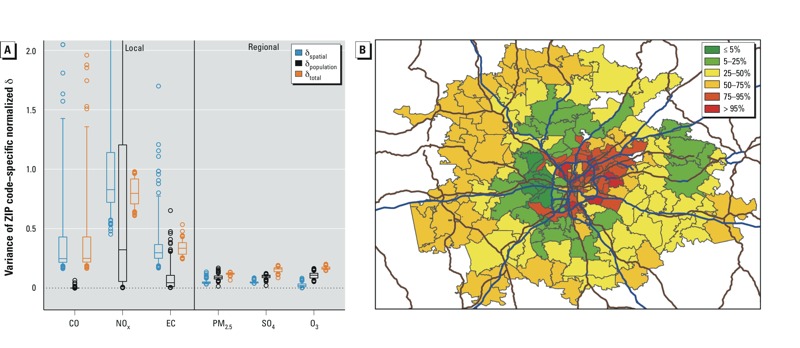
Pollutant concentrations and their exposure errors were moderately to highly correlated (typically, > 0.5), especially for CO, NOx, and EC (i.e., "local" pollutants); correlations differed across exposure metrics and types of exposure error. Spatial variability was evident, with variance of exposure error for local pollutants ranging from 0.25 to 0.83 for δspatial and δtotal. The attenuation of model coefficients in single- and bipollutant epidemiologic models relative to the true value differed across types of exposure error, pollutants, and space.
Under a classical exposure-error framework, attenuation may be substantial for local pollutants as a result of δspatial and δtotal with true coefficients reduced by a factor typically < 0.6 (results varied for δpopulation and regional pollutants).
使用多污染物模型来了解暴露于多种污染物的综合健康影响正变得越来越普遍。然而,污染物之间复杂的关系以及不同污染物之间不同程度的暴露误差会使多污染物模型的健康影响估计难以解释。
我们旨在量化多种污染物与其在不同暴露指标下的相关暴露误差之间的关系,并使用经验值来评估流行病学模型中系数的潜在衰减。
我们使用了1999年至2002年佐治亚州亚特兰大大都市区193个邮政编码区域的三种每日暴露指标(中心站点测量值、空气质量模型估计值和人群暴露模型估计值)来研究细颗粒物(PM2.5)及其成分(元素碳和硫酸根)以及臭氧(O3)、一氧化碳(CO)和氮氧化物(NOx),构建三种类型的暴露误差:δ空间误差(将空气质量模型估计值与中心站点测量值进行比较)、δ人群误差(将人群暴露模型估计值与空气质量模型估计值进行比较)和δ总误差(将人群暴露模型估计值与中心站点测量值进行比较)。我们比较了不同污染物内部和之间的暴露指标和暴露误差,并得出了单污染物和双污染物模型系数的衰减因子(感兴趣污染物的观测系数与真实系数之比)。
污染物浓度与其暴露误差呈中度至高度相关(通常>0.5),特别是对于一氧化碳、氮氧化物和元素碳(即 “本地” 污染物);不同暴露指标和暴露误差类型的相关性有所不同。空间变异性明显,本地污染物的暴露误差方差对于δ空间误差和δ总误差范围为0.25至0.83。单污染物和双污染物流行病学模型中模型系数相对于真实值的衰减在不同暴露误差类型、污染物和空间中有所不同。
在经典的暴露误差框架下,由于δ空间误差和δ总误差,本地污染物的衰减可能很大,真实系数通常会降低至<0.6的因子(δ人群误差和区域污染物的结果有所不同)。