Kumfor Fiona, Irish Muireann, Hodges John R, Piguet Olivier
Neuroscience Research Australia, Randwick Sydney, NSW, Australia ; School of Medical Sciences, The University of New South Wales Sydney, NSW, Australia ; ARC Centre of Excellence in Cognition and its Disorders Sydney, NSW, Australia.
Neuroscience Research Australia, Randwick Sydney, NSW, Australia ; School of Medical Sciences, The University of New South Wales Sydney, NSW, Australia ; School of Psychology, The University of New South Wales Sydney, NSW, Australia.
Front Behav Neurosci. 2014 Jun 24;8:225. doi: 10.3389/fnbeh.2014.00225. eCollection 2014.
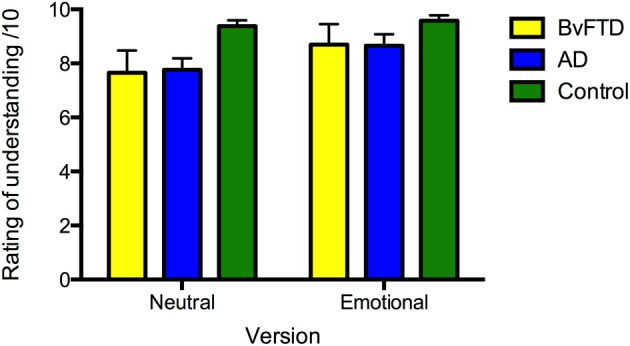
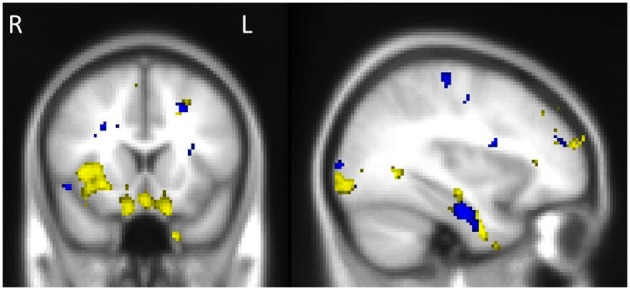
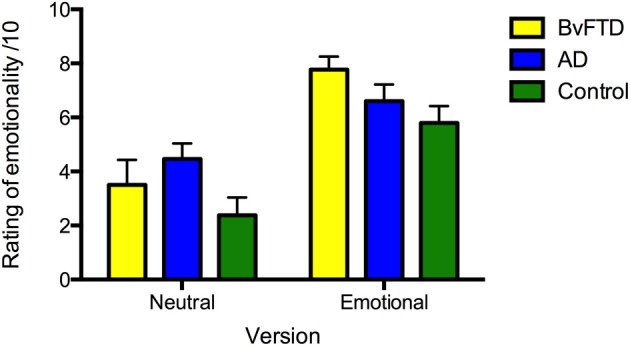
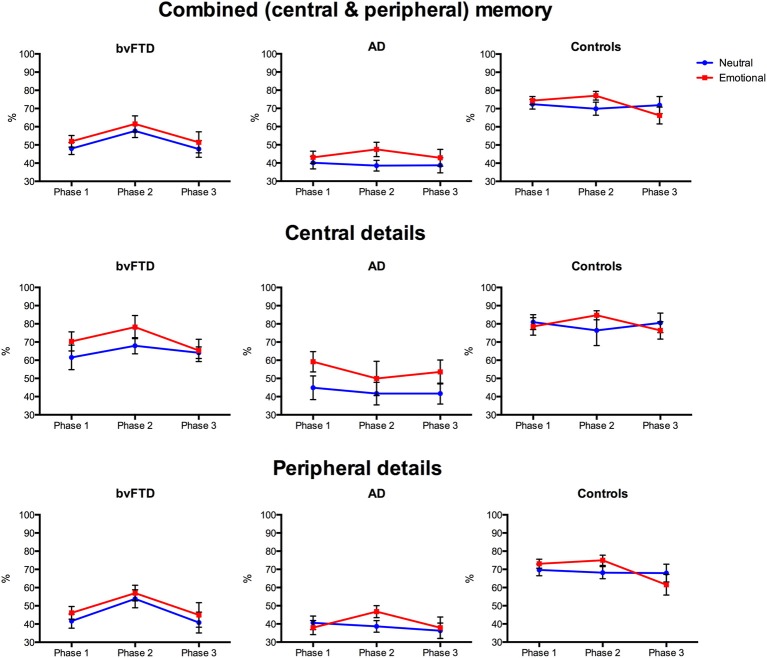
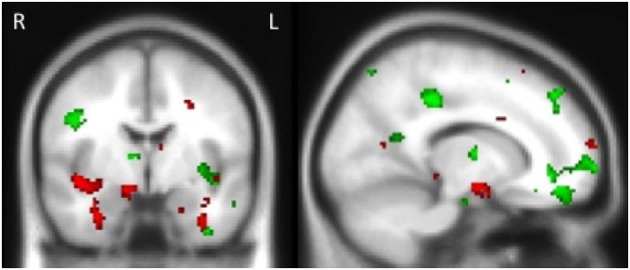
Emotional events gain special priority in how they are remembered, with emotionally arousing events typically recalled more vividly and with greater confidence than non-emotional events. In dementia, memory and emotion processing are affected to varying degrees, however, whether emotional enhancement of memory for complex ecologically-valid events is differentially affected across dementia syndromes remains unclear, with previous studies examining effects of emotion on simple visual recognition only. Here, we examined memory for an emotionally arousing short story and a closely matched, emotionally neutral story in behavioral-variant frontotemporal dementia (bvFTD) (n = 13) and Alzheimer's disease (AD) (n = 14), and contrasted their performance with healthy controls (n = 12). Multiple-choice recognition memory for specific details of the story was assessed after a 1-h delay. While AD and control groups showed enhanced memory for the emotional story, the bvFTD group recalled a similar number of details from the emotional and neutral stories. Voxel-based morphometry analyses revealed emotional enhancement of memory correlated with distinct brain regions in each patient group. In AD, emotional enhancement was associated with integrity of the bilateral hippocampus, parahippocampal gyri, temporal fusiform gyrus and frontal pole, regions typically implicated in memory processes. In contrast in bvFTD, integrity of emotion processing regions, including the orbitofrontal cortex, right amygdala and right insula, correlated with the extent emotion enhanced memory. Our results reveal that integrity of frontal and temporal regions determine the quality and nature of emotional memories. While emotional enhancement of memory is present in mild AD, in bvFTD emotion does not facilitate memory retrieval for complex realistic events. This attenuation of emotional enhancement is due to degradation of emotion processing regions, which may be important for modulating levels of arousal in response to emotional events in these patients.
情感事件在记忆方式上具有特殊的优先级,与非情感事件相比,引发情感的事件通常能被更生动、更自信地回忆起来。在痴呆症中,记忆和情感处理会受到不同程度的影响,然而,对于复杂的、具有生态学效度的事件,其记忆的情感增强效应在不同痴呆综合征中是否受到不同影响仍不清楚,之前的研究仅考察了情感对简单视觉识别的影响。在此,我们在行为变异型额颞叶痴呆(bvFTD)患者(n = 13)和阿尔茨海默病(AD)患者(n = 14)中,研究了对一个引发情感的短篇小说和一个紧密匹配的情感中性短篇小说的记忆,并将他们的表现与健康对照组(n = 12)进行对比。在延迟1小时后,评估对故事特定细节的多项选择识别记忆。虽然AD组和对照组对情感故事的记忆有所增强,但bvFTD组从情感故事和中性故事中回忆出的细节数量相似。基于体素的形态学分析显示,每个患者组中记忆的情感增强与不同的脑区相关。在AD中,情感增强与双侧海马体、海马旁回、颞叶梭状回和额极的完整性有关,这些区域通常与记忆过程有关。相比之下,在bvFTD中,包括眶额皮质、右杏仁核和右岛叶在内的情感处理区域的完整性与情感增强记忆的程度相关。我们的结果表明,额叶和颞叶区域的完整性决定了情感记忆的质量和性质。虽然轻度AD中存在记忆的情感增强,但在bvFTD中,情感并不能促进对复杂现实事件的记忆检索。这种情感增强的减弱是由于情感处理区域的退化,这可能对调节这些患者对情感事件的唤醒水平很重要。