
一种基于图注意力推断动态传染病传播的新框架:韩国新冠肺炎案例研究
A novel framework for inferring dynamic infectious disease transmission with graph attention: a COVID-19 case study in Korea.
作者信息
Lee Minji, Choi Heejin, Lee Chang Hyeong
机构信息
Department of Mathematical Sciences, Ulsan National Institute of Science and Technology, UNIST-gil 50, Ulsan, 44919, Republic of Korea.
出版信息
BMC Public Health. 2025 May 22;25(1):1884. doi: 10.1186/s12889-025-23059-7.
INTRODUCTION
Epidemic modeling is crucial for understanding and predicting infectious disease spread. To capture the complexity of real-world transmission, dynamic interactions between individuals with spatial heterogeneity must be considered. This modeling requires high-dimensional epidemic parameters, which can lead to unidentifiability; therefore, integrating various data types for inference is essential to effectively address these challenges.
METHODS
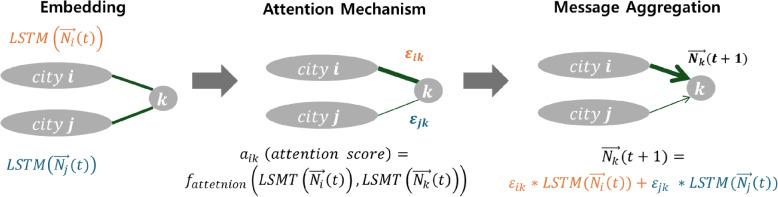
We introduce a novel hybrid framework, Multi-Patch Model Update with Graph Attention Network (MPUGAT), that combines a multi-patch compartmental model with a spatio-temporal deep learning model. MPUGAT employs a GAT (Graph Attention Mechanism) to transform static traffic matrices into dynamic transmission matrices by analyzing patterns in diverse time series data from each city.
RESULTS
We demonstrate the effectiveness of MPUGAT through its application to COVID-19 data from South Korea. By accurately estimating time-varying transmission rates, MPUGAT outperforms traditional models and aligns with actual policies such as social distancing.
CONCLUSION
MPUGAT offers a novel approach for effectively integrating easily accessible, low-dimensional, non-epidemic-related data into epidemic modeling frameworks. Our findings highlight the importance of incorporating dynamic data and utilizing graph attention mechanisms to enhance accuracy of infectious disease modeling and the analysis of policy interventions. This study underscores the potential of leveraging diverse data sources and advanced deep learning techniques to improve epidemic forecasting and inform public health strategies.
引言
疫情建模对于理解和预测传染病传播至关重要。为了捕捉现实世界传播的复杂性,必须考虑个体之间具有空间异质性的动态相互作用。这种建模需要高维疫情参数,这可能导致无法识别;因此,整合各种数据类型进行推断对于有效应对这些挑战至关重要。
方法
我们引入了一种新颖的混合框架,即带图注意力网络的多斑块模型更新(MPUGAT),它将多斑块 compartmental 模型与时空深度学习模型相结合。MPUGAT 采用图注意力机制(GAT),通过分析来自每个城市的不同时间序列数据中的模式,将静态交通矩阵转换为动态传播矩阵。
结果
我们通过将 MPUGAT 应用于韩国的 COVID-19 数据来证明其有效性。通过准确估计随时间变化的传播率,MPUGAT 优于传统模型,并与诸如社交距离等实际政策相符。
结论
MPUGAT 提供了一种新颖的方法,可有效地将易于获取的低维非疫情相关数据整合到疫情建模框架中。我们的研究结果强调了纳入动态数据和利用图注意力机制以提高传染病建模准确性和政策干预分析的重要性。这项研究强调了利用各种数据源和先进深度学习技术来改善疫情预测并为公共卫生策略提供信息的潜力。




 Zotero 插件