Faghih Shiva, Abdolahzadeh Maryam, Mohammadi Mohsen, Hasanzadeh Jafar
Department of Community Nutrition, School of Nutrition and Food Sciences, Shiraz University of Medical Sciences, Shiraz, Iran.
Department of Epidemiology, School of Health and Nutrition, Shiraz University of Medical Sciences, Shiraz, Iran.
Int J Prev Med. 2014 Jun;5(6):796-9.
Vitamin D deficiency is a public health concern even in sunny areas, so we decided to assess the prevalence of vitamin D deficiency and its related factors among university students in Shiraz.
This cross-sectional study was carried out on 254 (128 male and 126 female) university students. Demographic questionnaires and a questionnaire on exposure to sun light and sun protection were completed by the participants. Serum 25OH-vitamin D was measured using a radioimmunoassay kit. Data analysis was done using Statistical Package for Social Sciences (SPSS) software # 16. A P value less than 0.05 was considered as significant.
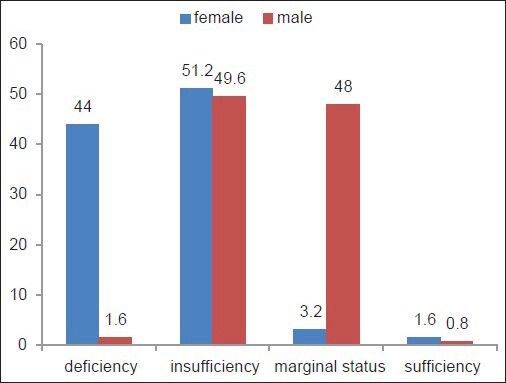
Mean ± standard deviation (SD) of serum 25OH-vitamin D was 49.29 ± 12.87 (nmol/l) and 27.46 ± 10.37 (nmol/l) among male and female students, respectively. 51.2% of female students were vitamin D insufficient and 44% of them had vitamin D deficiency. Prevalence of vitamin D insufficiency and marginal status among male students were 49.5 and 48%, respectively. Serum vitamin D of female students was significantly less than the males (P < 0.001). Serum vitamin D was negatively correlated to sun protection score (P < 0.001, r = 0.50), but there was no correlation between serum vitamin D and sun exposure.
Vitamin D deficiency especially among female students is alarmingly prevalent. Increasing use of sunscreen lotion and clothing style could be the main factors inhibiting endogenous vitamin D synthesis which results in its deficiency.
即使在阳光充足的地区,维生素D缺乏仍是一个公共卫生问题,因此我们决定评估设拉子大学生中维生素D缺乏的患病率及其相关因素。
对254名(128名男性和126名女性)大学生进行了这项横断面研究。参与者完成了人口统计学问卷以及一份关于阳光暴露和防晒的问卷。使用放射免疫分析试剂盒测量血清25羟维生素D。数据分析使用社会科学统计软件包(SPSS)16版进行。P值小于0.05被认为具有统计学意义。
男性和女性学生血清25羟维生素D的平均值±标准差(SD)分别为49.29±12.87(nmol/l)和27.46±10.37(nmol/l)。51.2%的女学生维生素D不足,其中44%维生素D缺乏。男学生中维生素D不足和边缘状态的患病率分别为49.5%和48%。女学生的血清维生素D显著低于男学生(P<0.001)。血清维生素D与防晒得分呈负相关(P<0.001,r=0.50),但血清维生素D与阳光暴露之间无相关性。
维生素D缺乏,尤其是在女学生中,患病率高得惊人。防晒霜和服装使用的增加可能是抑制内源性维生素D合成导致其缺乏的主要因素。