Braga Walter Moises Tobias, da Silva Bruna Raphaeli, de Carvalho Ana Carolina, Maekawa Yumi H, Bortoluzzo Adriana Bruscato, Rizzatti Edgar Gil, Atanackovic Djordje, Colleoni Gisele Wally Braga
Universidade Federal de São Paulo [UNIFESP], Rua Diogo de Faria, 824, 5º andar, Hemocentro, São Paulo, CEP 04037-003, Brazil,
Cancer Immunol Immunother. 2014 Nov;63(11):1189-97. doi: 10.1007/s00262-014-1589-9. Epub 2014 Aug 7.
Multiple myeloma (MM) development involves a series of genetic abnormalities and changes in the bone marrow (BM) microenvironment, favoring the growth of the tumor and failure of local immune control. T regulatory (Treg) cells play an important role in dampening anti-tumor immune responses while T-helper-17 (Th17) cells seem to be critical for the eradication of malignant cells. The aim of our study was to characterize the expression of Treg- and Th17-related genes in total myeloma BM samples to assess their role as biomarkers, prognostic factors, and possible therapeutic targets in this incurable disease.
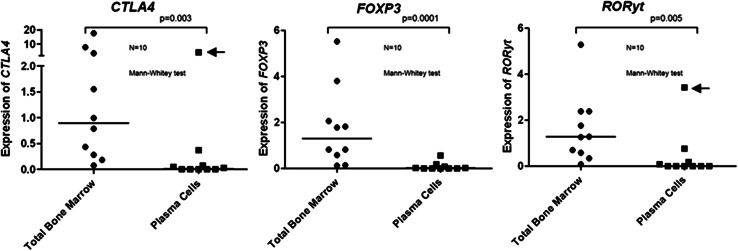
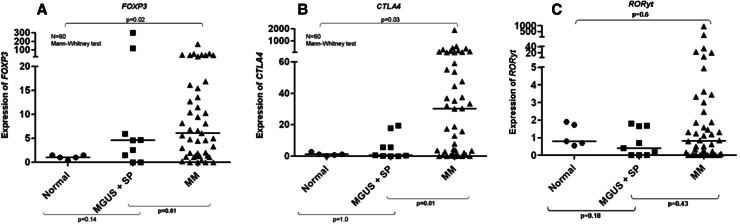
Expression of markers for Treg (FOXP3, CTLA4) and Th17 cells (RORγt) was determined by quantitative real-time PCR in BM aspirates of 46 MM patients, four patients with monoclonal gammopathy of undetermined significance, five solitary plasmacytomas, and five healthy BM donors. Gene expression was evaluated regarding an influence on the patients' overall survival (OS).
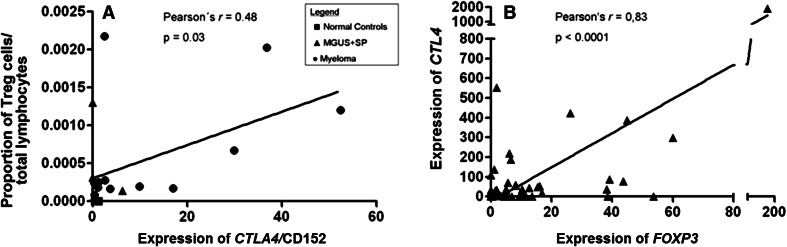
FOXP3 and CTLA4 presented a sixfold (p = 0.02) and 30-fold higher expression (p = 0.03), respectively, in MM patients than in controls. RORγt expression was similar in MM patients and controls. Median OS of MM patients was 16.8 (range 4.5-29.1) months, and international staging system was the only independent prognostic factor for patients survival.
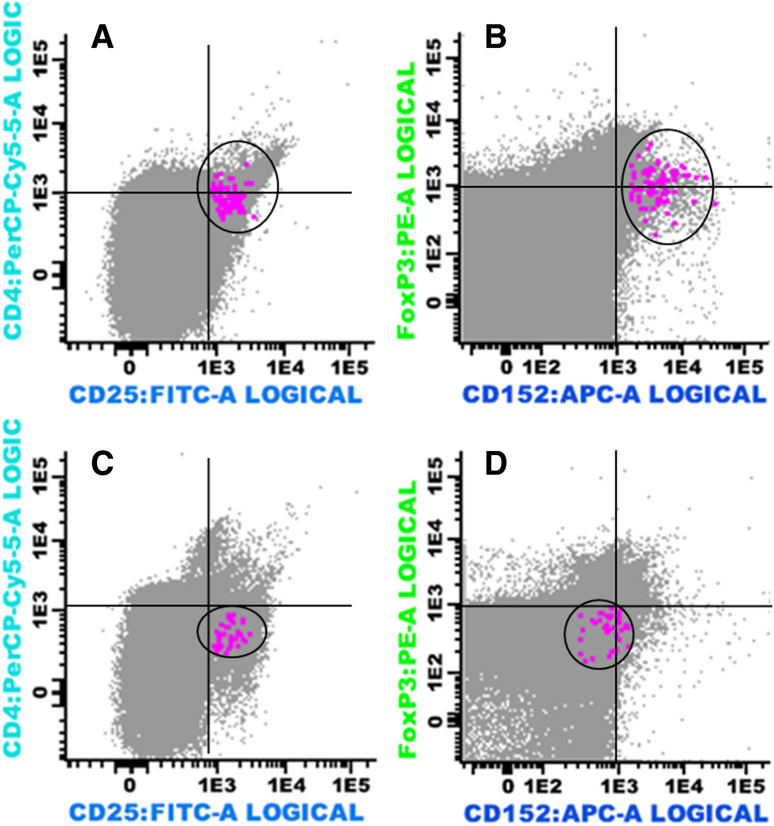
Overexpression of FOXP3 and CTLA4 in total BM samples suggests a local accumulation of immunosuppressive Tregs, the MM tumor environment, possibly dampening anti-tumor host immune responses. Therapeutic approaches targeting Treg cells and restoring local anti-tumor immunity may provide new treatment strategies for this incurable malignancy.
多发性骨髓瘤(MM)的发展涉及一系列基因异常以及骨髓(BM)微环境的改变,这有利于肿瘤生长及局部免疫控制的失效。调节性T(Treg)细胞在抑制抗肿瘤免疫反应中起重要作用,而辅助性T细胞17(Th17)细胞似乎对根除恶性细胞至关重要。我们研究的目的是在骨髓瘤患者的全部骨髓样本中表征Treg和Th17相关基因的表达,以评估它们作为生物标志物、预后因素以及这种不治之症可能的治疗靶点的作用。
通过定量实时聚合酶链反应(PCR)测定46例MM患者、4例意义未明的单克隆丙种球蛋白病患者、5例孤立性浆细胞瘤患者及5例健康骨髓供者骨髓抽吸物中Treg(FOXP3、CTLA4)和Th17细胞(RORγt)标志物的表达。评估基因表达对患者总生存期(OS)的影响。
与对照组相比,MM患者中FOXP3和CTLA4的表达分别高6倍(p = 0.02)和30倍(p = 0.03)。MM患者和对照组中RORγt的表达相似。MM患者的中位OS为16.8(范围4.5 - 29.1)个月,国际分期系统是患者生存的唯一独立预后因素。
全部骨髓样本中FOXP3和CTLA4的过表达提示免疫抑制性Treg在MM肿瘤环境中局部积聚,可能会抑制抗肿瘤宿主免疫反应。靶向Treg细胞并恢复局部抗肿瘤免疫力的治疗方法可能为这种不治之症提供新的治疗策略。