Moran Lauter Adrienne N, Peiffer Gregory A, Yin Tengfei, Whitham Steven A, Cook Dianne, Shoemaker Randy C, Graham Michelle A
USDA-Agricultural Research Service, Corn Insects and Crop Genetics Research Unit, 1565 Agronomy Hall, Ames, IA 50011, USA.
BMC Genomics. 2014 Aug 22;15:702. doi: 10.1186/1471-2164-15-702.
Iron is an essential micronutrient for all living things, required in plants for photosynthesis, respiration and metabolism. A lack of bioavailable iron in soil leads to iron deficiency chlorosis (IDC), causing a reduction in photosynthesis and interveinal yellowing of leaves. Soybeans (Glycine max (L.) Merr.) grown in high pH soils often suffer from IDC, resulting in substantial yield losses. Iron efficient soybean cultivars maintain photosynthesis and have higher yields under IDC-promoting conditions than inefficient cultivars.
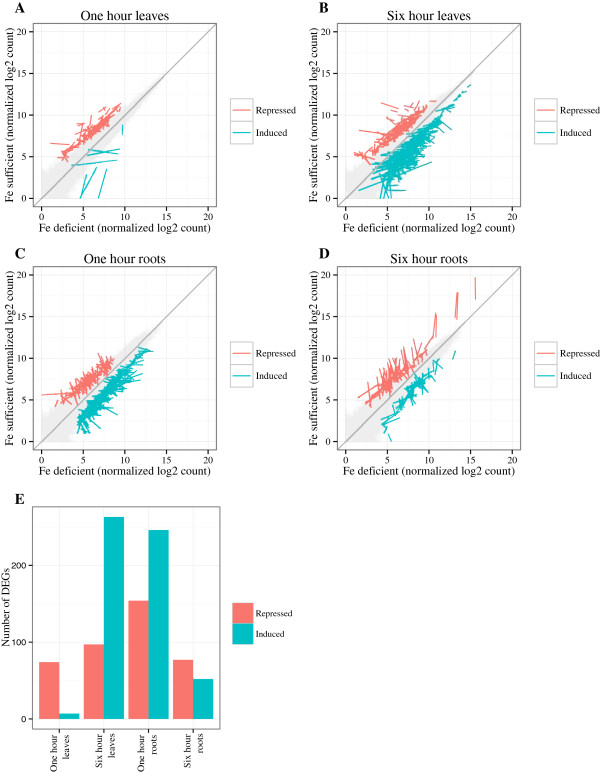
To capture signaling between roots and leaves and identify genes acting early in the iron efficient cultivar Clark, we conducted a RNA-Seq study at one and six hours after replacing iron sufficient hydroponic media (100 μM iron(III) nitrate nonahydrate) with iron deficient media (50 μM iron(III) nitrate nonahydrate). At one hour of iron stress, few genes were differentially expressed in leaves but many were already changing expression in roots. By six hours, more genes were differentially expressed in the leaves, and a massive shift was observed in the direction of gene expression in both roots and leaves. Further, there was little overlap in differentially expressed genes identified in each tissue and time point.
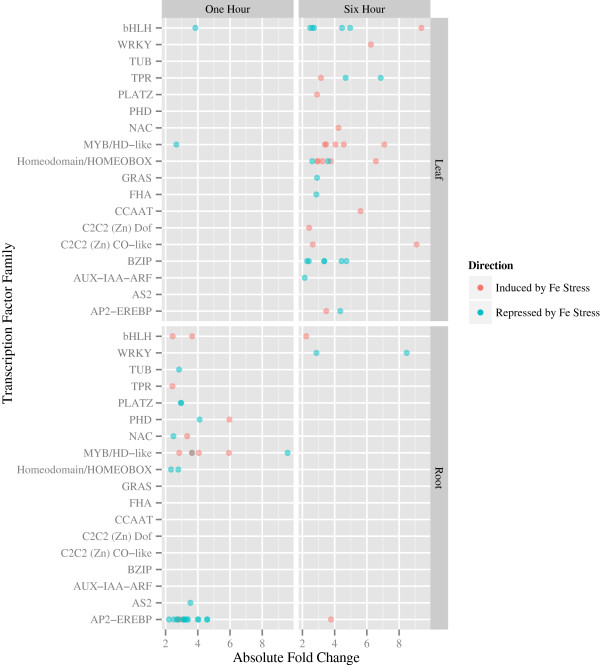
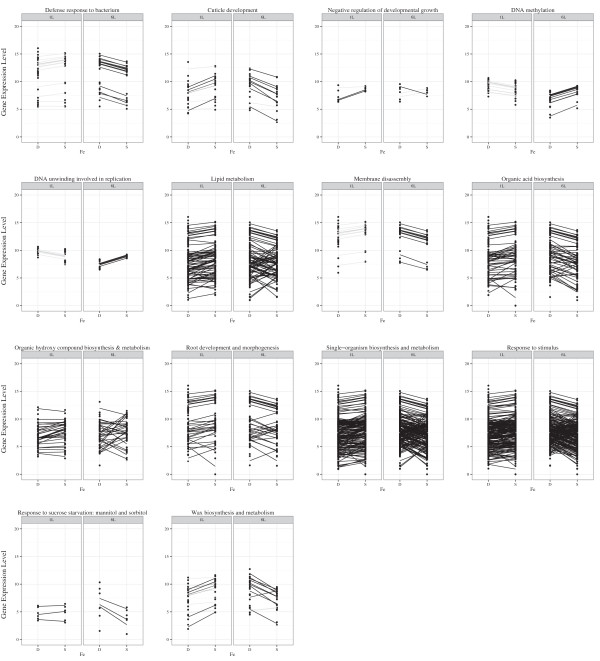
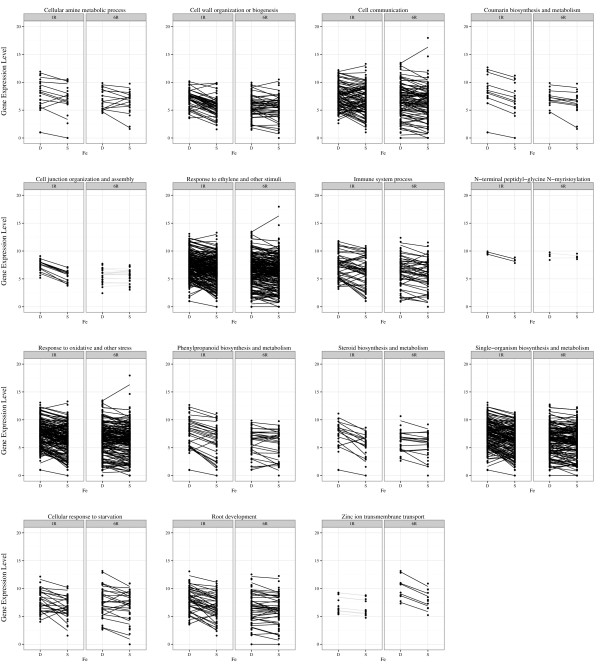
Genes involved in hormone signaling, regulation of DNA replication and iron uptake utilization are key aspects of the early iron-efficiency response. We observed dynamic gene expression differences between roots and leaves, suggesting the involvement of many transcription factors in eliciting rapid changes in gene expression. In roots, genes involved iron uptake and development of Casparian strips were induced one hour after iron stress. In leaves, genes involved in DNA replication and sugar signaling responded to iron deficiency. The differentially expressed genes (DEGs) and signaling components identified here represent new targets for soybean improvement.
铁是所有生物必需的微量营养素,植物进行光合作用、呼吸作用和新陈代谢都需要铁。土壤中缺乏可生物利用的铁会导致缺铁性黄化病(IDC),从而使光合作用减弱,叶片出现叶脉间黄化现象。在高pH值土壤中种植的大豆(Glycine max (L.) Merr.)常常遭受缺铁性黄化病的困扰,导致产量大幅下降。与低效品种相比,铁高效大豆品种在促进缺铁性黄化病发生的条件下能维持光合作用并具有更高的产量。
为了捕捉根和叶之间的信号传导并鉴定在铁高效品种克拉克中早期起作用的基因,我们在用缺铁培养基(50μM硝酸铁九水合物)替代铁充足的水培培养基(100μM硝酸铁九水合物)后1小时和6小时进行了RNA测序研究。在铁胁迫1小时时,叶片中很少有基因差异表达,但根中的许多基因已经在改变表达。到6小时时,叶片中有更多基因差异表达,并且在根和叶中基因表达方向都出现了巨大变化。此外,在每个组织和时间点鉴定出的差异表达基因几乎没有重叠。
参与激素信号传导、DNA复制调控和铁吸收利用的基因是早期铁效率反应的关键方面。我们观察到根和叶之间存在动态基因表达差异,这表明许多转录因子参与引发基因表达的快速变化。在根中,参与铁吸收和凯氏带发育的基因在铁胁迫1小时后被诱导。在叶中,参与DNA复制和糖信号传导的基因对缺铁作出反应。这里鉴定出的差异表达基因(DEGs)和信号成分代表了大豆改良的新靶点。