
组织中离子分布的自动解剖学解读:将成像质谱与精选图谱相联系。
Automated anatomical interpretation of ion distributions in tissue: linking imaging mass spectrometry to curated atlases.
作者信息
Verbeeck Nico, Yang Junhai, De Moor Bart, Caprioli Richard M, Waelkens Etienne, Van de Plas Raf
机构信息
Department of Electrical Engineering (ESAT), STADIUS Center for Dynamical Systems, Signal Processing, and Data Analytics, KU Leuven , Kasteelpark Arenberg 10, Box 2446, 3001 Leuven, Belgium.
出版信息
Anal Chem. 2014 Sep 16;86(18):8974-82. doi: 10.1021/ac502838t. Epub 2014 Aug 25.
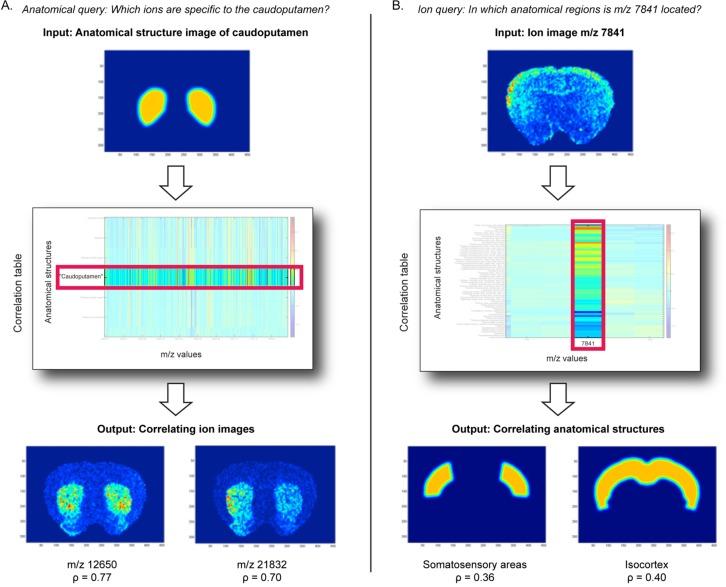
Imaging mass spectrometry (IMS) has become a prime tool for studying the distribution of biomolecules in tissue. Although IMS data sets can become very large, computational methods have made it practically feasible to search these experiments for relevant findings. However, these methods lack access to an important source of information that many human interpretations rely upon: anatomical insight. In this work, we address this need by (1) integrating a curated anatomical data source with an empirically acquired IMS data source, establishing an algorithm-accessible link between them and (2) demonstrating the potential of such an IMS-anatomical atlas link by applying it toward automated anatomical interpretation of ion distributions in tissue. The concept is demonstrated in mouse brain tissue, using the Allen Mouse Brain Atlas as the curated anatomical data source that is linked to MALDI-based IMS experiments. We first develop a method to spatially map the anatomical atlas to the IMS data sets using nonrigid registration techniques. Once a mapping is established, a second computational method, called correlation-based querying, gives an elementary demonstration of the link by delivering basic insight into relationships between ion images and anatomical structures. Finally, a third algorithm moves further beyond both registration and correlation by providing automated anatomical interpretation of ion images. This task is approached as an optimization problem that deconstructs ion distributions as combinations of known anatomical structures. We demonstrate that establishing a link between an IMS experiment and an anatomical atlas enables automated anatomical annotation, which can serve as an important accelerator both for human and machine-guided exploration of IMS experiments.
成像质谱(IMS)已成为研究生物分子在组织中分布的主要工具。尽管IMS数据集可能会变得非常大,但计算方法已使在这些实验中搜索相关发现变得切实可行。然而,这些方法无法获取许多人工解读所依赖的重要信息来源:解剖学见解。在这项工作中,我们通过以下方式满足这一需求:(1)将精心策划的解剖学数据源与通过实验获取的IMS数据源整合在一起,在它们之间建立算法可访问的链接;(2)通过将这种IMS-解剖图谱链接应用于组织中离子分布的自动解剖学解读,展示其潜力。该概念在小鼠脑组织中得到了验证,使用艾伦小鼠脑图谱作为与基于基质辅助激光解吸电离(MALDI)的IMS实验相链接的精心策划的解剖学数据源。我们首先开发一种方法,使用非刚性配准技术将解剖图谱在空间上映射到IMS数据集。一旦建立映射,第二种计算方法,即基于相关性的查询,通过提供对离子图像与解剖结构之间关系的基本见解,对这种链接进行了初步演示。最后,第三种算法通过提供离子图像的自动解剖学解读,进一步超越了配准和相关性。这项任务被视为一个优化问题,即将离子分布解构为已知解剖结构的组合。我们证明,在IMS实验与解剖图谱之间建立链接能够实现自动解剖学标注,这对于人工和机器引导的IMS实验探索而言,都可作为一个重要的加速器。


 Zotero 插件